Everyone else is about to work harder at marketing. You do not have to.
Why a focused marketing strategy beats doing everything at once
August 10, 2026
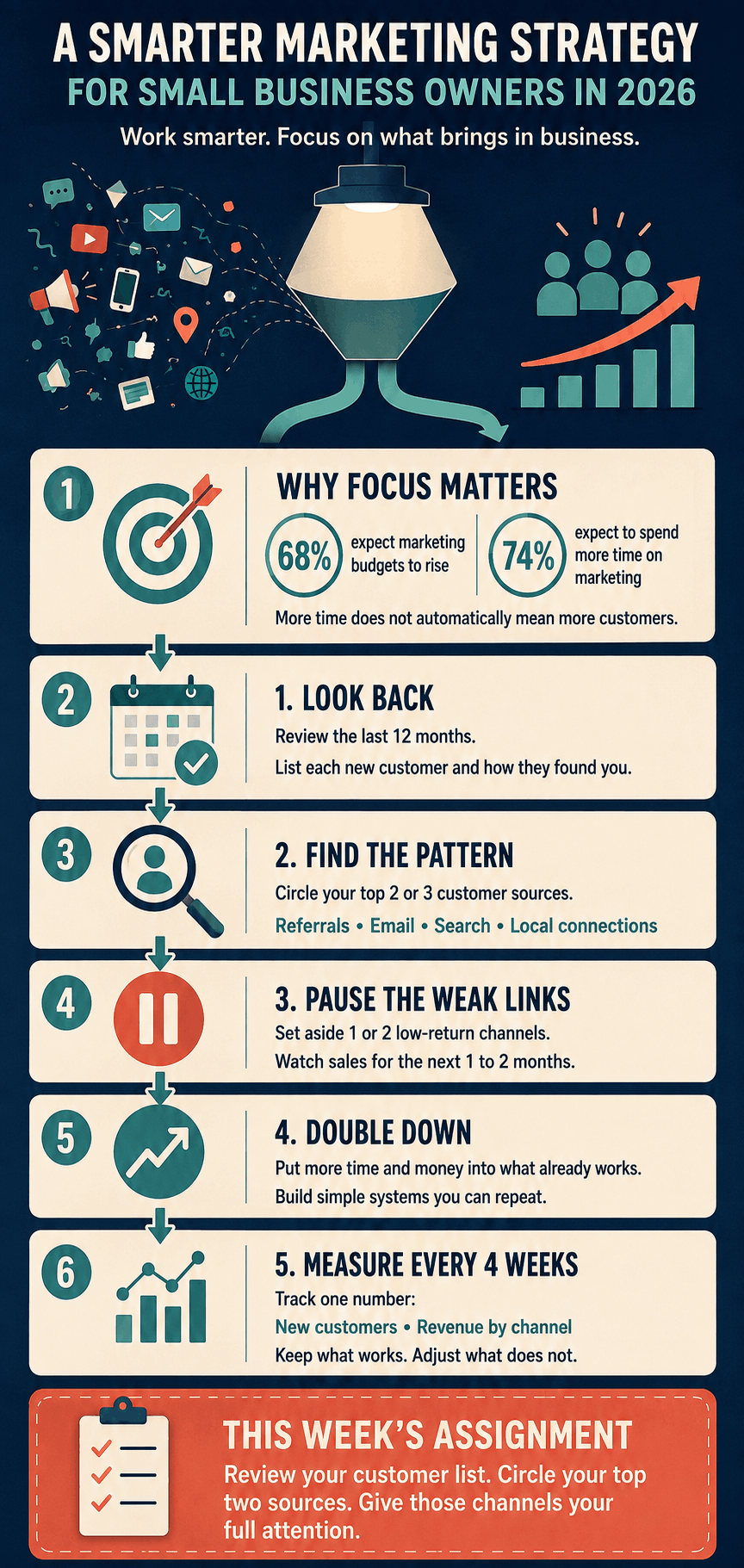
New research from Constant Contact found that 68 percent of small business owners expect their marketing budgets to go up in 2026, and 74 percent expect to spend more time on it. More hours will not automatically mean more customers. A smart marketing strategy for small business owners means picking two or three things that actually bring in business and letting the rest go.
Why is everyone planning to spend more time on marketing this year?
The Constant Contact survey polled 1,500 small business owners across the US, Canada, the UK, Australia, and New Zealand. Most named rising costs as their top worry for the year. When money gets tight, owners tend to add marketing activities instead of cutting them, hoping something sticks.
But busywork is not a marketing strategy. Piling on tasks means less attention goes to the few things that actually move the needle.
What does a working marketing strategy for small business owners actually look like?
A solo owner or small team cannot run social media, email, blog content, video, paid ads, and local partnerships well at the same time. A working strategy is narrow on purpose. It picks a small number of channels, gets good at them, and repeats that work. Owners who try to cover every channel end up doing all of them halfway, which brings in less business than doing two channels well.
How do you build a marketing strategy around what already works?
Pull up your sales records or client list from the last twelve months. For each new customer, write down how they found you. A referral. A blog post that answered their question. An email that reminded them you exist. A conversation at a local event.
You will likely notice a pattern fast. Most owners get the bulk of their customers from two or three sources, even while spending time and money across six or seven. That gap is the foundation of a marketing strategy for small business owners that actually holds up over a full year.
Should you drop the channels that are not working?
Yes, but do it one at a time. Pick the weakest channel and pause it. Watch your sales over the next month or two.
If nothing changes, that channel was not doing much work for you. If you see a drop, that channel was doing something you could not see directly, like keeping your name in front of people before they were ready to buy. Either way, you are testing with real information instead of guessing.
Where should your marketing strategy put more time and money?
Put more time into your best channels, not less. If referrals drive most of your business, build a repeatable system: a short email a week after a project wraps up, a discount for whoever sends someone your way.
If email brings people back to buy again, treat your list like the asset it is. You own it. No platform can take it away or change the rules overnight the way social media can. Send it regularly, even if it is short. A useful email every other week beats a brilliant one twice a year.
If most of your business comes from one blog post that answers a specific question, write two or three more just like it instead of scattering your writing across ten topics.
What about the pressure to keep up with every new trend?
Before adopting anything new, ask one question: does this extend a channel that already works, or is it a bet on something unproven? A new short video format might be worth testing if it extends a channel you know works. Starting from zero on a platform you have never used is a different bet, and it pulls focus from what already works.
How do you know your marketing strategy is working?
Pick one number, like new customers per month or revenue per channel, and check it every four weeks. Do not judge a channel after one week. If you cut a channel and your number holds steady or climbs, that decision was right. If a channel you doubled down on brings in more business, that confirms the call. Let the numbers guide the next round of decisions.
The Assignment
This week, pull up your customer list or sales records from the last twelve months. Write down how each new customer found you. Circle your top two sources. Those get your full attention for the rest of the year. Everything else goes on a trial pause.
Research shows 74% of small business owners expect to spend more time on marketing this year. Before adding more to your plate, build a marketing strategy around the two channels that already bring in customers, and cut the rest. Share on X

Note: Some links on this page are affiliate links, meaning that if you click on my link and make a purchase, I will receive a small commission. It does not however affect the price you pay. Plus, it’s a great way to support me and the content I’m providing.