Why Podcasting for Small Business Gets Sold Wrong
Most pitches for podcasting for small business start the same way. They tell you 80% of Americans have listened to a podcast at least once, and 58% tune in every month, according to the Infinite Dial 2026 study from Edison Research. Then they tell you to start recording.
Audience size is the wrong number to chase if you run a small business with no marketing team and maybe five hours a week to spare. The number that actually matters is how people find new shows in the first place, and that number should change how you plan a podcast, not whether you start one.
Why the Big Audience Number Misleads Small Business Owners
A big national audience does nothing for you if none of those listeners ever hear about your show, and most will not find you through a podcast app search or a chart.
Research from podcast discovery firm PodRewind, drawing on Infinite Dial 2026 data, found that word of mouth from friends and family remains the top way people find new shows, with 78% of listeners discovering a podcast that way. App directories come in a distant second, used by about half of listeners. YouTube is now the most-used platform for weekly podcast consumption at 39%, but that mostly helps shows that already have an audience willing to search for them by name.
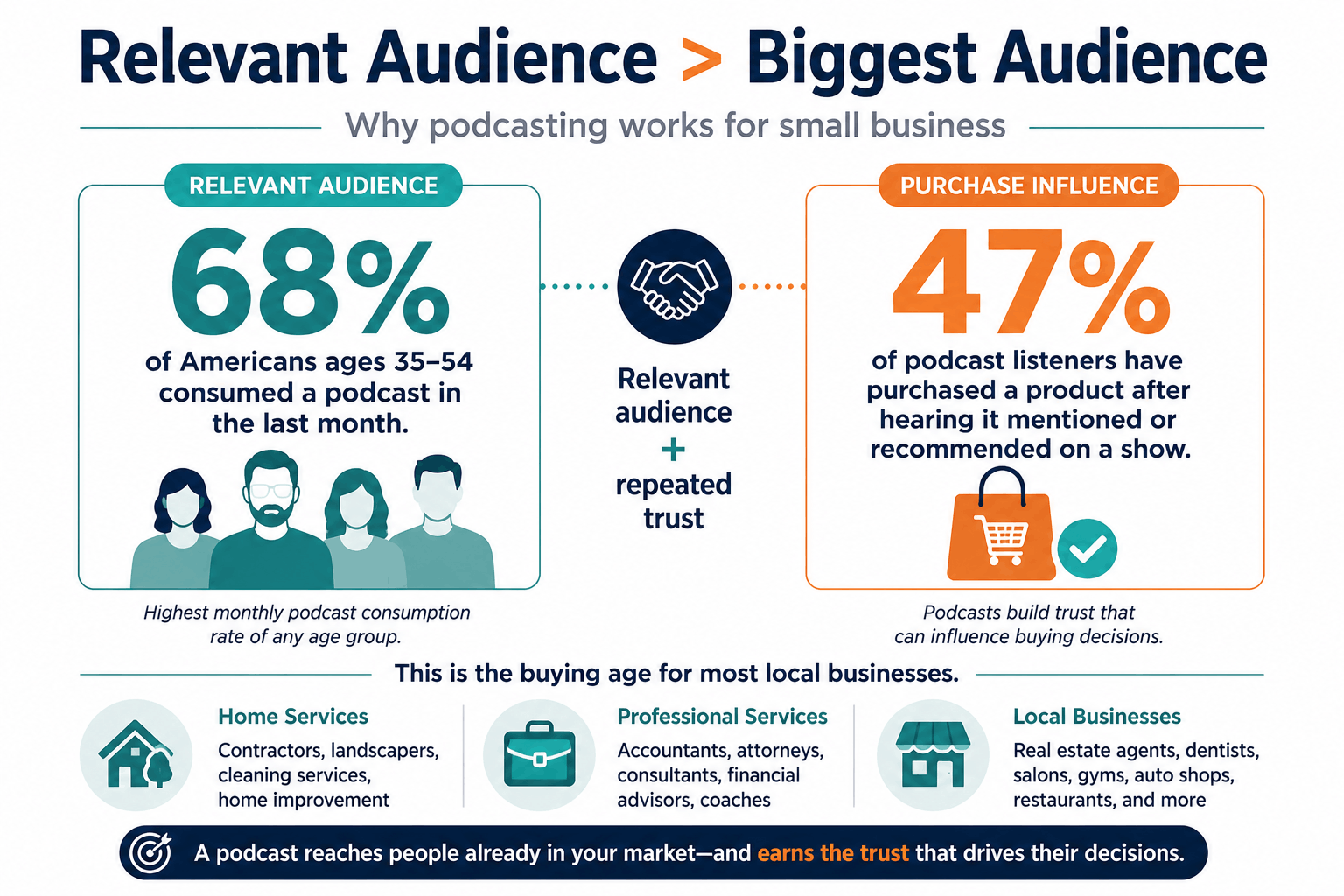
One demographic number is worth knowing. Sixty-eight percent of Americans between 35 and 54 consumed a podcast in the last month, the highest monthly rate of any age group Edison tracks, according to the Infinite Dial 2026 data reported by SSRS. That group is also the core buying age for most local service businesses: homeowners hiring a contractor, parents choosing a dentist, business owners hiring an accountant. If your customer base skews into that range, the audience already listens to podcasts. The open question is whether they hear about your specific show.
So the honest starting point is not “millions of people listen to podcasts.”
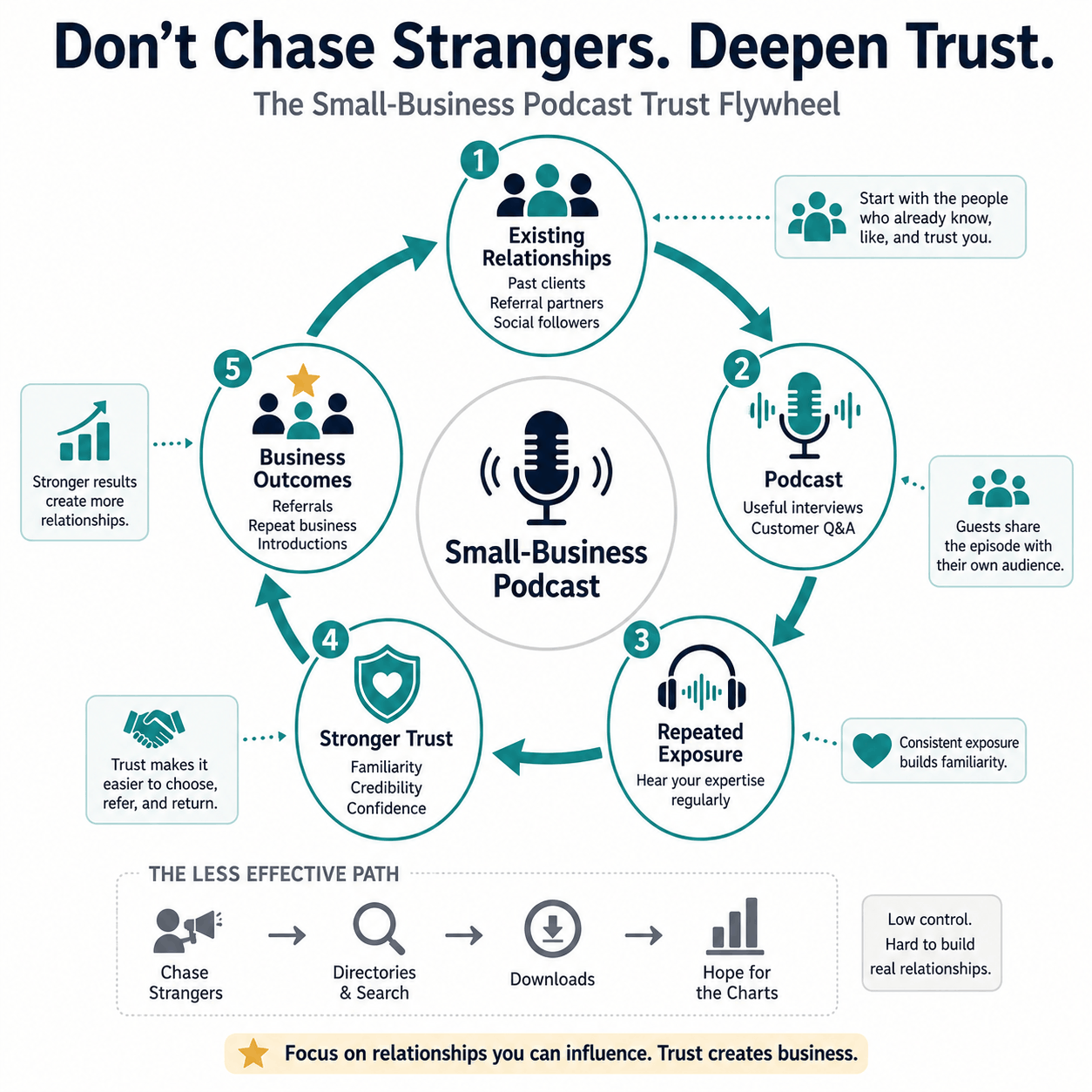
It is this: you already have a small pool of people who trust you, and a podcast is a tool for turning that trust into repeat business, not a tool for finding strangers.
Who Podcasting Actually Works For
Say you run a landscaping company, a small accounting firm, or a boutique real estate team. You have three groups already in your orbit: past clients, referral partners, and people who follow you on social media because they know your name. A podcast built around interviews with those people, or built to answer the questions those people keep asking you by phone, has a starting audience before episode one goes live.
This matters because of what podcast listening does to buying behavior. Research firm Searchlab, citing Edison Research data, found that 47% of podcast listeners have purchased a product after hearing it mentioned or recommended on a show. That number reflects the trust listeners build with a host over repeated episodes. It is not something you get from a Facebook ad. It is something you get from twelve people hearing your voice every month for a year.
If your business depends on strangers finding you through search or paid ads, a podcast is a slow, indirect tool. If your business depends on referrals, repeat clients, or a local reputation, a podcast is one of the few formats built for exactly that kind of trust.
What It Actually Costs to Start
A single USB microphone that produces broadcast-quality audio runs $60 to $130. Free tools like Audacity or paid tools like Descript, with monthly plans as low as $16 to $24 a month, handle recording and editing without hiring anyone. Hosting a podcast feed on a platform like Buzzsprout is free at the entry level, and it distributes automatically to Apple Podcasts, Spotify, and YouTube. Total setup cost for a one-person show lands under $200, with an ongoing cost near zero if you skip a paid hosting tier (not recommended).
Time is the real cost, and batching is what makes it manageable. Recording four 30-minute interviews in a single afternoon covers an entire month of episodes. Editing each one, using a tool like Descript that removes filler words automatically, takes 30 to 45 minutes. Total monthly production time lands at four to six hours, including guest scheduling. That is closer to writing four blog posts than launching a media company.
Pick a Format You Can Actually Sustain
What determines whether a small business podcast survives past episode five is not audio quality. It is whether the format holds up for one person to keep producing.
The interview show. Book one guest a month from your referral network, a supplier, a past client, or a complementary local business. Thirty minutes, one topic, no script. Someone else is doing half the talking, and each guest becomes a promoter who shares the episode with their own list.
The Q&A show. Answer the five questions your customers ask most, one per episode, in 10 minutes or less. This doubles as content for your website and social posts, so the same recording does three jobs.
The Search Benefit Nobody Mentions
There is a second payoff that has nothing to do with listeners at all. A transcript of each episode, posted alongside the audio on your website, becomes a page full of the exact phrases your customers type into Google. A ten-minute answer to “How much does a roof replacement cost in my area?” becomes a page that can rank for that search, months after the episode stops getting new plays.
Show notes, transcripts, and pulled quotes give you a new web page every time you publish, without writing a separate blog post from scratch. For a business already paying someone to maintain a website, that transcript is close to free content, generated as a byproduct of a conversation you were going to have anyway.
What to Cut From the Plan
Skip a custom intro jingle. Skip worrying about chart rankings, since a show built around your existing 200 email contacts and referral partners was never competing for the charts anyway. Skip video production until the audio show proves it can hold an audience for six months.
The one thing not to skip is distribution to people who already know you.
Send every episode to your email list. Post the audio clip where your referral partners already see your posts. Ask each guest, before you hit record, whether they will share the episode with their own audience. That single ask does more for a small business podcast than any directory submission.
The Actual Test of Whether It Is Working
Do not judge a small business podcast by download counts in month one. Judge it by two things: whether past clients or referral partners mention an episode to you unprompted and whether a guest becomes a more active referral source after appearing on the show.
Give it 10 episodes, roughly two and a half months on the batch schedule above, before deciding anything. If neither signal shows up by then, change the guest list or the topic before deciding the medium itself failed. Most small business podcasts that fail were built around chasing new listeners through search and directories, the exact strategy the discovery data says does not work.
Build around the people who already trust you instead.
Most advice on podcasting for small business leads with audience size. Wrong number. 78% of listeners find new shows through word of mouth, not search. Build your show around clients and referral partners who already trust you. Share on X

Note: Some links on this page are affiliate links, meaning that if you click on my link and make a purchase, I will receive a small commission. It does not however affect the price you pay. Plus, it’s a great way to support me and the content I’m providing.