The 5-Minute Marketing Audit Every Small Business Should Do
This post may contain affiliate links. If you buy through them, I earn a small commission at no extra cost to you.
Last updated: September 5, 2026
Quick Answer
A 5-minute marketing audit is a focused, recurring self-check that small business owners run across four core areas: value proposition clarity, website health, Google Business Profile accuracy, and call-to-action visibility. It takes five minutes or less, requires no specialist tools, and consistently surfaces the highest-ROI fixes available to any small business. Run it monthly at minimum, or weekly if your marketing budget is actively in play.
Key Takeaways
- A 5-minute marketing audit covers four quick checks: website speed and mobile display, Google Business Profile accuracy, cross-channel brand consistency, and call-to-action clarity.
- The fastest wins from a quick audit are often the simplest: correcting an outdated phone number, fixing a broken contact form, or rewriting a vague homepage headline.
- Run this audit at least monthly. If you run paid ads, do it weekly.
- Free tools like Google PageSpeed Insights, Google Search, and your own social media insights panels are sufficient for the core checks.
- A marketing audit is systematic and evidence-based; a marketing review is a casual glance. The distinction matters for follow-through.
- After completing the audit, assign one owner and one deadline to each issue found, or the exercise produces no results.
- Professional marketing audits can cost anywhere from a few hundred to several thousand dollars. The 5-minute version costs nothing except your time.
- Small businesses can absolutely run this audit themselves. External help becomes worthwhile only when the audit consistently reveals strategic gaps, not just tactical fixes.
What Is a Marketing Audit and Why Do You Need One
A marketing audit is a structured review of your marketing activity, assets, and results to identify what is working, what is not, and where the biggest gaps are. For small businesses, even a five-minute version can prevent costly misdirection of time and budget.
Without any regular audit, small businesses often keep spending on channels that stopped performing months ago or miss obvious problems like a broken contact link or an outdated service description. These issues quietly drain leads and erode trust with potential customers.
A full audit covers strategy, branding, website, SEO, content, paid media, and reporting. The 5-Minute Marketing Audit distills that into the handful of checks most likely to reveal a “leak” in your funnel before you invest more in filling it.
Common mistake: Treating an audit as a one-time event. The most useful audits are short and repeated, not long and forgotten.
Signs Your Marketing Strategy Needs an Audit
Your marketing strategy needs an audit if any of the following are true: you cannot explain in one sentence what makes your business the right choice for a specific customer, your website traffic has dropped without explanation, or your conversion rate has declined while ad spend stayed flat.
More specific warning signs include:
- Customers frequently ask questions that your website should already answer
- Your Google Business Profile shows outdated hours, an old phone number, or no recent photos
- Your logo, tagline, or value proposition differs across your website, social profiles, and email signature
- You have no idea which marketing channel is generating actual revenue
- Your homepage call-to-action is vague, buried, or missing entirely
Any one of these is sufficient reason to run a 5-minute marketing audit today.
What Should You Check in a 5-Minute Marketing Audit
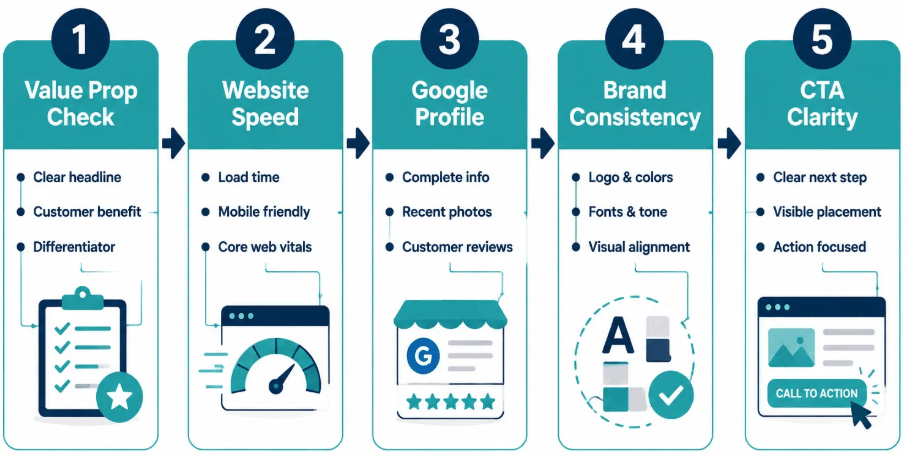
A well-structured 5-minute marketing audit covers five areas in sequence: value proposition clarity, website speed and mobile display, Google Business Profile accuracy, cross-channel brand consistency, and call-to-action visibility. Each check takes roughly one minute.
Step 1: Value Proposition (1 minute)
Read your homepage headline aloud. A stranger should be able to identify your buyer, your product, and your key differentiator in one breath. If they cannot, rewriting that headline is your first priority.
Step 2: Website Speed and Mobile Display (1 minute)
Load your homepage and one key service page on a mobile device. Note whether they appear quickly and without layout issues. Slow pages directly hurt conversions and search visibility. Use Google PageSpeed Insights (free) if you want a score, but a manual load test on your own phone is sufficient for this check.
Step 3: Google Business Profile Accuracy (1 minute)
Search your business name on Google. Verify that your phone number, address, opening hours, and primary category are correct. Check that you have at least a few recent photos and that unanswered reviews are not sitting unacknowledged. Outdated GBP data is one of the fastest ways to improve local discovery.
Step 4: Cross-Channel Brand Consistency (1 minute)
Open your website, your most active social profile, and your email signature side by side. Confirm that your logo, tagline, and core value proposition match across all three. Inconsistency signals to potential customers that the business is either disorganized or no longer active.
Step 5: Call-to-Action Clarity (1 minute)
On every page and profile you just reviewed, ask: is there one clear next step for a visitor? A phone number, booking link, contact form, or “Get a Quote” button should be visible without scrolling. If it is not, that is a conversion leak.
Marketing Audit Checklist for Small Businesses
Use this checklist as a repeatable 5-minute marketing audit template. Score each item: Pass, Needs Work, or Fail.
| Check | What to Look For | Time |
|---|---|---|
| Value proposition | Homepage headline names buyer, product, and differentiator | 1 min |
| Mobile speed | Homepage loads fast, no broken layout on phone | 1 min |
| Google Business Profile | Phone, hours, photos, and reviews are current | 1 min |
| Brand consistency | Logo, tagline, and tone match across website and social | 1 min |
| CTA visibility | One clear next step is visible on every key page | 1 min |
For a deeper pass, comprehensive audit frameworks offer 20 to 95 questions across strategy, SEO, content, paid media, and reporting. Use those quarterly to define what “good” looks like, then distill the findings into your weekly five-minute check.

What Is the Difference Between a Marketing Audit and a Marketing Review
A marketing audit is systematic, evidence-based, and covers all marketing activity against defined benchmarks. A marketing review is a casual, periodic glance at recent performance, usually limited to a few metrics. The distinction matters because audits produce actionable findings, while reviews often produce observations without follow-through.
In practical terms:
- A marketing audit asks, “Is our strategy correct, are our assets accurate, and is our tracking working?”
- A marketing review asks, “How did last month’s numbers look?”
Both are useful. But a business that only does reviews will keep optimizing the wrong things. The 5-Minute Marketing Audit is a lightweight audit, not a review, because it checks the structural integrity of your marketing presence, not just recent metrics.
How Often Should You Audit Your Marketing Strategy
Small businesses should run a 5-minute marketing audit at least once a month. If you run paid advertising, weekly is more appropriate.
The reasoning is straightforward: marketing assets change without warning. A Google Business Profile can display incorrect hours after a public holiday. A website plugin update can break a contact form. A social media bio can become outdated after a service change. Monthly checks catch these issues before they cost leads.
For deeper strategic audits covering SEO, content performance, competitor positioning, and budget allocation, a quarterly cadence is realistic for most small businesses. Annual audits using a full 40-to-95-question framework are appropriate when planning a significant rebrand, entering a new market, or onboarding a new marketing agency.
Free Marketing Audit Tools for Small Business
The core 5-Minute Marketing Audit requires no paid tools. The following free resources cover every check:
- Google Search: Search your business name to review your GBP listing in real time
- Google PageSpeed Insights: Free mobile and desktop speed scores with specific recommendations
- Google Analytics (free tier): Traffic trends, top pages, and basic conversion data
- Meta Business Suite / LinkedIn Analytics: Built-in social insights at no cost
- Google Search Console: Organic search visibility and indexing issues, free
For more structured audits, marketing agencies and consultants often offer downloadable checklists and scored templates as free lead magnets. Use these quarterly to go beyond the five-minute surface check.
Edge case: If your business relies heavily on email marketing, add a one-minute check of your last campaign’s open and click rates against your own historical averages. Most email platforms (Mailchimp, Klaviyo, etc.) show this on their free dashboards.
How to Audit Your Social Media Marketing in 5 Minutes
A social media mini-audit within the broader 5-Minute Marketing Audit focuses on three things: profile completeness, posting recency, and message consistency. It does not require analytics software.
Open each active social profile and check:
- Is the bio current and does it match the website’s value proposition?
- Is the profile photo and cover image the current logo or brand image?
- Has the account posted within the last 30 days? A dormant account can signal to potential customers that the business is no longer active.
- Does the most recent post include a clear call to action or link?
One 2026 scoring framework recommends a minimum content cadence of two posts per month as a baseline for maintaining credibility. Below that threshold, a social presence can do more harm than good by appearing abandoned.
Marketing Audit for E-commerce vs. Service Businesses
The core 5-minute marketing audit applies to both e-commerce and service businesses, but the emphasis shifts slightly by model.
For e-commerce businesses, prioritize:
- Product page load speed on mobile (slow pages directly reduce add-to-cart rates)
- Accuracy of product descriptions and prices
- Visibility of shipping, returns, and trust signals at checkout
- Whether conversion tracking is firing correctly on purchase confirmation pages
For service businesses, prioritize:
- Clarity of the service offering and target client on the homepage
- Ease of booking or contacting (one click or less)
- Recency and visibility of client testimonials or case studies
- Google Business Profile accuracy, especially for local service businesses
Choose the ecommerce emphasis if more than 50% of your revenue comes from online transactions. Choose the service emphasis if most leads come through phone, form, or referral.
Common Marketing Mistakes Small Businesses Make
The 5-Minute Marketing Audit consistently surfaces the same recurring mistakes across small businesses. Knowing them in advance makes the audit faster.
- Vague homepage headline: The most common single issue. If the headline could describe any business in your category, it describes none of them effectively.
- Outdated contact information: An incorrect phone number or old address on Google can silently kill local leads for months.
- No conversion tracking: Many small businesses run paid ads without verifying that their tracking pixel or goal event records conversions.
- Inconsistent branding across channels: Different logos, taglines, or tones across platforms reduce trust and make the business harder to recognize.
- Missing or buried CTA: Visitors who do not know what to do next leave. A single, visible next step on every page is non-negotiable.
- Posting inconsistency: Going weeks without social activity, then posting in bursts, signals unreliability to both algorithms and potential customers.
What to Do After Completing a Marketing Audit
After completing a 5-minute marketing audit, the most important step is converting findings into a short action list with assigned owners and deadlines. An audit that produces observations without accountability produces no results.
Follow this sequence:
- List every issue found, no matter how small.
- Score each by impact and ease of fix. A broken phone number is high impact and easy to fix. A full website redesign is high impact but slow and expensive.
- Pick the single highest-priority fix, assign it to one person, and set a specific deadline.
- Set a date for the next audit before closing the current one.
For issues that require deeper investigation, use the audit findings as input into a longer quarterly review. One 2026 SME guide recommends identifying a single main constraint per audit cycle and resolving it before moving to the next priority. This prevents the common trap of identifying ten problems and fixing none.
For businesses running paid ads, also check whether you know customer acquisition cost (CAC) per channel and whether budget allocation still reflects which channels are performing. An AI-assisted audit framework tested in 2026 compressed a revenue attribution scan, customer journey mapping, content performance review, and competitor gap analysis into five minutes by using analytics dashboards and AI tools in sequence and claimed significant budget reallocation savings as a result.
Can You Do a Marketing Audit Yourself or Do You Need Help
Most small businesses can and should run the 5-minute marketing audit themselves. The checks require no specialist knowledge, only honesty and a willingness to act on what is found.
External help becomes genuinely worthwhile in three situations:
- The audit consistently reveals strategic problems (wrong target audience, weak positioning, ineffective channel mix) rather than just tactical fixes
- The business is preparing for a significant investment in paid advertising or a rebrand
- No one internally has time or inclination to act on audit findings
How much does a professional marketing audit cost? Professional audits from agencies or consultants range widely. A basic digital presence audit may cost a few hundred dollars. A comprehensive audit covering strategy, SEO, paid media, content, and analytics can run into several thousand dollars, depending on business size and scope. Many agencies offer a free abbreviated audit as an entry point into a broader engagement.
For most small businesses at an early stage, the free 5-minute marketing audit done consistently is worth more than an expensive audit done once and shelved.
Final Thought
The 5-Minute Marketing Audit is one of the highest-return habits a small business owner can build. It costs nothing, requires no specialist tools, and consistently surfaces the fixes most likely to improve conversions, local visibility, and customer trust.
Actionable next steps:
- Run the five-step audit today using the checklist above. It takes five minutes.
- Write down every issue found, even minor ones.
- Fix the single easiest, highest-impact item before the end of the week.
- Schedule a recurring calendar reminder to repeat the audit monthly.
- Once per quarter, use a deeper checklist (20 to 40 questions) to assess strategy, SEO, content, and budget allocation.
The businesses that benefit most from marketing are not always the ones with the largest budgets. They are the ones that regularly check whether their marketing is actually working and fix what is not.
FAQ
What is a 5-Minute Marketing Audit?
A 5-minute marketing audit is a short, structured self-check covering value proposition clarity, website speed, Google Business Profile accuracy, brand consistency, and call-to-action visibility. Small business owners can run it monthly without specialist tools.
How often should a small business do a marketing audit?
At minimum, monthly. If paid advertising is active, weekly. Do a deeper strategic audit quarterly or before any major marketing investment.
What tools do I need for a 5-Minute Marketing Audit?
None that cost money. Google Search, Google PageSpeed Insights, Google Analytics, and your own social media insights panels cover every core check.
What is the difference between a marketing audit and a marketing review?
A marketing audit is systematic and checks structural integrity against benchmarks. A marketing review is a casual look at recent performance metrics. Audits produce actionable findings; reviews often produce observations.
Can I do a marketing audit myself?
Yes. The 5-Minute Marketing Audit is designed for non-specialists. Consider external help only when the audit reveals strategic problems, not tactical fixes.
How much does a professional marketing audit cost?
Costs range from a few hundred dollars for a basic digital presence audit to several thousand for a comprehensive agency audit. Many agencies offer a free abbreviated version as a starting point.
What should I do after completing a marketing audit?
List every issue found, score each by impact and ease of fix, assign one owner and one deadline to the top priority, and schedule the next audit before closing the current one.
What are the most common marketing mistakes a small audit will find?
Vague homepage headlines, outdated contact information, missing conversion tracking, inconsistent branding across channels, and buried or missing calls-to-action.
Is a 5-Minute Marketing Audit useful for e-commerce businesses?
Yes, with a slight shift in emphasis toward product page speed, checkout trust signals, and conversion tracking accuracy rather than local profile accuracy.
How is a 5-Minute Marketing Audit different from a full marketing audit?
A full audit covers strategy, SEO, content, paid media, analytics, and competitive positioning across 20 to 95 questions. The 5-minute version distills that into five high-impact checks for frequent, recurring use.
What is the single most important check in a quick marketing audit?
Value proposition clarity. If a stranger cannot identify your buyer, product, and differentiator from your homepage headline in one breath, every other marketing effort is working against itself.
Do I need a marketing audit if my business is growing?
Yes. Growth can mask inefficiency. A quick audit during a growth phase often reveals that one or two channels are driving most results while others consume budget with no return.
References
- Marketing Audit – https://sivonhq.com/blog/marketing-audit
- The 5 Minute Marketing Audit Every Small Business Should Do – https://ggworldwide.co.uk/blog/the-5-minute-marketing-audit-every-small-business-should-do/
- Marketing Audit Checklist For Small Business Owners – https://www.darrenamner.com/post/marketing-audit-checklist-for-small-business-owners
- The Complete Marketing Audit Checklist 40 Questions To Assess Your Marketing Health – https://www.marketingeye.com/blog/the-complete-marketing-audit-checklist-40-questions-to-assess-your-marketing-health.html
- Marketingovyj Audit – https://effect-on.com/en/blog/marketingovyj-audit
- The 5 Minute Marketing Audit That Reveals Why Youre Losing Customers – https://byteinspired.com/2025/07/28/the-5-minute-marketing-audit-that-reveals-why-youre-losing-customers/
- Marketing Audit for Small Business – https://adrunkaro.com/marketing-audit-for-small-business/
- Audit – https://phillipstutts.com/audit/
- Marketing Audit – https://www.scribd.com/doc/213066523/Marketing-Audit
- The 5 Minute Marketing Audit That Saved My Startup 50k – https://mavic.ai/the-5-minute-marketing-audit-that-saved-my-startup-50k/
"Marketing Monday" articles archive.
Note: Some links on this page are affiliate links, meaning that if you click on my link and make a purchase, I will receive a small commission. It does not, however, affect the price you pay. Plus, it's a great way to support me and the content I'm providing.