This plan assumes you’re running a small local business (a shop, a service business, a small team) with a marketing budget under $2,000 for the quarter and no one on staff whose full-time job is marketing.
Most Q4 advice tells you to ramp up in November. By then you’ve already lost the best window. Big retailers start their holiday ad spend in early October, so the cost to reach people on Facebook and Google climbs steadily from October through December. Wait until Black Friday week, and you’re paying peak prices for the leftovers.
A good Q4 marketing plan for small business owners front-loads October, spends November on three specific dates instead of a whole month of noise, and treats December as a deadline business instead of a discount business.
October: Build the list before the noise starts
Your main job this month isn’t selling. It’s collecting emails and phone numbers before your competitors start emailing three times a week in November. October is rent-free advertising space. Nobody else is fighting for attention yet.
Run one promotion built around getting an email address, not a sale. “Sign up for early access to our Black Friday deals” gets you a name and email without giving away margin. Put it on a sign at the register, in your email signature, and as the first thing people see on your website. Don’t bury it on a contact page.
Pull your customer list from the last 12 months and send one email reminding people you exist. Keep it short, three or four sentences. Ask what they’re shopping for this year. Replies tell you what to stock, promote, or offer. One email, double duty: it warms up your list, and it’s free market research.
Halloween weekend (October 31 falls on a Saturday this year) is a real local traffic day. If you’re retail or food, that’s a built-in reason for people to be near your storefront. A window display or a same-day post pointing to your hours can catch traffic you’d otherwise miss.
Check last year’s numbers before you plan this year’s promotion. If you tracked anything, October through December of last year shows you which week actually drove sales, not which week you assumed drove sales. Most small businesses guess. The ones that check their own history stop wasting money on the wrong week.
Skip the full holiday decor and messaging this early. It reads as desperate and trains your list to tune you out by November.
November: Three dates matter more than the whole month
Pick your moments instead of spreading yourself thin across thirty days.
Small Business Saturday is November 28 this year, the day after Black Friday. American Express created it in 2010 to send shoppers to independent businesses instead of big-box stores. Use the actual name, not a vague “shop local” message. Put it on a sandwich board outside your door. Say it in your email subject line.
Black Friday (Nov 27) and Cyber Monday (Nov 30) are not optional to acknowledge, even if you don’t discount. Go silent while every other business in your category runs a sale and customers assume you have nothing to offer, not that you’re above it. A stripped-down version still works: one bundled offer, one limited item, or free local delivery instead of a price cut.
Send your email list a gift guide organized by who it’s for, not by price. “For the person who’s impossible to shop for” sells better than “20% off everything” because it does the thinking for the buyer. People forward gift guides to family. They don’t forward coupon codes.
Watch your shipping and fulfillment promises closely. November is when carrier delays start creeping in. Don’t promise delivery dates you can’t back up. One bad review about a late Christmas gift costs you more in December than any sale in November.
Skip discounting your whole catalog for the month. Margin you give away in November doesn’t come back in December, and it trains customers to wait for sales instead of buying at full price when they need something.
December: Deadlines beat discounts
By December, people want something that will arrive, or get finished, in time. That’s your leverage, and it costs nothing to use.
Post your last order date for guaranteed holiday delivery (or last booking date for services) everywhere: website banner, email subject line, social bio, a sign by the register. Stated clearly and repeated often, this drives more urgency than a coupon code. A deadline is honest pressure. A fake “sale ends tonight” banner that resets every day is not, and customers can tell the difference.
Run a “last call” email sequence in the two weeks before your cutoff. Three emails: two weeks out, one week out, the day before. Each one shorter and more direct. This works because it’s true. People are actually running out of time.
After December 25, send one email to everyone who bought something. Thank them by name if your tool allows it. Mention gift cards or a January promotion briefly. The days between Christmas and New Year’s are when people redeem gift cards and decide where to spend leftover holiday cash. Most businesses go dark this week. That’s why showing up works: you’re talking to an inbox with almost no competition in it.
Start your January plan now. The gift card money and post-holiday returns you’re about to collect are a second sales window most small businesses ignore because they’re already thinking about next year instead of finishing this one out.
The budget behind this Q4 marketing plan for small business owners
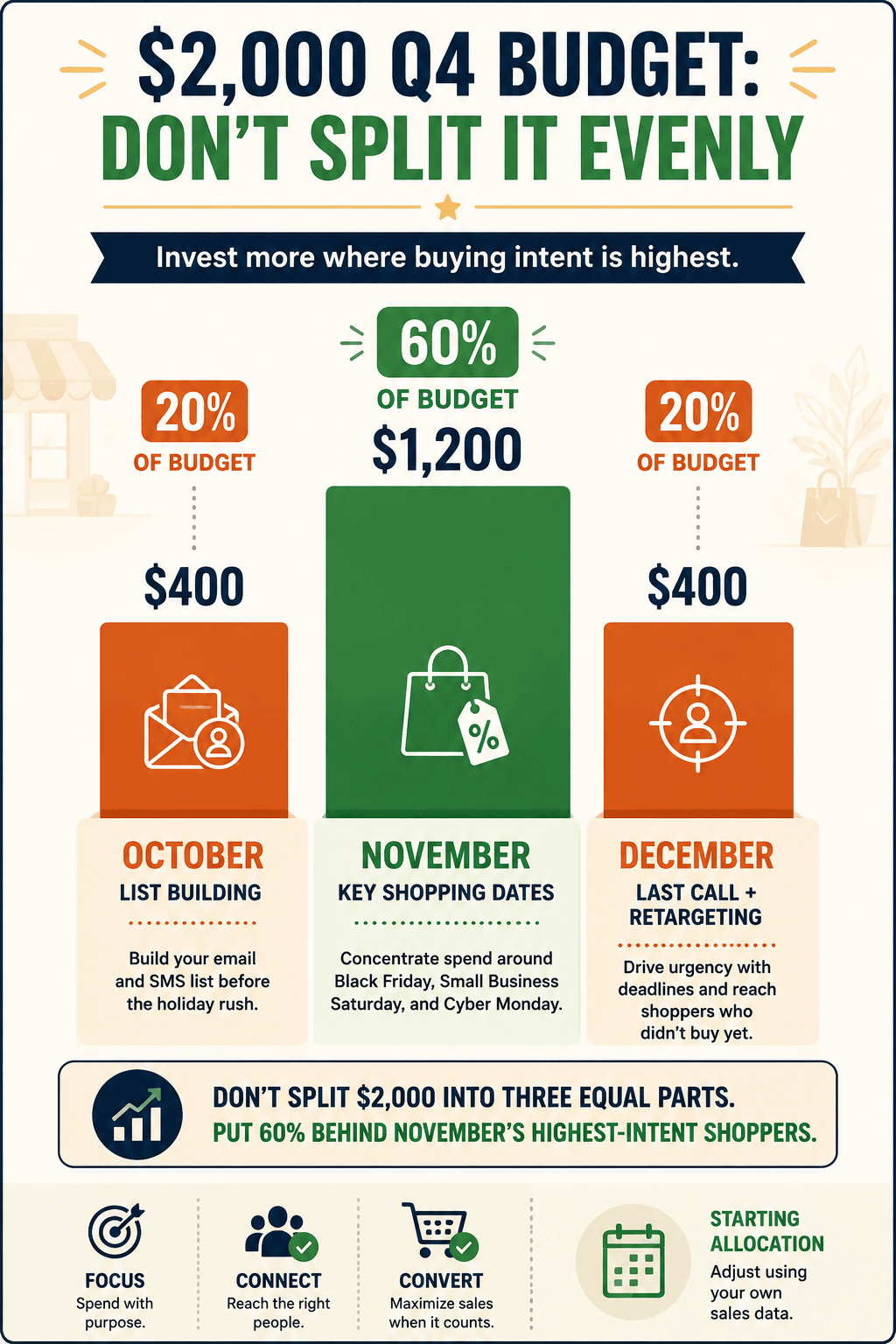
For $2,000 across the quarter, don’t spread it evenly. That’s the instinct, and it’s wrong.
- $400 in October on list-building: a small ad budget or a modest giveaway prize to get sign-ups.
- $1,200 in November on ads and promotion around your three key dates. This is where the buying happens, so this is where the money goes.
- $400 in December on the last-call push and retargeting ads for people who visited but didn’t buy.
Not a hard rule. A starting point. Once you see which month actually drives sales for your business, shift next year’s numbers to match what really happened.
Most small businesses start their Q4 marketing in November. That's already too late. Ad costs climb all through October as big retailers ramp up spend. Here's a month-by-month plan that starts before the noise does. Share on X

Note: Some links on this page are affiliate links meaning that if you click on my link and make a purchase, I will receive a small commission. It does not however affect the price you pay. Plus, it’s a great way to support me and the content I’m providing.