A Simple System To Ask For Testimonials Without Feeling Awkward
August 12, 2026
The Direct Answer
The fastest way to get more testimonials is to ask at the right moment, make it easy to say yes, and ask for something specific instead of a general “what did you think.” Most solopreneurs and small business owners skip testimonial requests because it feels awkward to ask. A simple system fixes that, and it does not take much time to run.
Testimonials do more than sit on a website looking nice. A good one answers the question a new customer is silently asking: will this work for someone like me? A large company can lean on brand name and ad budget to earn trust. A solopreneur usually cannot. Real words from a real customer often do that job instead.
Why Testimonials Matter More For a Solopreneur or Small Business
When someone hires a one-person business, they take on more risk than they would with a big company. There is no support team. There is no long track record to look up. Sometimes there are no other reviews at all. A testimonial fills that gap. It tells a stranger that someone else already took the risk, and it worked out.
Think about a freelance bookkeeper. A potential client is comparing that bookkeeper against three others found through a search. Price and services might look similar across all four. What tips the decision is often one line from a past client that says something like, “she caught an error that would have cost me thousands.” That single sentence can do more work than an entire services page.
What To Decide Before You Start Asking
Before sending a single request, get clear on three things.
- Who you want to hear from. Pick customers who got a clear result, not just anyone who was polite.
- What you want them to talk about. A vague request gets a vague answer. A specific request gets a specific, usable quote.
- Where the testimonial will live. A website page, a proposal, a social post, and an email all call for slightly different lengths and tones.
Skipping this step is why so many testimonial requests get ignored. “Would you mind leaving a review?” is easy to put off. A specific ask is easier to answer.
How To Build a System Instead of Asking Randomly
Asking for testimonials should not depend on remembering to do it. Build it into steps you already take.
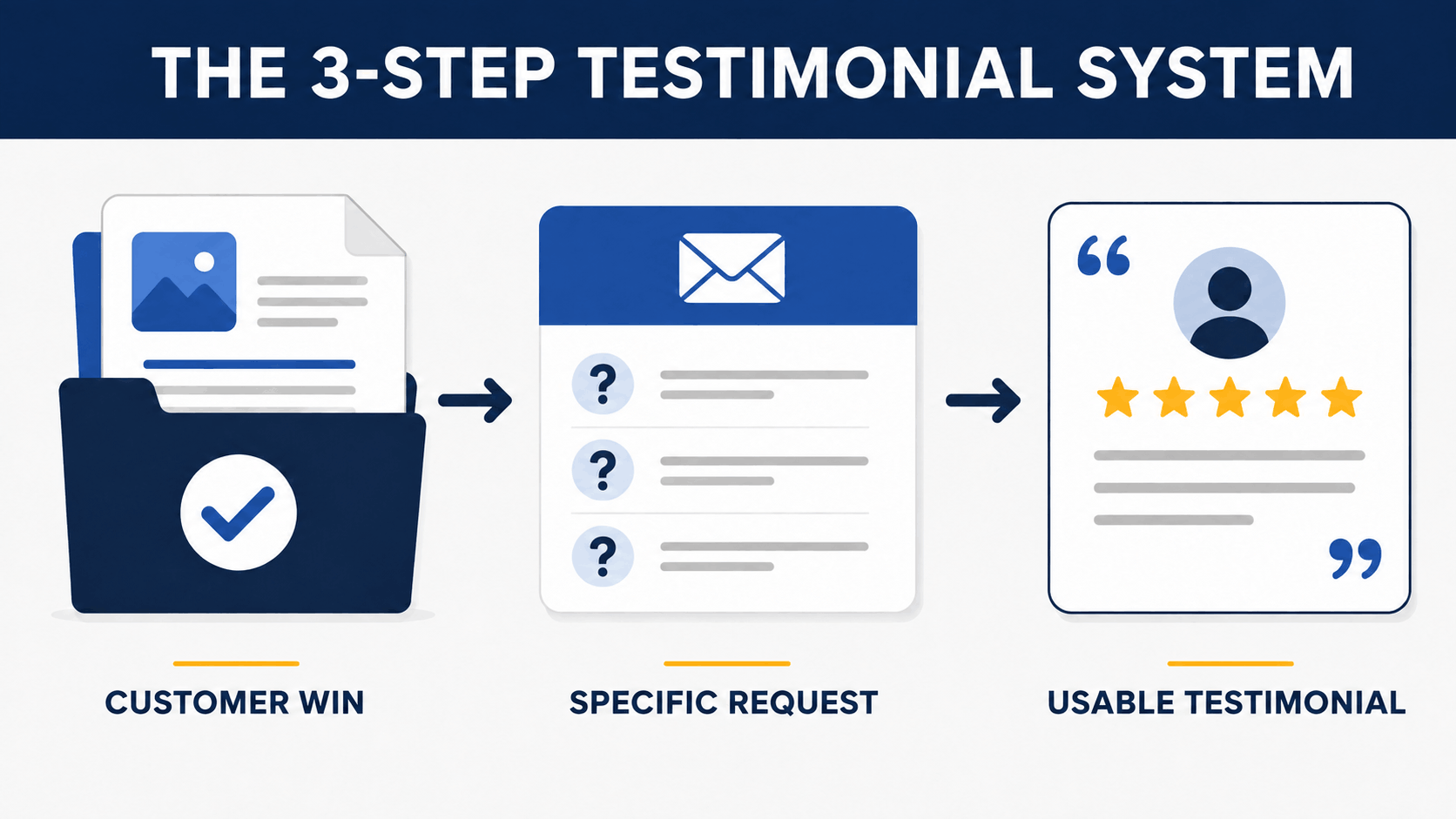
The best time to ask is right after a customer gets a win, not months later. That could be the moment a project wraps up, a goal gets hit, or a customer thanks you out of nowhere in an email. Feelings fade fast. Ask while the result is still fresh.
Make the ask short and specific. Instead of “can you write a testimonial,” try three quick questions:
- What problem were you trying to solve before you found us?
- What changed after working together?
- Would you tell another business owner to try this, and why?
Lightly edited, those three answers often turn into a full testimonial. The customer never has to stare at a blank box wondering what to write.
Make it easy to respond. A short form, a reply-to-this-email request, or even a text message works better than sending someone to a separate review site with a login wall. Every extra step loses a percentage of people who meant to respond.
Always ask permission to use their name, business, and words in your marketing before you publish anything. This protects the relationship and keeps things above board.
Common Mistakes That Cost You Testimonials
The first mistake is asking too late. Waiting until a quarterly newsletter or an annual push means most customers will have moved on mentally. Ask close to the win.
The second mistake is asking everyone the same generic question. “How was your experience?” invites a one-line, forgettable answer. A specific question gets a specific, quotable one.
The third mistake is only asking happy customers who already offered praise on their own. Some of your best testimonials come from customers who needed a nudge. If you only collect from people who volunteer, you miss a lot of good material.
The fourth mistake is collecting testimonials and never using them. A folder of nice quotes does nothing sitting in your inbox. Put them where buyers will actually see them. Add one to the page where someone decides to book. Add one to a proposal. Add one to a follow-up email for a lead who has gone quiet.
How To Measure Whether Your System Is Working
Track a few simple numbers each month. This works the same way for a solo service provider or a small business with a few employees.
- How many requests did you send?
- How many people responded?
- How many of those responses were strong enough to use?
If the response rate is low, the timing or the question is probably the problem, not the customers. If you are getting responses but few are usable, tighten the question so people know what to talk about.
Also watch whether testimonials are doing their job. Are new leads mentioning one you sent them? Did adding a testimonial to a certain page change how many people booked a call? These are the signs a testimonial system is paying off, not just sitting there.
When This Might Not Be the Right Move
If you are brand new and only have a handful of customers, do not force testimonials before the work has had time to show results. A rushed, thin testimonial can do more harm than none at all. In that case, spend the early months delivering a strong result for a few customers first, then start asking.
Some industries have strict rules about what you can publish, like legal, medical, or financial services. If that is you, check the rules first. Then build the request into your process.
Make It a Habit
Pick one moment in your customer process where a win naturally happens, and attach the testimonial request there. For a coach, that might be the end of a program. For a service provider, that might be project delivery. For a product business, that might be thirty days after purchase.
Keep a simple running document with every testimonial you collect. Sort them by the problem each one solves. When you need proof for a specific type of customer, you can find the right quote in seconds instead of digging through old emails.
Review the document once a month. Notice which questions produced the best answers, and which moments in your process led to the strongest responses. Adjust the timing or wording, then keep going.
What You Should Do Next
Your Practical Assignment
Look back at your last ten customers or clients. Pick the three who got the clearest result. Send each one the three-question request above this week. At the end of the week, note how many responded and whether the answers gave you something you can actually use.
You do not need dozens of testimonials to see a difference. A handful of specific, well-placed ones can carry more weight than a long wall of generic praise.
Frequently Asked Questions
When is the best time to ask for a testimonial?
Right after the customer gets a clear result, while the experience is still fresh. Waiting weeks or months usually lowers both the response rate and the quality of what you get back.
What if a customer says yes but never sends anything?
Send one short, friendly follow-up with the same three questions already filled in as a starting point. Many people say yes and mean it, then simply forget. A quick nudge with the work already half done for them often gets it across the line.
Do testimonials need to be written, or can they be video?
Either works. Written testimonials are faster to collect and easier to place on a page. Video carries more weight because people can see and hear a real person. But video takes more effort from the customer. Expect a lower response rate if video is the only option you offer.
Learn how to get more testimonials from customers with a simple ask-and-collect system built for solopreneurs and small business owners. Share on X

Note: Some links on this page are affiliate links meaning that if you click on my link and make a purchase, I will receive a small commission. It does not however affect the price you pay. Plus, it’s a great way to support me and the content I’m providing.