Strategic isolation is the primary barrier to sustainable scaling for solo operators in the modern economy. By implementing a shadow board, a curated group of human advisors and specialized AI agents, solopreneurs create the necessary friction to stress test their systems and eliminate cognitive bias.
Why is strategic isolation the greatest threat to your scale?
The solopreneur journey is often praised for its autonomy, yet that same independence can become a bottleneck when high-stakes decisions are made in a vacuum. Without external perspectives, your Pro-Focus workflow is vulnerable to blind spots and personal biases, leading to strategic drift. When you operate as the CEO, COO, and individual contributor simultaneously, the lack of a feedback loop creates a dangerous echo chamber.
According to research published by Harvard Business Review, leaders who operate without diverse external input are significantly more likely to succumb to confirmation bias. This risk is amplified for solopreneurs who lack a team to challenge their assumptions.
A shadow board serves as an artificial governing body.
It is not about seeking permission: it is about seeking perspective. By building this infrastructure, you ensure that your business operates on logic and market data rather than momentary impulses or fatigue.
How can you build a shadow board without a corporate budget?
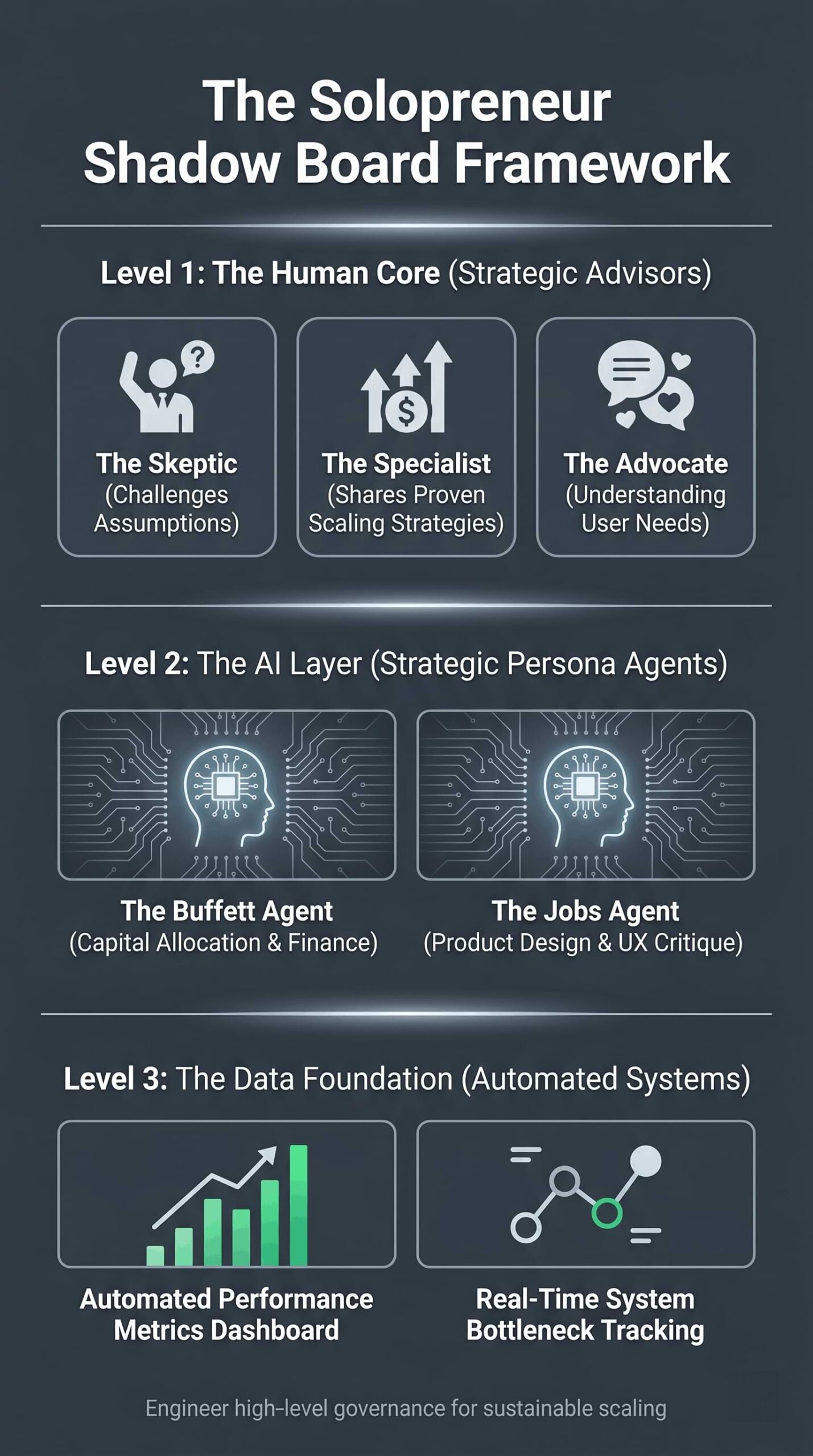
In 2026, the cost of high-level expertise has been democratized through a combination of fractional talent and generative intelligence. You do not need a paid board of directors to achieve institutional-grade oversight. Instead, you can construct a hybrid shadow board using a three-step selection process that focuses on cognitive diversity and systems thinking.
- Identify Your Knowledge Gaps: Audit your past six months of operations and pinpoint where you hesitated or made errors. Are you strong in product development but weak in financial forecasting? Your board must fill these specific voids.
- Curate Three Human Archetypes: Select three individuals who agree to a quarterly 30-minute check-in. These should include The Skeptic (someone who challenges your growth assumptions), The Specialist (a peer who has achieved the scale you desire), and The Customer Advocate (someone who deeply understands your target audience).
- Deploy AI Persona Agents: Supplement your human advisors with custom AI agents trained on specific frameworks. You can create a “Buffett Agent” for capital-allocation advice or a “Jobs Agent” for design and user-experience critiques. These agents are available for real-time interrogation during your Pro-Focus deep work sessions.
A study by Forbes indicates that founders who utilize structured advisory systems grow their revenue 3.5 times faster than those who do not. This growth is a direct result of improved decision-making speed and clarity. By utilizing tools like Notion to document these advisory interactions, you create a searchable database of strategic wisdom that compounds over time.
What is the step-by-step process for a shadow board session?
Efficiency is the cornerstone of the Pro-Focus philosophy. Your shadow board meetings should be rigorous, timed, and focused on output. Do not treat these as coffee chats or casual networking. Treat them as formal governance sessions that dictate the trajectory of your operations. Use the following framework to manage your quarterly board review.
First, prepare a “State of the System” report. This document should outline your current key performance indicators, the primary bottleneck you are facing, and three proposed solutions. Sharing this forty-eight hours in advance ensures your human advisors come prepared with actionable feedback rather than surface-level reactions.
Second, conduct the “Friction Phase.” During the meeting, present your primary bottleneck and allow your board to ask clarifying questions for fifteen minutes. The goal here is not to defend your position but to listen for patterns in their inquiries. If two advisors ask about your customer churn rate, that is a signal that your retention system requires an immediate audit.
Third, define the “Actionable Pivot.” Conclude the session by committing to one specific system change based on the board’s input. This commitment creates the accountability that solopreneurs often lack. You are no longer just answering to yourself: you are answering to the infrastructure you built to protect your business from your own biases.
How does technology facilitate high-level governance?
The transition from a solo operator to a systems-led founder requires a shift in how you use your digital environment. Your shadow board should not exist only in your calendar. It should be integrated into your project management software. Use specific tags for “Board Reviewed” tasks to differentiate between tactical to-do items and strategic initiatives that have been stress tested.
Automating the data flow to your shadow board is also essential for maintaining transparency. Use integration platforms like Zapier to feed your weekly metrics into a shared dashboard. When your advisors can see your progress in real time, their feedback becomes more precise and less reliant on your subjective reporting. This transparency is the hallmark of a high-performance operations strategist. It moves the business from a “feeling” to a “formula.”
Finally, remember that the shadow board is a living system. As your business evolves from early-stage growth to mature scaling, the composition of your board must change. The advisor who helped you find your first fifty customers may not be the same person who can help you automate your referral engine or prepare for a mid-year scale audit. Be ruthless with the composition of your board to ensure the advice remains relevant to your current altitude.
The Bottom Line
Implementing a shadow board transforms your solopreneur practice from a solo effort into a systems-driven organization. By introducing intentional friction and diverse expertise, you eliminate the strategic blind spots that prevent long-term scale.
The greatest risk for a solopreneur is strategic isolation. Without a feedback loop, your biases become your bottlenecks. In 2026, the 'Shadow Board' is the essential infrastructure for scaling without a team. Share on XSee my archive of Tips Tuesday articles.

If you need a podcast host, I recommend Blubrry. No contracts, and you can cancel at any time.
Competitive prices too! And if you already have a podcast host, migrate to Blubrry for free!