How to Get More Customers From the Marketing You Already Have
This post may contain affiliate links. If you buy through them, I earn a small commission at no extra cost to you.
Last updated: August 24, 2026
Quick Answer: Most small businesses already have enough marketing assets to grow significantly; they just aren’t fully using them. Learning how to get more customers from the marketing you already have means auditing existing channels (blog posts, email lists, Google Business Profile, testimonials, and website traffic) for missed conversion opportunities before spending another dollar on new campaigns.
Key Takeaways
- Optimizing existing marketing channels almost always delivers faster ROI than launching new ones.
- A slow website, a cluttered landing page, or a weak call-to-action can silently kill conversions from traffic you already paid for.
- Dormant email subscribers, past customers, and Google Business Profile visitors are among the most underused assets in small business marketing.
- Smarter remarketing, with frequency caps, audience exclusions, and sequenced messaging, turns existing attention into new customers without increasing ad spend.
- Trust signals and social proof (testimonials, reviews, case studies) are among the highest-impact, lowest-cost conversion tools available.
- First-party data and consented tracking now underpin effective remarketing and conversion optimization.
- A single focused call-to-action on a landing page consistently outperforms pages with multiple competing options.
- Small businesses can see meaningful conversion improvements within 30 to 90 days of focused optimization work.
What Does It Mean to Optimize Existing Marketing Channels
Optimizing existing marketing channels means improving the performance of what you already have, your website, email list, social posts, Google Business Profile, and past customer relationships, rather than adding new platforms or campaigns. The goal is to extract more value from resources already in motion.
For most small businesses, this is the highest-leverage activity available. New channels take months to build. Existing channels already have traffic, subscribers, or brand recognition that can be converted more effectively with targeted adjustments.
What this looks like in practice:
- Refreshing old blog posts with updated information and stronger calls-to-action
- Reactivating dormant email subscribers with a simple re-engagement sequence
- Adding a booking link or offer to a Google Business Profile that currently has none
- Repurposing a high-performing social post into an email or landing page
How Do I Know If My Marketing Is Underperforming?
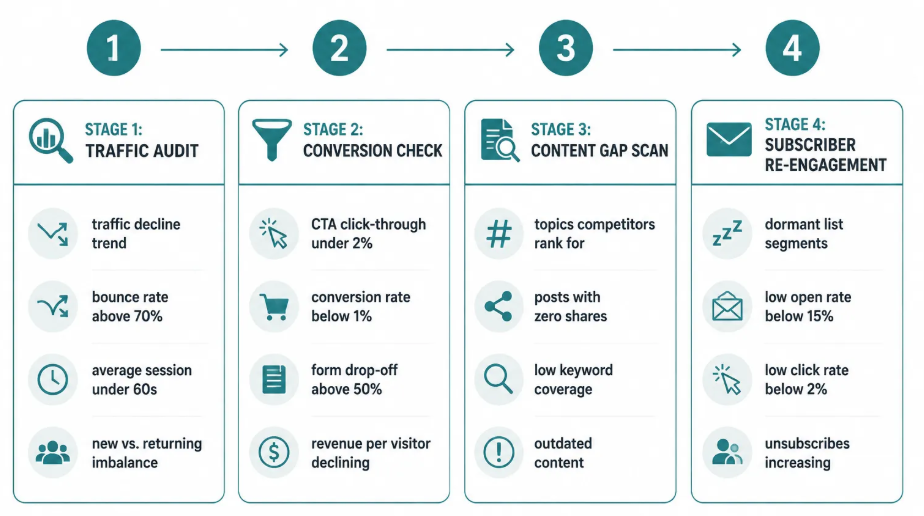
Your marketing is underperforming if traffic arrives but doesn’t convert, or if existing assets generate no measurable action. The clearest signals include a high bounce rate, low email click-through rates, and stagnant conversions despite steady or growing traffic.
Specific warning signs to check:
- Website bounce rate above 70% on key landing pages
- Email open rates below 20% or click-through rates below 2%
- Google Business Profile views with no corresponding calls, clicks, or direction requests
- Blog posts ranking on page two or three of search results that could rank higher with minor updates
- Testimonials sitting on a hidden page rather than placed near purchase decisions
According to conversion rate benchmarks across industries and channels, the gap between average and top-performing businesses is widening, meaning businesses doing basic optimization work are pulling significantly ahead of those that aren’t.
What Are Common Mistakes Businesses Make With Their Marketing Spend
The most common mistake is investing in new marketing before fixing the leaks in existing marketing. Sending more traffic to a page that converts poorly just amplifies the waste.
Other frequent errors include:
- Running ads to a homepage instead of a dedicated landing page with one clear action
- Ignoring past customers as a source of repeat business and referrals
- Collecting email subscribers but sending infrequent or irrelevant messages
- Posting on social media without ever directing followers to take a next step
- Leaving Google Business Profile incomplete: no photos, no offers, no updated hours
A related mistake is treating every marketing channel as equally important. Not all channels deserve equal attention. The right move is to identify which one or two channels already generate the most leads, then focus optimization energy there first.
What’s the Difference Between Getting New Customers vs. Maximizing Existing Marketing
Getting new customers through new channels requires time, budget, and experimentation before results appear. Maximizing existing marketing means improving the performance of assets already generating some activity, and results can arrive much faster.

| Approach | Time to Results | Typical Cost | Best For |
|---|---|---|---|
| New channel (new social platform, new ad type) | 3-12 months | Medium to high | Businesses with stable existing channels |
| Existing channel optimization (CRO, email, GBP) | 30-90 days | Low to medium | Any business with existing traffic or subscribers |
| Past customer re-engagement | Days to weeks | Very low | Businesses with a customer list of 50 or more |
Is It Better to Expand Marketing or Optimize What You Have
For most small businesses, optimization comes first. Expanding marketing before optimizing existing assets means spending more money to achieve the same underwhelming results at larger scale.
The exception: if a business has genuinely exhausted the conversion potential of its current channels, or if a specific new channel offers a direct path to an untapped audience, expansion makes sense. But that situation is rarer than most business owners assume.
Current conversion rate optimization trends show that the shift in 2026 is toward full-funnel, journey-based optimization, not just tweaking individual pages, but improving every step from first click to final purchase. This approach captures more value from each existing campaign without requiring new spend.
How to Improve Conversion Rates on Current Marketing Campaigns
Improving conversion rates on existing campaigns starts with identifying the single biggest drop-off point in the customer journey and fixing it before touching anything else.
A practical five-step process:
- Audit your highest-traffic pages. Find pages with significant traffic but low conversion. These are your biggest opportunities.
- Simplify the call-to-action. Pages with one clear CTA consistently outperform pages with multiple competing options, according to data-backed CRO research for 2026.
- Check page speed and mobile layout. Page speed and mobile-first design are delivering measurable conversion lifts from existing traffic. A page that loads in under two seconds converts better than one that loads in four.
- Add trust signals near the decision point. Place testimonials, reviews, or case study snippets directly above or below your primary CTA, not on a separate page.
- Run one focused test at a time. Change one element, measure the result, then move to the next. AI-assisted experimentation tools are making it easier to run more tests on existing traffic without needing a large technical team.
How to Find Untapped Potential in Your Current Marketing Strategy
Untapped potential almost always lives in one of five places: old content, inactive subscribers, past customers, underused social proof, and incomplete business profiles.
Where to look first:
- Old blog posts: Posts that once ranked well but have drifted down in search results. Updating them with current information and a stronger CTA can quickly recover traffic.
- Inactive email subscribers: A re-engagement campaign sent to subscribers who haven’t opened in 90 days often produces a meaningful response and cleans your list for better deliverability.
- Past customers: A simple “we’d love to work with you again” email or a referral request costs almost nothing and regularly produces new business.
- Testimonials and reviews: Most businesses collect them and then bury them. Moving strong testimonials to homepage hero sections, product pages, and email footers increases trust at the moments that matter.
- Google Business Profile: Businesses that add photos, post weekly updates, and respond to reviews consistently see higher click-through rates from local search traffic.
Smarter remarketing also belongs in this category. Effective remarketing strategies in 2026 use frequency caps to prevent ad fatigue, audience exclusions to avoid showing ads to recent buyers, and sequenced messaging that warms prospects before asking for a sale.
What Tools Help Measure and Track Marketing Performance
The right tools depend on which channels you’re optimizing, but a core stack for most small businesses is straightforward and largely free.
Essential tools:
- Google Analytics 4 tracks website traffic, user behavior, and conversion events
- Google Search Console shows which search queries bring visitors and which pages are losing ranking
- Google Business Profile Insights reveals how many people found your profile, called, or clicked for directions
- Your email platform’s built-in analytics, open rates, click rates, and unsubscribe trends tell you what content resonates
- Heatmap tools (Hotjar, Microsoft Clarity) show where visitors click and where they stop scrolling
Conversion optimization statistics consistently show that businesses using structured measurement and testing outperform those relying on intuition alone. The goal isn’t to track everything, it’s to track the two or three metrics that directly reflect whether your existing marketing is turning visitors into customers.
Can Small Businesses Get More Customers Without Spending More on Marketing
Yes. The core principle behind getting more customers from the marketing you already have is that spending more is rarely the first answer. Spending smarter almost always comes first.
Concrete no-cost actions that produce results:
- Ask every satisfied customer for a Google review this week
- Send a personal email to your five most recent customers asking if they know anyone who needs your service
- Update the top three pages on your website with a clearer headline and a single CTA
- Post one piece of content per week that answers a question your customers ask repeatedly
- Respond to every Google Business Profile review, positive or negative
According to digital remarketing and customer retention research, retaining and re-engaging existing customers costs significantly less than acquiring new ones, and those customers convert at higher rates because trust is already established.
What Questions Should I Ask About My Marketing Before Scaling Up
Before adding budget, platforms, or campaigns, every small business should answer these questions honestly:
- Where is traffic going, and what happens when it arrives? If visitors land and leave without taking action, scaling traffic makes the problem bigger, not smaller.
- What is the conversion rate on my best-performing page? If it’s under 2%, there’s room to improve before spending more.
- When did I last contact my email list? If the answer is “months ago,” re-engagement is a higher priority than list growth.
- Are past customers being asked for referrals? Most are not, and most would give them if asked directly.
- Is my Google Business Profile complete and active? An incomplete profile loses local search traffic to competitors who filled theirs out.
- Do my landing pages have one clear action or several competing ones? Best practices in conversion optimization consistently point to simplicity as the highest-impact change most businesses can make.
How Long Does It Take to See Results From Optimizing Marketing?
Results from optimizing existing marketing typically appear within 30 to 90 days for conversion-focused changes, and within one to two weeks for direct outreach to past customers or email re-engagement campaigns.
Timeline by tactic:
- Email re-engagement campaign: 1-2 weeks
- Google Business Profile update: 2-4 weeks to see search visibility changes
- Landing page CTA simplification: 2-6 weeks with enough traffic to measure
- Blog post refresh for SEO: 4-12 weeks for ranking improvements
- Remarketing campaign optimization: 3-6 weeks to see cost-per-conversion improve
The key variable is traffic volume. Low-traffic pages take longer to produce statistically meaningful data. Prioritize optimizing pages and channels that already have the most activity.
Final Thought
The path to more customers rarely requires a new platform, a bigger ad budget, or the latest AI tool. For most small businesses, the answer is already sitting in existing assets, a blog post that needs refreshing, an email list that hasn’t been contacted in months, a Google Business Profile that’s missing a phone number, or a testimonial page that nobody sees before they buy.
Actionable next steps to take this week:
- Pull up Google Analytics and identify the three pages with the most traffic and the lowest conversion rate. Pick one and simplify its CTA.
- Export your email list and segment out subscribers who haven’t opened in 90 days. Send them a single re-engagement message.
- Check your Google Business Profile. Add at least one photo, confirm your hours are current, and respond to any unanswered reviews.
- Contact five past customers personally, not with a mass email, and ask if they know anyone who could use your service.
- Move your best testimonial from wherever it lives now to the top of your homepage or most-visited landing page.
Understanding how to get more customers from the marketing you already have is not a complex strategy. It’s a discipline of finishing what you started, and most businesses find that the biggest gains come not from doing more, but from doing what they already do better.
Frequently Asked Questions
What is the fastest way to get more customers from existing marketing?
Contacting past customers directly, by email or phone, is typically the fastest method. These people already trust you, so conversion rates are higher and response times are shorter than with cold outreach.
How do I know which marketing channel to optimize first?
Start with the channel that already generates the most traffic or leads. Improving a channel that’s already working is faster than fixing one that’s barely active.
Does improving page speed really increase conversions?
Yes. Pages that load faster retain more visitors, and retaining visitors is a prerequisite for converting them. Even a one-second improvement in load time can measurably lift conversion rates on high-traffic pages.
What’s the difference between a conversion rate and a click-through rate?
A click-through rate measures how many people click a link or ad. A conversion rate measures how many of those people complete a desired action, a purchase, a booking, or a form submission. Both matter, but conversion rate more directly measures marketing effectiveness.
How often should I contact my email list?
At minimum, once per month. Subscribers who go more than 60 days without hearing from a business tend to forget they signed up, which increases unsubscribe rates when you do reach out.
Can I improve my Google Business Profile ranking without paid ads?
Yes. Completing every section of the profile, adding fresh photos regularly, collecting reviews, and posting weekly updates all improve organic visibility in local search results at no cost.
What is remarketing, and how does it help existing marketing?
Remarketing shows targeted ads to people who have already visited your website or interacted with your content. With frequency caps and sequenced messaging, it re-engages warm prospects instead of annoying them with repetitive ads.
What is a good conversion rate for a small business website?
Conversion rates vary widely by industry and traffic source, but a general benchmark for a service business landing page is 2-5%. Pages below 2% typically have a fixable issue, unclear CTA, slow load time, or lack of trust signals.
Should I delete old blog posts that aren’t getting traffic?
Not necessarily. Many old posts can be refreshed with updated information and stronger SEO targeting, which is faster and cheaper than writing new content from scratch.
What does “first-party data” mean for small business marketing?
First-party data is information you collect directly from your customers and website visitors, including email addresses, purchase history, and on-site behavior, with their consent. It’s more reliable than third-party data and is the foundation of effective remarketing and personalization.
"Marketing Monday" articles archive.
Note: Some links on this page are affiliate links, meaning that if you click on my link and make a purchase, I will receive a small commission. It does not, however, affect the price you pay. Plus, it's a great way to support me and the content I'm providing.