This post may contain affiliate links. If you buy through them, I earn a small commission at no extra cost to you.
Last updated: August 17, 2026
Quick Answer: Low-cost strategies often beat paid ads for local and service-based businesses. The best budget tactics are organic social media, email marketing, Google Business Profile, and referral programs. You don’t need a big budget. You need consistency and clarity.
Key Takeaways
- Email, organic social, and local SEO are the cheapest channels and often the highest-ROI ones too.
- You can market a business with zero dollars. It takes more time, but it works.
- Most small businesses spend on ads before they’ve nailed their message. Fix the message first.
- Organic marketing builds assets that last. Paid marketing stops the moment you stop paying.
- Review your channels every 90 days. Keep what works, cut what doesn’t.
- Inconsistency and no clear call to action cost more than any ad budget ever could.
What Are the Cheapest Ways to Market a Small Business?
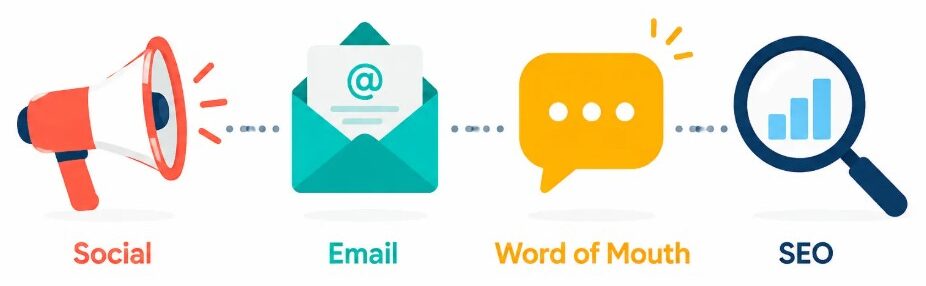
The cheapest ways to market a small business are the ones that cost your time instead of your money. For solopreneurs and small business owners working with tight margins, that’s actually good news, because time invested in the right places compounds over months and years.
Here are the highest-value, lowest-cost channels to start with:
- Google Business Profile: Free to set up. Optimizing it helps local customers find you in search results without spending a cent on ads.
- Email marketing: Platforms like Mailchimp and MailerLite offer free tiers. A list of 500 engaged subscribers beats 5,000 cold social media followers.
- Organic social media: Posting consistently on one or two platforms costs nothing but time.
- Content marketing (blogging or video): A well-written blog post or YouTube video can drive traffic for years.
- Referral programs: Ask happy customers to refer friends. A simple “tell a friend and get 10% off” system costs almost nothing to run.
- Community involvement: Local events, Facebook groups, and online forums put you in front of your exact audience for free.
Decision rule: If you have under $500/month for marketing, put 80% of your effort into email and organic content. Paid ads can wait until you know your message converts.
How to Do Marketing With No Budget at All
Zero-budget marketing is real. It’s slower, but it builds something paid ads never can, trust.
Start with what you already have: your story, your expertise, and your existing network. These are your first marketing assets.
Actionable steps for zero-budget marketing:
- Post value-driven content on one social platform three times per week.
- Send a personal email to your existing contacts introducing your business or new offer.
- Ask every satisfied customer for a Google or Facebook review.
- Join two or three online communities where your ideal customer hangs out, and contribute genuinely, not just to sell.
- Partner with a complementary business for a simple cross-promotion (no money changes hands).
The mindset shift here matters. Marketing without a budget isn’t a disadvantage; it’s a discipline. It forces you to get clear on your message because you can’t just throw money at the problem.
Free Social Media Marketing Tools for Small Businesses
You don’t need expensive software to run effective social media marketing. Several free tools do the heavy lifting for small business owners who are managing everything themselves.
Top free tools worth using in 2026:
- Canva (free tier): Design social posts, flyers, and graphics without a designer.
- Buffer or Later (free tiers): Schedule posts across platforms in advance.
- Meta Business Suite: Manage Facebook and Instagram in one place, free.
- Google Analytics: Track what’s driving traffic to your website at no cost.
- Mailchimp (free up to 500 contacts): Build and send email campaigns.
- ChatGPT or similar AI tools: Draft captions, email subject lines, and blog outlines faster.
Common mistake: Solopreneurs often sign up for five tools and use none of them consistently. Pick two, learn them well, and build small daily wins around them.
Best Low-Cost Marketing Strategies That Actually Work
The best low-cost marketing strategies share one thing in common: they build relationships, not just reach. Reach is vanity. Relationships drive revenue.
Here’s what consistently works for small businesses and solopreneurs:
- Email newsletters: Weekly or bi-weekly emails keep you top-of-mind with warm leads.
- Short-form video: Reels, TikToks, and YouTube Shorts still get organic reach without ad spend.
- SEO content: One well-optimized blog post can bring in leads for years.
- Strategic partnerships: Co-hosting a webinar or doing a joint giveaway with a complementary brand doubles your audience instantly.
- Testimonials and case studies: Social proof is free to collect and incredibly persuasive.
These aren’t flashy. But this is where strategy meets psychology, the best marketing feels like a helpful conversation, not a sales pitch.

How Much Should a Small Business Spend on Marketing?
A common rule of thumb is to allocate 5% to 10% of gross revenue to marketing for an established small business. For a newer business trying to grow faster, that figure can climb to 12% to 20%. These are estimates based on widely cited small business guidance; your actual number depends on your industry, margins, and growth goals.
Practical breakdown by stage:
- Pre-revenue / just starting: Focus on zero-cost channels. Invest time, not money.
- $0 to $5,000/month revenue: Keep paid spending minimal. Prioritize email list building and organic content.
- $5,000 to $20,000/month: Consider a small paid ad budget ($200 to $500/month) to amplify what’s already working organically.
- $20,000+/month: A 5% to 8% marketing budget starts to make more sense and gives you room to test.
The real answer: Spend the minimum needed to stay consistent. Consistency beats budget size every single time.
Can You Market a Business Without Paid Ads?
Yes, and many successful small businesses do exactly that. Paid ads are a tool, not a requirement. Organic marketing through content, email, SEO, and referrals has built countless businesses without a single dollar going to Facebook or Google.
The trade-off is time. Organic strategies take longer to gain momentum, but they create durable assets like a blog post, an email list, and a strong reputation that paid ads never build for you.
What’s the difference between organic and paid marketing?
- Organic marketing builds over time. It includes SEO, social media posts, email newsletters, and word-of-mouth. It costs time and effort but generates compounding returns.
- Paid marketing (ads) delivers faster visibility but stops the moment you stop paying. It’s a rental, not an asset.
For most solopreneurs and small business owners, the roadmap to success starts with organic, then adds paid once the message is proven.
What Marketing Channels Give the Best ROI for Startups and Small Businesses?
Email marketing and referral programs consistently rank as the highest-ROI channels for small businesses. They reach warm audiences, cost very little, and convert at higher rates than cold traffic from ads.
Ranked by typical ROI for small businesses (general industry consensus, not a single study):
- Email marketing
- Referral and word-of-mouth programs
- Local SEO and Google Business Profile
- Organic social media (especially short-form video)
- Content marketing/blogging
- Paid search (Google Ads), higher cost, faster results
- Paid social (Meta Ads), useful for retargeting warm audiences
Edge case: For product-based businesses with strong visuals (food, fashion, home goods), Pinterest and Instagram organic can outperform email early on. For service-based businesses, LinkedIn and referrals almost always win.
How to Get Customers Without a Marketing Budget
Getting customers without a marketing budget comes down to one thing: being visible where your ideal customer already is, and making it easy for them to trust you.
Practical steps:
- Ask every current customer for a referral. Make it easy; give them a template or a link.
- Show up in local Facebook groups, Reddit communities, or LinkedIn groups as a genuinely helpful resource.
- Optimize your Google Business Profile completely: photos, hours, services, and responses to reviews.
- Reach out directly to five potential clients per week via personalized email or DM. Not a pitch, a conversation.
- Speak at local events, virtual summits, or podcast interviews in your niche.
This is how you build your brand from the ground up. No ad budget required. Just daily disciplines and a willingness to connect deeper with real people.
Is Email Marketing Still Effective for Small Businesses?
Email marketing is still one of the most effective channels available to small businesses in 2026. It reaches people directly in their inbox, no algorithm deciding whether your message gets seen.
For solopreneurs especially, a small but engaged email list is one of the most valuable business assets you can build. Even a list of 300 to 500 people who genuinely want to hear from you can sustain a service-based business.
What makes email work:
- Consistent sending schedule (weekly or bi-weekly)
- A clear, single call to action per email
- Subject lines that feel personal, not promotional
- Content that delivers value before it asks for anything
Common mistake: Many small business owners build a list and then never email it. The list goes cold. Start small, even a monthly email is better than silence.
How to Market a Service-Based Business With Little Money
Service-based businesses, coaches, consultants, freelancers, tradespeople, have a natural marketing advantage that product businesses don’t: your personality and expertise are the product. That’s free to share.
What works best for service businesses on a tight budget:
- Testimonials and case studies: Document every win your clients have. Turn them into social posts, emails, and website copy.
- LinkedIn presence: For B2B service providers, consistent LinkedIn posting builds authority faster than most other channels.
- Referral partnerships: Build relationships with businesses that serve the same client but don’t compete with you.
- Free consultations or audits: A strategic audit offer (even a 20-minute call) lowers the barrier to entry and starts the relationship.
- Podcast guesting: Pitching yourself as a guest on relevant podcasts gets your message in front of warm, targeted audiences at zero cost.
The art of influence for service businesses isn’t about reach; it’s about depth. Ten people who deeply trust you will refer more business than 10,000 followers who barely know you exist.
Common Marketing Mistakes Small Businesses Make
The biggest marketing mistakes aren’t about strategy; they’re about consistency and clarity. Most small businesses don’t fail at marketing because they picked the wrong channel. They fail because they quit too soon or never got clear on who they’re talking to.
The most common mistakes:
- Trying to be everywhere: Pick one or two channels and go deep. Spreading thin kills momentum.
- No clear call to action: Every piece of content should tell the reader what to do next.
- Ignoring existing customers: Your best marketing opportunity is the person who already bought from you.
- Inconsistency: Posting three times one week and then disappearing for a month destroys trust.
- Copying competitors: Your story and your voice are your differentiator. Use them.
- Skipping the strategic audit: If you never review what’s working, you keep doing what isn’t.
Take ownership of these habits before spending a dollar on ads.
When Should a Small Business Hire a Marketing Agency, and DIY vs. Hiring a Professional
Hire a marketing agency when you have a proven offer, a clear customer profile, and consistent revenue, but not enough time to execute the marketing yourself. Hiring before those pieces are in place usually wastes money.
DIY marketing makes sense when:
- You’re in the early stages and still testing your offer.
- Your budget is under $1,000/month for marketing.
- You need to deeply understand your customer before delegating.
Hiring a professional makes sense when:
- You’re consistently turning down work because you’re too busy.
- You have a marketing budget of at least $1,500 to $3,000/month (enough to cover agency fees and ad spend).
- You’ve identified a channel that’s working and need to scale it faster.
The middle path: Before hiring a full agency, consider a freelance specialist, a copywriter, a social media manager, or an SEO consultant. You get professional skills without the full agency retainer.
Your Next Big Marketing Opportunity Is Already in Front of You
Small business marketing on a budget isn’t about doing less. It’s about doing the right things consistently and not waiting until you have a bigger budget to start.
Here’s your action plan for this week:
- Do a strategic audit of your current marketing. What’s working? What have you been ignoring?
- Pick one free channel, email, organic social, or local SEO, and commit to it for 90 days.
- Ask three current customers for a referral or a review today.
- Set up or optimize your Google Business Profile if you haven’t already.
- Start building your email list, even if it’s just 10 people right now.
Empowering entrepreneurs doesn’t require a massive budget. It requires clarity, consistency, and the willingness to show up. The solopreneurs who win aren’t the ones with the biggest ad spend, they’re the ones who build real relationships and keep showing up when others quit.
Finish strong. Your next big marketing opportunity is already in front of you.
Frequently Asked Questions
What’s the most effective free marketing strategy for a small business?
Email marketing and Google Business Profile optimization. Both reach warm, high-intent people and cost nothing but time.
How do I market my business with no money?
Email your existing contacts, ask for referrals, post value on one platform, and fill out your Google Business Profile. All free, all effective.
How much should a brand-new business spend on marketing?
Focus on free channels first. Once revenue is steady, a common guideline is 5% to 10% of gross revenue, though newer businesses chasing faster growth often spend more.
Is social media or email better?
Email usually converts better because people already opted in. Social media is better for building awareness. Use both: social to grow, email to convert.
Can a small business compete with big marketing budgets?
Yes, especially locally. Small businesses can build real relationships and respond faster than large brands ever will. That’s the edge.
What’s the biggest marketing mistake owners make?
Inconsistency. A simple, steady schedule, one email a week, three posts a week, beats sporadic bursts of effort every time.
Do I need a website to market my business?
It helps, but it’s not required. Many businesses grow through Google Business Profile, social media, and email alone.
How long does organic marketing take to work?
SEO and content usually take three to six months. Email and referrals can pay off within weeks.
What’s the best social platform for small business marketing?
Depends on your audience. Facebook and Instagram work for local and consumer businesses. LinkedIn wins for B2B and service businesses. TikTok and YouTube Shorts work if you’re willing to make short videos.
Should a new business run paid ads?
Not yet. Ads amplify what’s already working; they don’t fix a message that isn’t converting. Nail your message organically first, then scale with ads.
“Marketing Monday” articles archive.
Note: Some links on this page are affiliate links, meaning that if you click on my link and make a purchase, I will receive a small commission. It does not, however, affect the price you pay. Plus, it’s a great way to support me and the content I’m providing.