You know that feeling when someone slides into your DMs and immediately tries to sell you something?
Yeah. That’s exactly how most welcome email sequences feel.
Here’s the thing: 74% of subscribers expect a welcome email right away.[3] They’re actually waiting to hear from you. But the moment you hit them with a hard pitch, you’ve broken the trust before it even started.
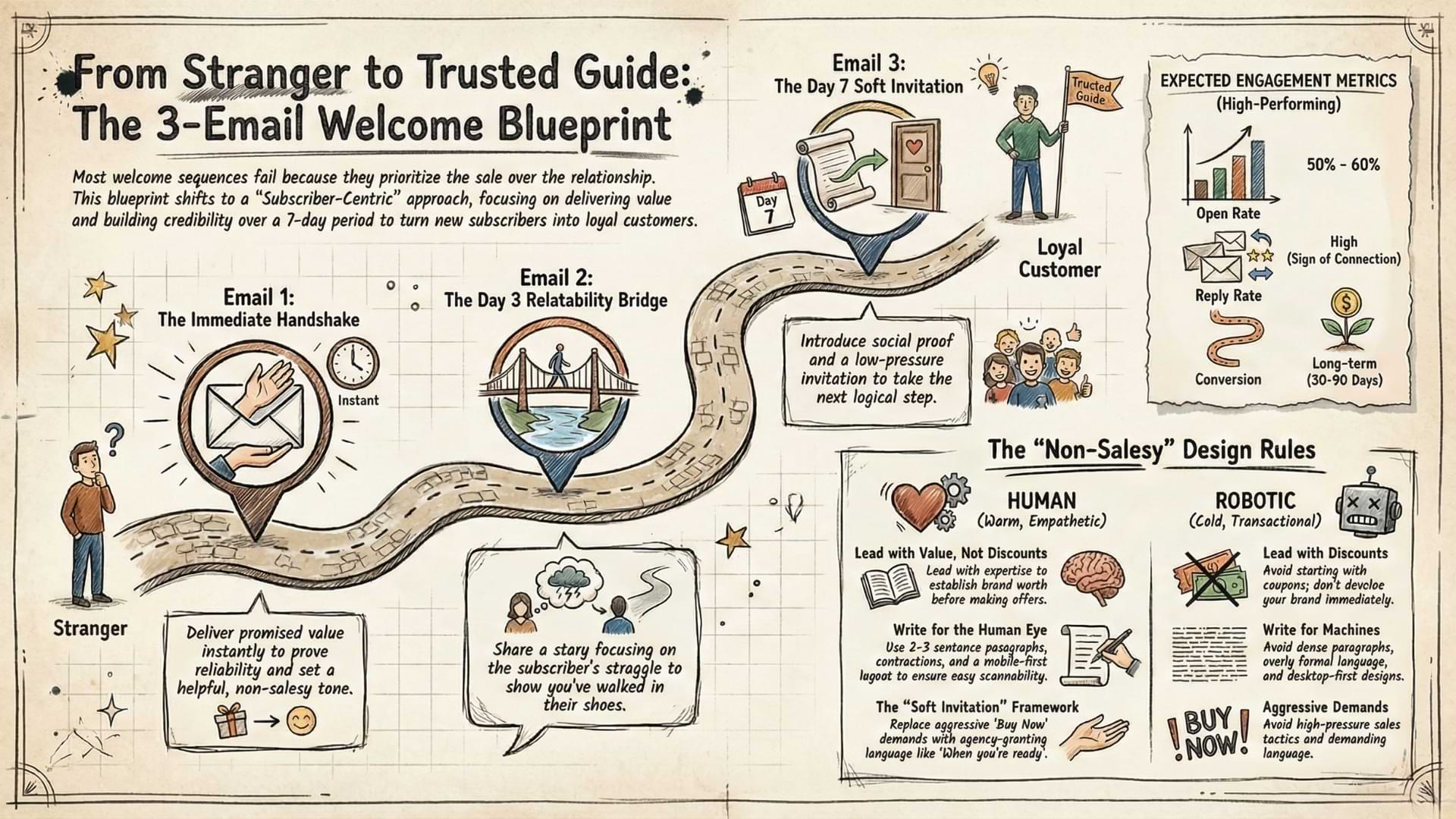
If you’re a solopreneur or small business owner building your email list in 2026, you need a welcome sequence that feels like a conversation over coffee—not a used car lot. You need to create a 3-email welcome sequence that doesn’t feel salesy while still moving people toward becoming customers.
This isn’t about being soft or avoiding the sale. It’s about strategy meets psychology. It’s about understanding that people don’t buy from brands they just met. They buy from people they trust.
Let me show you how to build that trust in three simple emails.
Key Takeaways
- Send Email 1 immediately to deliver promised value and set the tone for a human relationship, not a sales funnel
- Use Email 2 (Day 3) to share your story in a way that connects to their problem, building credibility without bragging
- Email 3 (Day 7) introduces social proof and a soft invitation to take the next step—no pressure, just possibility
- Keep copy short and scannable with 2-3 sentence paragraphs and one clear CTA per email to reduce sales pressure
- Personalize beyond first names by segmenting based on interests and tailoring content to where subscribers came from

Why Most Welcome Sequences Feel Like a Sales Pitch (And How to Fix It)
Let’s get real for a second.
Most welcome sequences fail because they’re built backward. They start with what you want (the sale) rather than what you need (the solution).
When someone signs up for your list, they’re not ready to buy. They’re ready to see if you’re worth their attention. That’s it. They gave you their email address—the most valuable currency in digital communication—and now you’ve got maybe 48 hours to prove you’re not going to waste their time.
Here’s where most solopreneurs and small business owners go wrong:
- Email 1: “Thanks for signing up! Here’s 20% off!”
- Email 2: “Did you see our products?”
- Email 3: “Last chance for this discount!”
That’s not a welcome sequence. That’s a panic attack disguised as marketing.
The fix? Lead with value, not offers. Your welcome sequence should feel like you’re onboarding a new friend, not closing a transaction. Think about it like your personal development journey—you don’t trust a Mindset Mentor after one conversation. You trust them after they’ve shown up, shared something useful, and proven they understand where you’re coming from.
The Subscriber-Centric Approach
An audience-focused sequence mirrors the subscriber’s actual decision-making journey.[4] It looks like this:
- Acknowledge their problem (Email 1)
- Show you understand their world (Email 2)
- Demonstrate how your solution helps people like them (Email 3)
Notice what’s missing? The hard sell. The countdown timer. The artificial urgency.
Instead, you’re building a roadmap to success that they can follow at their own pace. You’re taking ownership of the relationship, not just the revenue.
When you strengthen your email marketing efforts by putting the subscriber first, something magical happens: they actually want to buy from you. Because by the time you make an offer, it doesn’t feel like a pitch. It feels like the next logical step.
How to Create a 3-Email Welcome Sequence That Doesn’t Feel Salesy
Alright, let’s get into the actionable steps. This is your blueprint for building a welcome sequence that connects deeper without coming across like a desperate infomercial.
Email 1 (Immediate): Warm Welcome with Value Delivery
Timing: Send this immediately upon signup.[3]
Purpose: Confirm their signup, remind them what they signed up for, and deliver on your promise.
Here’s the structure:
Subject Line: “Welcome to [Your Brand]” or “[First Name], here’s what you signed up for”
Keep it simple. Your subject line should confirm context, not try to be clever.[2] They just signed up—they know why this email is in their inbox.
Body Copy:
Start with a warm, personal greeting:
“Hey [First Name],
Welcome! I’m so glad you’re here.”
Then immediately deliver value. If you promised a checklist, guide, or resource, give it to them in the first three sentences. Don’t make them scroll. Don’t make them click through five pages.
Here’s an example:
“You signed up for the [Free Resource Name], and I’m delivering it right now. [Link to download]
This guide walks you through [specific benefit]. I created it because [one-sentence story about why this matters].
Over the next week, I’ll send you a couple more emails to help you [achieve specific outcome]. No spam. No daily pitches. Just practical wisdom you can actually use.”
CTA: Use a low-commitment call-to-action like:
- “Explore our blog”
- “Follow us on Instagram”
- “Reply and tell me what you’re working on”
Notice what you’re NOT saying: “Buy now.” “Shop our products.” “Book a call.”
This email is about building your brand in their mind as helpful, not sales-focused. When you create an email newsletter approach that prioritizes value delivery, you set the tone for everything that follows.
Design: Keep it clean. Use an 80:20 text-to-image ratio.[2][4] One clear CTA button. Short paragraphs (2-3 sentences max).
Email 2 (Day 3): Build Credibility Through Story
Timing: Send this 3 days after Email 1.
Purpose: Share your brand’s origin story in a way that focuses on how it benefits them, not just your accomplishments.
This is where most people screw up. They turn Email 2 into a resume. “I’ve been in business for 15 years. I’ve worked with 500 clients. I have 17 certifications.”
Nobody cares.
What they care about is whether you understand their problem and have a solution that works.
Subject Line: “Why I started [Your Business]” or “The story behind [Your Brand]”
Body Copy:
Lead with their problem, not your solution:
“Hey [First Name],
Three years ago, I was exactly where you are.
I was [specific struggle your audience faces]. I tried [common failed solutions]. Nothing worked.
That’s when I realized [key insight that led to your solution].”
Keep your brand story to one sentence, then pivot immediately to subscriber benefits.[4][5]
“So I built [Your Solution]—not because I wanted to start another business, but because I needed it to exist.
Since then, I’ve helped [number] people [specific outcome]. And I’m here to help you do the same.”
CTA: Instead of a purchase link, use:
- “Customize your email preferences”
- “Tell me what you’re struggling with most”
- “Check out this article on [related topic]”
This email is about empowering entrepreneurs by showing you’ve walked their path. You’re not selling. You’re connecting.
One of the best ways to do this is by incorporating the kind of practical wisdom you’d share during a Marketing Monday session—real talk about real challenges, with real solutions.
Email 3 (Day 7): Social Proof and Soft Invitation
Timing: Send this 7 days after Email 1.
Purpose: Showcase how your solution works for people like them through customer stories, then extend a soft invitation to take the next step.
Subject Line: “How [Customer Name] achieved [specific result]” or “[First Name], here’s what’s possible”
Body Copy:
Lead with a customer story or case study:
“Hey [First Name],
I want to introduce you to Sarah.
Six months ago, she was [where your subscriber is now]. She was overwhelmed by [specific problem].
Today? She’s [specific outcome]. Here’s what she told me:
‘[Short customer quote that focuses on transformation, not features]’
Sarah’s not special. She’s not a tech genius. She’s just someone who decided to take the next step.”
The Soft Invitation:
This is where you can introduce your offer—but frame it as an invitation, not a demand:
“If you’re ready to [achieve specific outcome], I’d love to help.
[Your Product/Service] is designed for people exactly like you—[describe ideal customer]. It includes [brief benefit-focused description].
No pressure. No hard sell. Just an invitation to take the next step when you’re ready.
[CTA Button: ‘Learn More’ or ‘See How It Works’]”
Notice the language: “when you’re ready,” “no pressure,” “invitation.” You’re giving them permission to move at their own pace.
The CTA should describe outcomes, not generic calls.[2] Instead of “Get Started,” use “Create your first workflow” or “See the full roadmap.”
This approach transforms your mindset from “I need to close this sale” to “I’m here to serve when they’re ready.” That shift—strategy meets psychology—is what separates amateur email marketing from professional growth.
Advanced Tips to Keep Your Sequence Human (Not Robotic)
You’ve got the basic structure. Now let’s talk about the details that make your welcome sequence feel like it came from a real person, not a marketing automation platform.
Personalization Beyond First Names
Using [First Name] in your emails is table stakes in 2026. Everyone does it. If you want to stand out, you need to go deeper.
Interest-based segmentation is your secret weapon.[4] In Email 1, include a simple question:
“Quick question: Are you a freelancer, agency owner, or in-house marketer?
[Button: Freelancer] [Button: Agency] [Button: In-House]”
Those clicks tell you exactly how to tailor Emails 2 and 3. A freelancer has different pain points than an agency owner. Speak to those specific challenges.
You can also personalize based on where they came from:
- Blog post signup? Reference the topic they were reading
- Social media opt-in? Mention the platform
- Webinar registration? Acknowledge the topic
This level of personalization prevents your sequence from feeling like a robotic sales notification.[1][4] It shows you’re paying attention.
Write as You Talk
Here’s a test: Read your emails out loud.
If you sound like a corporate press release, rewrite it. Your welcome sequence should feel like a transcript of a coaching call or a conversation over coffee.
Use:
- Contractions (you’re, I’m, don’t)
- Short sentences (Like this one.)
- Questions (You know what I mean?)
- Casual language (Not “utilize”—use “use”)
This is the art of influence: sounding like a human being, not a marketing department.
One Clear CTA Per Email
Every email should have one job. Not three. Not five. One.
Email 1: Deliver the promised resource.
Email 2: Build a connection through a story
Email 3: Invite the next step
When you try to do too much, you do nothing well. Keep each email focused on a single outcome, with a single clear CTA.
Sender Name Matters
Don’t send from “noreply@yourbusiness.com” or “Team at [Brand].”
Use a real person’s name—ideally yours.[6] “Jim from JimPerson.com” feels infinitely more trustworthy than “The JimPerson.com Team.”
This is especially critical for solopreneurs and small business owners. Your personal brand is your business brand. Own it.
Mobile-First Design
Over 60% of emails are opened on mobile devices. If your welcome sequence isn’t optimized for mobile, you’re losing more than half your audience.
Keep paragraphs short. Use plenty of white space. Make CTA buttons big enough to tap with a thumb. Test on your phone before you hit send.
Common Mistakes That Make Welcome Sequences Feel Salesy (And How to Avoid Them)
Even with the best intentions, it’s easy to slip into sales mode. Here are the most common mistakes I see—and how to fix them.
Mistake #1: Leading with Discounts
“Welcome! Here’s 20% off your first purchase!”
This trains subscribers to expect discounts. It devalues your product. And it attracts bargain hunters, not loyal customers.
Fix: Lead with value, not discounts. If you want to include an offer in your welcome sequence, save it for Email 4 or 5—after you’ve built trust.
Mistake #2: Talking About Yourself Too Much
Nobody signed up to hear your life story. They signed up to solve a problem.
Fix: Follow the 80/20 rule. 80% about them and their challenges. 20% about you and your solution.
Mistake #3: Multiple CTAs Per Email
When you give people five options, they choose none.
Fix: One email, one CTA. Make it crystal clear what you want them to do next.
Mistake #4: Ignoring the Unsubscribe
Some people will unsubscribe from your welcome sequence. That’s not failure—that’s filtering.
You don’t want an audience that doesn’t want to hear from you. Let them go. Focus on the people who stay.
Fix: Make your unsubscribe link easy to find. Add a line like “Not interested? No hard feelings—[unsubscribe here].”
Mistake #5: Forgetting to Test
What works for one audience might bomb with another. Test your subject lines. Test your CTAs. Test your timing.
Fix: Use A/B testing to optimize your sequence over time. Track open rates, click rates, and conversion rates. Adjust based on data, not assumptions.
For more strategies on testing and optimization, explore one simple trick to increase email clicks 35 percent.
Real-World Examples: What a Non-Salesy Welcome Sequence Looks Like
Let’s bring this all together with a concrete example.
Scenario: You’re a business coach helping solopreneurs overcome overwhelm and build sustainable businesses.
Email 1 (Day 0):
Subject: “Welcome, [First Name]—here’s your Business Clarity Checklist”
Body:
“Hey [First Name],
Welcome! I’m so glad you’re here.
You signed up for the Business Clarity Checklist, and I’m delivering it right now. [Download Link]
This checklist walks you through the 5 decisions every solopreneur needs to make before they can scale. I created it because I spent three years spinning my wheels trying to do everything—and getting nowhere.
Over the next week, I’ll send you a couple more emails to help you build a business that doesn’t burn you out. No spam. No daily pitches. Just actionable steps you can take today.
Talk soon, Jim”
Email 2 (Day 3):
Subject: “Why I almost quit (and what changed)”
Body:
“Hey [First Name],
Five years ago, I was ready to quit.
I was working 60-hour weeks, juggling a dozen projects, and making barely enough to cover expenses. I thought the problem was me—that I wasn’t working hard enough.
Then I realized: I didn’t have a business problem. I had a clarity problem.
So I stripped everything down. I focused on one offer. One audience. One message. Within six months, I’d doubled my revenue and cut my hours in half.
That’s why I do this work. Not because I love marketing (though I do). But because I know what it’s like to feel stuck—and I know there’s a way out.
If you’re feeling overwhelmed right now, you’re not alone. And you’re not broken. You just need a clearer roadmap to success.
Want to tell me what you’re struggling with most? Just hit reply. I read every email.
Jim”
Email 3 (Day 7):
Subject: “How Sarah went from chaos to $10K months.”
Body:
“Hey [First Name],
I want to introduce you to Sarah.
A year ago, she was exactly where you might be now. She had a dozen half-finished projects, no clear niche, and a business that felt like a second full-time job.
Today? She’s consistently hitting $10K months, working 25 hours a week, and actually enjoying her business again.
Here’s what she told me:
‘I didn’t need more tactics. I needed someone to help me see what was actually working—and give me permission to let go of everything else.’
Sarah’s not special. She’s just someone who decided to get clear on her next big opportunity and take ownership of her business.
If you’re ready to do the same, I’d love to help.
My 90-Day Business Clarity Program is designed for solopreneurs who are done with overwhelm and ready to build something sustainable. It includes weekly coaching calls, a proven framework, and a community of people on the same journey.
No pressure. No hard sell. Just an invitation to take the next step when you’re ready.
[Button: Learn More About the Program]
Rooting for you, Jim”
See the difference? No countdown timers. No false scarcity. No aggressive pitching.
Just human connection, practical wisdom, and a clear invitation.
That’s how you create a 3-email welcome sequence that doesn’t feel salesy.
Measuring Success: What to Track (Besides Sales)
Here’s the truth: A welcome sequence that doesn’t feel salesy might not convert as fast as an aggressive discount campaign.
But it will build a more loyal, engaged audience that converts at higher rates over time.
So what should you measure?
Open Rates
Welcome emails typically have the highest open rates of any email type—50-60% is common.[3] If your open rates are lower, test your subject lines and sender name.
Click-Through Rates
Are people clicking on your CTAs? If not, your offer might not be compelling, or your copy might be unclear.
Reply Rates
This is an underrated metric. If people are replying to your emails, you’re building a real connection. Track how many replies you get and what people are saying.
Unsubscribe Rates
A few unsubscribes are normal. If you’re seeing 10%+ unsubscribe rates, something’s wrong. You might be too salesy, too frequent, or attracting the wrong audience.
Long-Term Conversion Rates
Track how many people from your welcome sequence eventually become customers—not just in the first week, but over 30, 60, 90 days.
This is where a non-salesy sequence shines. You might not get instant sales, but you’ll build trust that pays off in the long run.
For more insights on creating content that converts over time, check out tips for building a simple content calendar that works.
Final Thought: Build Trust First, Sales Will Follow
Look, I get it. You need sales. You need revenue. You need customers.
But here’s what I’ve learned after years of helping solopreneurs and small business owners build their brands:
Success is something you attract by the person you become—not by the tactics you use.
When you create a 3-email welcome sequence that doesn’t feel salesy, you’re not just sending emails. You’re building a relationship. You’re establishing trust. You’re showing up as a real human being who genuinely wants to help.
And that’s the kind of business that lasts.
Here are your actionable steps to get started today:
- Map out your 3-email sequence using the structure in this article
- Write Email 1 focused on delivering immediate value
- Craft Email 2 sharing your story in a way that connects to their problem
- Create Email 3 with social proof and a soft invitation
- Set up the automation in your email platform with proper timing (Day 0, Day 3, Day 7)
- Test on mobile before you launch
- Track your metrics and optimize over time
Remember: This isn’t about being soft or avoiding the sale. It’s about understanding that people don’t buy from brands they just met. They buy from people they trust.
Build that trust in your welcome sequence, and the sales will follow.
Now create something that connects more deeply. Your next big marketing opportunity is waiting—and it starts with an email that feels like a conversation, not a pitch.
Finish strong.
References
- [1] Welcome Email Series – https://act-on.com/learn/blog/welcome-email-series/
- [2] Welcome Email Examples – https://knock.app/blog/welcome-email-examples
- [3] Start The Customer Journey Right With An Automated Welcome Email Series – https://www.bloomreach.com/en/blog/start-the-customer-journey-right-with-an-automated-welcome-email-series
- [4] Email Welcome Series Best Practices – https://www.emailtooltester.com/en/blog/email-welcome-series-best-practices/
- [5] The Ideal Welcome Email Sequence – https://www.wealthmanagement.com/growth-strategies/the-ideal-welcome-email-sequence
- [6] Welcome Email Best Practices Making A Great First Impression – https://blogs.oracle.com/marketingcloud/welcome-email-best-practices-making-a-great-first-impression
>>> Read more Weekend Workshop lessons here
Note: Some links on this page are affiliate links meaning that if you click on my link and make a purchase, I will receive a small commission. It does not however affect the price you pay. Plus, it’s a great way to support me and the content I’m providing.