Zero-touch client onboarding is the strategic automation of administrative tasks between a client’s payment and the start of a project, ensuring a seamless experience without manual intervention. By implementing a system that automatically triggers contracts, questionnaires, and welcome kits, solopreneurs protect their deep work time and eliminate the friction of back-and-forth emails.
It is 6 a.m. on a Monday. You wake up, grab a coffee, and check your notifications. Instead of a pile of “Where do we start?” emails, you see three notifications from your payment processor and a confirmation that your new clients have already filled out their project briefs. The contracts are signed. The folders are created. You have done nothing but exist. This is the relief of a zero-touch system. In an era where AI noise has made our inboxes feel like chaotic digital carnivals, silence is the ultimate luxury.
For the solopreneur, silence signifies a business that is finally working for you, rather than you working for it.
Why is manual onboarding hurting your focus?
Every time you manually send a contract or follow up on a missing document, you are paying a heavy “context switching” tax. Studies in early 2025 indicated that it takes the average knowledge worker approximately 23 minutes to return to deep focus after a minor interruption. If you are onboarding three clients a month and managing those steps manually, you are likely losing hours of creative energy to tasks that a machine can do better.
Beyond your productivity, manual onboarding creates a “trust gap” for the client. When a client pays a significant deposit, they experience a momentary spike in anxiety known as buyer’s remorse. If they have to wait twelve hours for you to wake up and send a “welcome” email, that anxiety grows. A zero-touch system closes that gap instantly. It provides immediate gratification and reinforces the idea that you are a professional who has their act together. We are moving toward a system-first economy where the smoothness of the transaction is just as important as the quality of the work.
What are the essential components of a zero-touch system?
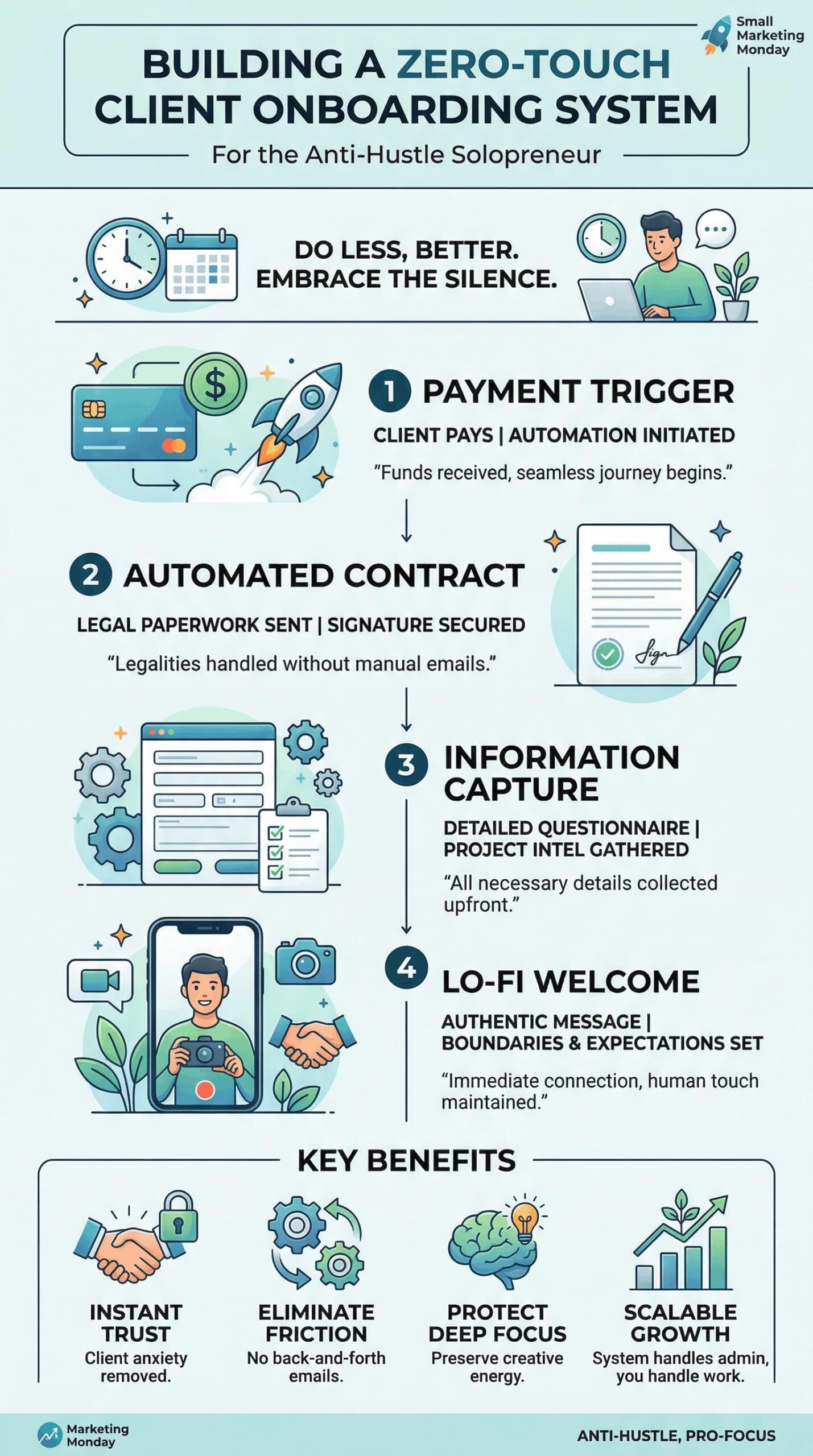
Building this system does not require a degree in computer science. It requires a clear map of your client’s journey. There are four non-negotiable pillars to a successful automated workflow. First, you need a single point of entry, typically your checkout page or a signed proposal. Second, you need a legal trigger. As soon as the payment is processed, your contract management tool should automatically fire off the necessary paperwork.
Third, you need the “Information Capture” phase. This is usually a detailed questionnaire that gathers everything you need to actually start the work. If you find yourself asking for logos or login credentials three weeks into a project, your system has failed. Finally, you need the “Welcome Guide.” This is a lo-fi, authentic PDF or hidden web page that sets boundaries, explains your communication style, and tells the client exactly when they will hear from you next. This document is the most important part of the anti-hustle framework because it manages expectations before they become problems.
How do you maintain a human touch through automation?
The biggest fear solopreneurs have about automation is that it will feel “cold” or “robotic.” In 2026, we are seeing a massive backlash against overly polished, AI-generated corporate speak. To keep your onboarding human, you must lean into lo-fi content. Instead of a generic “Success” page after a payment, embed a thirty-second video of yourself filmed on your phone. Mention how excited you are to start. Keep the lighting natural and the script unpolished.
According to a 2025 Customer Experience Report, 73 percent of consumers say that a “human-feeling” experience is the primary driver of brand loyalty, even when they know a system is automated. You can achieve this by using your natural voice in your automated emails. Use the same slang you use in person. Avoid “Dear Valued Customer” and use “Hey [First Name], I’m so glad you’re here.” The goal of a zero-touch system is not to remove the human but to remove the human’s “busy work” so the real connection can happen during the project.
Where do most solopreneurs fail in this process?
The most common failure point is over-complication. Solopreneurs frequently attempt to create a universal system that accommodates every conceivable edge case. This leads to broken links and a confusing experience for the client. Build your zero-touch system for the 80 percent of your clients who follow a standard path. For the 20 percent who need something custom, you can still handle those manually.
Another failure point is the “black hole” effect. This happens when a client completes all the automated steps but has no idea what happens next. Your final automated email must include a clear “What to Expect” timeline. If the project is scheduled to start in two weeks, please inform them of this timeline. If you want to really stand out, send them a “pre-work” assignment that keeps them engaged while they wait for your start date. This keeps the momentum alive without requiring you to check your email every hour.
The Assignment
This week, I want you to perform a “Friction Audit.” Draw a line down the middle of a piece of paper. On the left side, list every single step that happens from the moment a prospect says “yes” to the moment you start the work. On the right side, write down which tool could handle that step. If you don’t have a tool, look for an integration solution like Zapier to bridge the gap. Your goal is to automate just one of those steps by next Monday. Start with the contract or the questionnaire. Experience the joy of silence for yourself.
Building a zero-touch client onboarding system isn't about being a robot, it is about creating space for human work that actually matters. Automate the admin so you can elevate the craft. Share on X“Marketing Monday” articles archive.

Note: Some links on this page are affiliate links, meaning that if you click on my link and make a purchase, I will receive a small commission. It does not, however, affect the price you pay. Plus, it’s a great way to support me and the content I’m providing.