Last updated: April 4, 2026
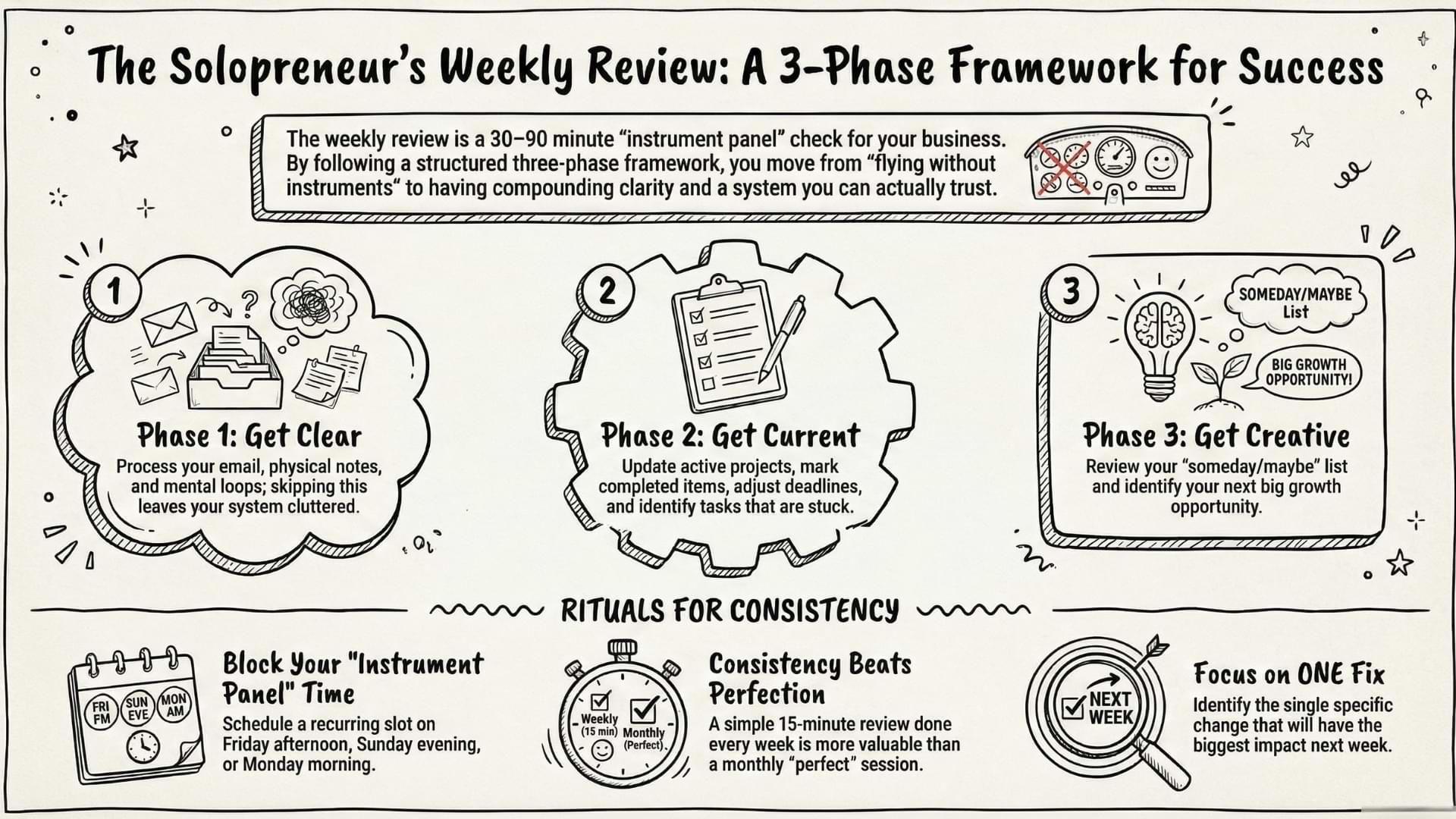
Quick Answer: A weekly review is a scheduled, structured session in which solopreneurs and small business owners look back on the past week, assess what worked, and decide what to change next. Done consistently, it shifts you from reacting to your business to actually running it. The whole process takes 30 to 90 minutes, and the payoff is compounding clarity over time.
Key Takeaways
- A weekly review is not the same as weekly planning. Planning is just one piece of it.
- The three core phases are: Get Clear (process your inboxes), Get Current (update your projects), and Get Creative (think ahead).
- Schedule it as a recurring calendar block, not a “when I have time” task.
- The best time is Friday afternoon, Sunday evening, or Monday morning, depending on your work style.
- Start with just 15 minutes if you’re new to the habit. Build from there.
- Track metrics that connect to real outcomes. Ignore vanity numbers that feel good but change nothing.
- The goal is one clear fix per week, not a total overhaul.
- Consistency beats perfection. A simple review done weekly beats a perfect review done once a month.
Why Most Solopreneurs Skip the Weekly Review (And Pay for It)
Most solopreneurs skip the weekly review because it feels like extra work on top of already-full days. But skipping it is exactly why the same problems keep showing up week after week.
Here’s a scenario that might sound familiar. You finish a busy week, feel like you worked hard, but can’t quite name what you actually moved forward. Monday rolls around, and you’re already behind. You’re not lazy. You’re just flying without instruments.
A weekly review gives you the instrument panel. It answers three questions every solopreneur needs answered regularly:
- What actually happened this week?
- What’s stalling, and why?
- What’s the one thing to fix next week?
Without this, you’re running on gut feel alone. And gut feel is fine until it isn’t.
“Your mind is for having ideas, not holding them.”
— David Allen
That quote from productivity expert David Allen is the whole argument for a weekly review system. Your brain is not a reliable filing cabinet. A structured review gets everything out of your head and into a system you can trust.
How to Set Up a Weekly Review That Actually Improves Results
Setting up a weekly review that actually improves results starts with three non-negotiable steps: block the time, pick a format, and commit to showing up. Everything else builds from there.
Step 1: Block the Time First
Pick one of these three windows and put it on your calendar as a recurring event:
| Time Slot | Best For |
|---|---|
| Friday Afternoon | Closing the week cleanly, no loose ends into the weekend |
| Sunday Evening | Reflecting and preparing before Monday hits |
| Monday Morning | Fresh-start thinkers who prefer forward momentum |
There’s no wrong answer here. The right time is the one you’ll actually keep.
When starting out, block 60-90 minutes. After a few months of consistent practice, most people can do it in 30 to 45 minutes.
Step 2: Use the Three-Phase Framework
This is the structure that makes a weekly review actually work, based on the GTD (Getting Things Done) methodology.
Phase 1: Get Clear. Process everything that landed in your world this week. That means:
- Clear your email inbox (or at least triage it)
- Process physical notes, receipts, and sticky notes
- Capture any ideas still floating in your head
Phase 2: Get Current. Update your active projects and task lists:
- Mark off what’s done
- Move deadlines that shifted
- Identify anything stuck or overdue
Phase 3: Get Creative. This is the part most people skip, and it’s where the real growth happens:
- Review your “someday/maybe” list
- Ask: What’s the next big opportunity worth exploring?
- Note any new ideas worth capturing
A common mistake is jumping straight to planning (Phase 3) without doing Phases 1 and 2. When you skip clearing and updating, your system feels untrustworthy, and you stop using it.

What to Track, What to Ignore, and What to Fix Next Week
During your weekly review, focus only on metrics and tasks that connect directly to outcomes. Ignore anything that looks impressive but doesn’t move the needle.
What to Track
Keep this list short. For most solopreneurs and small business owners, these are the numbers worth watching weekly:
- Revenue vs. goal (are you on pace?)
- Leads or inquiries (is your pipeline moving?)
- Content published (are you showing up consistently?)
- Client deliverables (what’s due, what’s done?)
- Top 3 wins from the week
If you’re building your brand through content, check out these 5 must-do solopreneur marketing tips to ensure your content efforts are headed in the right direction.
What to Ignore
These metrics feel productive to check but rarely change your decisions:
- Social media follower counts (week-to-week)
- Email open rates (unless you’re running a specific test)
- Website traffic (unless you’re actively running traffic campaigns)
- Competitor activity (a weekly rabbit hole that helps no one)
The rule is simple: if reviewing a number doesn’t change what you do next week, stop tracking it weekly.
What to Fix Next Week
Pick one thing. Not five. Not three. One.
Ask: “If I fixed just one thing next week, what would have the biggest impact?”
Write it down. Make it specific. “Improve my marketing” is not a fix. “Send follow-up emails to the three leads who went cold” is a fix.
If you’re struggling to identify what’s actually working in your marketing, a smart pricing review or a look at your content calendar might quickly surface the answer.
How Long Should a Weekly Review Actually Take?
A weekly review should take 30 to 90 minutes, depending on experience and how much has accumulated during the week.
New to the habit? Start with just 15 minutes. Focus only on inbox processing and a quick calendar scan. Add the project review and creative thinking phases once the habit is locked in.
Experienced practitioners typically finish in 30 to 45 minutes because their systems stay cleaner throughout the week.
Don’t let “I don’t have 90 minutes” be the reason you skip it. A 15-minute mini review beats zero every single time.
What Makes a Weekly Review Actually Stick?
A weekly review sticks when it becomes a ritual, not a chore. The difference usually lies in the environment and consistency.
A few things that help:
- Same time, same place, every week. Habit stacking works. Pair it with something you enjoy, like a good cup of coffee.
- Use a simple template. A blank page is intimidating. A checklist is not.
- Celebrate small daily wins. At the end of each review, write down three wins from the week, no matter how small. This builds momentum.
- Protect the time. Treat your weekly review like a client meeting you can’t cancel.
For mindset support on building consistent habits, the Mindset Mentor series on Napoleon Hill is worth a read. The principle that success is something you attract through who you become applies directly here.
If you’re working on your personal development journey alongside your business, using audiobooks to improve yourself is a practical way to stack learning into your week without adding extra screen time.
Common Mistakes That Kill the Weekly Review Habit
The biggest mistake is treating the weekly review as optional. The second biggest is making it too complicated to sustain.
Watch out for these:
- Skipping the “Get Clear” phase and jumping straight to planning. This leaves your system cluttered and untrustworthy.
- Tracking too many metrics. More data does not bring more clarity. Pick five numbers max.
- Making the fix list too long. One priority beats five half-finished ones every time.
- Doing it inconsistently. A review done every other week gives you half the benefit. Consistency is the whole game.
- Ignoring the creative phase. This is where your next big opportunity often lives. Don’t cut it to save time.
Conclusion: Your Roadmap to Results Starts With One Hour a Week
Here’s the truth: you don’t need a complex system to set up a weekly review that actually improves results. You need a consistent habit, a simple structure, and the discipline to show up for it every week.
Start small. Block 15 to 30 minutes this week. Process your inbox, check your calendar, and pick one thing to fix. That’s it. Do that four weeks in a row, and you’ll feel the shift.
Your actionable steps right now:
- Open your calendar and block a recurring weekly review slot (Friday, Sunday, or Monday).
- Create a simple three-section template: Get Clear / Get Current / Get Creative.
- Choose five metrics to track weekly. Delete the rest from your weekly checklist.
- At the end of your first review, write down one specific fix for next week.
- Show up again next week.
The solopreneurs and small business owners who finish strong aren’t the ones with the best tools or the biggest budgets. They’re the ones who take ownership of their time and consistently review their progress.
One hour a week. That’s your roadmap to results.
FAQ
What is a weekly review for solopreneurs? A weekly review is a scheduled session where you process everything from the past week, update your projects and tasks, and decide what to prioritize next. It’s a core habit for solopreneurs who want to stay intentional instead of reactive.
How long should a weekly review take? Start with 15 minutes if you’re new to the habit. Most experienced practitioners complete a full review in 30 to 45 minutes. When starting out, budget 60 to 90 minutes to get your systems clean and consistent.
What’s the best day and time for a weekly review? Friday afternoon, Sunday evening, and Monday morning are the three most popular options. The best choice is whichever time you’ll actually protect and keep consistently.
What’s the difference between a weekly review and weekly planning? Weekly planning is only one phase of a full review. A complete review also includes clearing your inboxes and updating your project lists. Skipping those steps makes your planning feel disconnected from reality.
What metrics should I track in my weekly review? Focus on revenue vs. goal, leads or inquiries, content published, client deliverables, and your top three wins. Avoid tracking social follower counts or website traffic week-to-week unless you’re running active tests.
What if I keep skipping my weekly review? Start with a 15-minute “mini review” focused only on inbox processing and a calendar check. Build the habit first, then add the full structure once it’s locked in.
Do I need special software for a weekly review? No. A notebook and a simple checklist work fine. The tool matters far less than the consistency of showing up.
How do I know if my weekly review is actually working? If you finish each week knowing exactly what you accomplished, what’s stalled, and what you’re fixing next, it’s working. If you still feel like the week “just happened to you,” the review needs more structure.
Can a weekly review help with business growth, not just task management? Yes. The “Get Creative” phase is specifically designed to surface new ideas, opportunities, and strategic thinking. It’s where the growth conversations happen, not just the cleanup.
What’s the single most important part of a weekly review? Consistency. A simple review done every week compounds into massive clarity over time. A perfect review done once a month gives you almost nothing compared to doing it more often.
References
- GTD Weekly Review – https://www.asianefficiency.com/productivity/gtd-weekly-review/
- Weekly Review Reports – https://reviewscout.ai/blog/weekly-review-reports
>>> Read more Weekend Workshop lessons here
Note: Some links on this page are affiliate links, meaning that if you click on my link and make a purchase, I will receive a small commission. It does not, however, affect the price you pay. Plus, it’s a great way to support me and the content I’m providing.