Turn one piece of content into a full week of posts by extracting different angles, formats, and lessons from your original work. Instead of repeating yourself, you reshape the core idea into platform-specific posts: a quote graphic for Instagram, a question for engagement, a tip for LinkedIn, a story for email, and more. This approach lets solopreneurs and small business owners maintain daily visibility without having to create from scratch every day.
You spent three hours writing that blog post. It’s good. Really good.
Then you hit publish, share it on social media once, and… crickets.
Meanwhile, you’re staring at tomorrow thinking, “What the heck am I going to post now?”
Here’s the truth: most solopreneurs and small business owners are sitting on a content goldmine and don’t even know it. You don’t need seven different ideas for seven different posts. You need one solid idea and a system to reshape it.
That’s what we’re covering today. No fluff. No complicated workflows. Just a straightforward roadmap to success that turns your best content into a full week of posts—without sounding like a broken record.
Key Takeaways
- One well-crafted piece of content can be transformed into seven unique posts without sounding repetitive
- Strategic repurposing saves time while maintaining consistent visibility across platforms
- The key is changing format, angle, and audience focus—not just reposting the same message
- Batching your content creation into focused work sessions maximizes productivity for busy solopreneurs
- A simple content calendar prevents overwhelm and keeps you showing up daily
Why Most People Struggle with Daily Content
Most entrepreneurs hit the same wall: they think showing up daily means creating something brand new every single day.
That’s exhausting. And it’s not sustainable.
The problem isn’t your creativity. It’s your strategy. You’re treating content as a one-and-done event rather than a reusable asset. When you shift your mindset from “I need to post today” to “I need to extract value from what I’ve already created,” everything changes.
Here’s what happens when you don’t repurpose:
- You burn out trying to stay consistent
- Your best ideas get buried after one post
- You waste time reinventing the wheel daily
- Your audience only sees a fraction of your expertise
Content repurposing isn’t about being lazy. It’s about being smart. It’s recognizing that your audience didn’t see your post the first time, won’t remember it the second time, and needs to hear your message in different formats before it clicks.
For more context on why this matters, check out our guide on content repurposing.
How to Turn One Piece of Content into a Full Week of Posts
The secret is changing the angle, format, and delivery—not the core message.
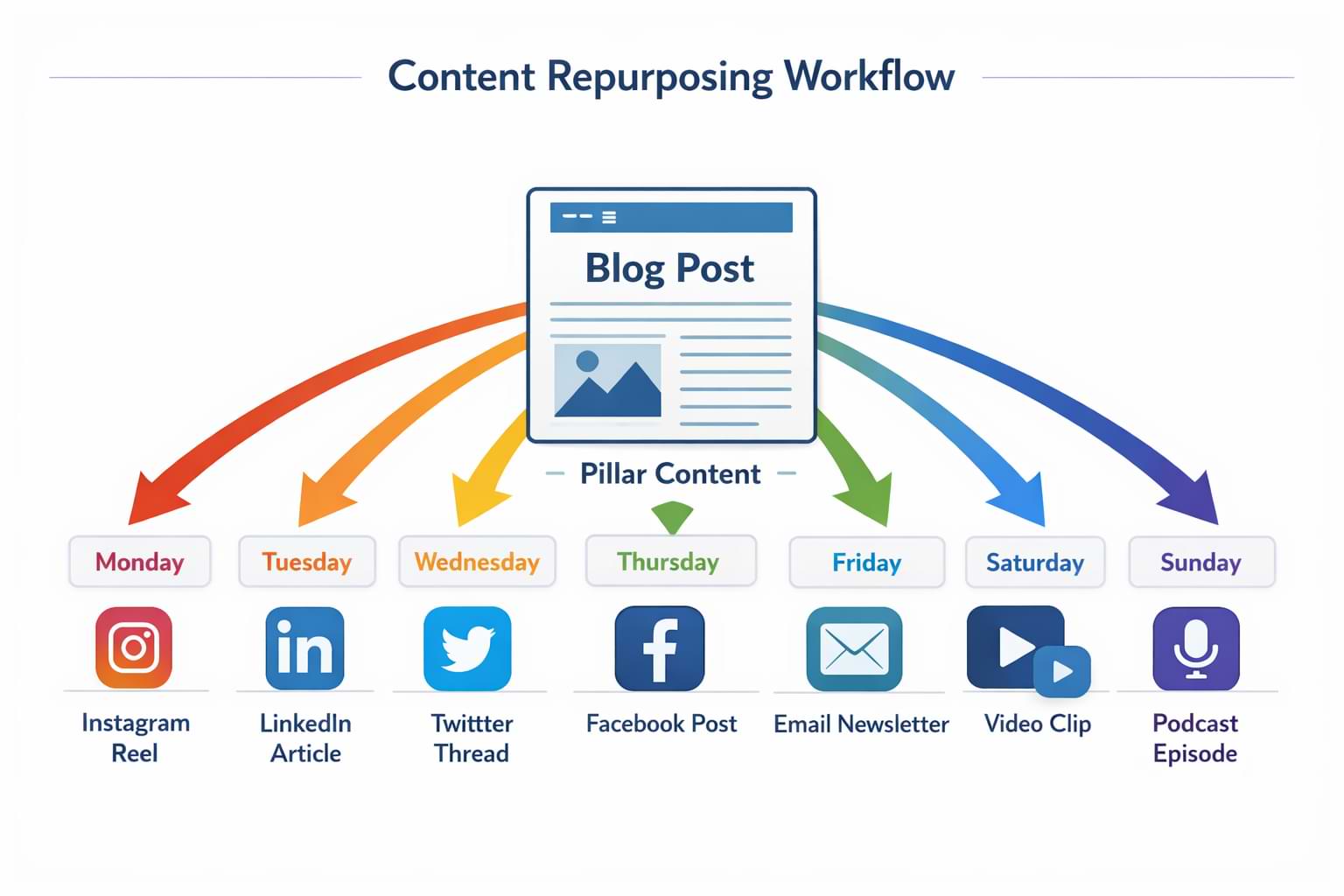
Start with one “pillar” piece of content. This could be a blog post, a podcast episode, a video, or even a detailed email you sent. That’s your foundation.
From there, you extract seven different expressions of the same idea:
Monday: Share the main lesson as a text post
Tuesday: Pull out a quote graphic
Wednesday: Ask a question related to the topic
Thursday: Share a personal story or example
Friday: Create a tip or action step
Saturday: Post a behind-the-scenes or process note
Sunday: Tie it to a bigger theme or mindset shift
Each post serves a different purpose. Each one reaches a different segment of your audience. And none of them feel repetitive because you’re approaching the idea from fresh angles.
This is your Marketing Monday through Sunday system in action—small daily wins that build momentum.
The One-to-Seven Content Framework
Let’s break this down step by step. This framework works whether you’re working with a 1,000-word blog post or a 10-minute video.
Step 1: Identify Your Core Message
What’s the one big idea? Strip away everything else and get clear on the transformation, lesson, or insight your content delivers.
Example: If your blog post is about overcoming fear of starting a business, your core message might be: “Action cures fear.”
Step 2: Extract Seven Content Angles
Here’s where the magic happens. You’re not reposting the same thing. You’re pulling out different facets.
| Day | Format | Angle |
|---|---|---|
| Monday | Text post | State the main problem and solution |
| Tuesday | Quote graphic | Pull the most powerful line |
| Wednesday | Question | Ask your audience to share their experience |
| Thursday | Story | Share a personal example or case study |
| Friday | Tip | Give one actionable step |
| Saturday | Behind-the-scenes | Show your process or research |
| Sunday | Mindset shift | Connect to a bigger life principle |
Step 3: Adapt for Platform
Instagram loves visuals. LinkedIn wants professional insights. Email subscribers prefer deeper dives. Tailor each post to its destination.
You’re not changing the message. You’re changing the wrapper.
Step 4: Schedule and Batch
Don’t create these posts one at a time throughout the week. That defeats the purpose.
Set aside 90 minutes. Create all seven posts in one sitting. Schedule them. Walk away.
This is what daily disciplines look like for high-performing solopreneurs—you batch the work, then let the system run.
To help you organize this process, our simple content calendar guide walks you through setting up a system that actually works.
Real Example: Blog Post to Seven Posts
Let’s say you wrote a blog post titled “3 Reasons Your Email List Isn’t Growing.”
Here’s how you turn that into seven posts:
Monday (Text Post): “Your email list isn’t growing because you’re not asking. Sounds simple, but most people bury their opt-in form or assume people will just sign up. They won’t. Make the ask clear, visible, and valuable.”
Tuesday (Quote Graphic): “If you’re not asking, you’re not growing.”
Wednesday (Question): “Quick question: Where do you currently promote your email list? Drop a comment—I’m curious what’s working for you.”
Thursday (Story): “I spent six months wondering why my list wasn’t growing. Turns out, I had the opt-in form at the bottom of my homepage. Nobody scrolled that far. I moved it to a popup and added 200 subscribers in 30 days. Small change, big result.”
Friday (Tip): “Tip: Add a lead magnet to your Instagram bio link. Give people a reason to subscribe beyond ‘join my newsletter.’ What problem can you solve in a one-page PDF?”
Saturday (Behind-the-Scenes): “I just audited my own website for email opt-ins. Found three broken links and one form that wasn’t even connected. If you haven’t checked yours in a while, do it today.”
Sunday (Mindset Shift): “Building your brand isn’t about perfection. It’s about showing up, testing, and fixing what’s broken. Your email list is the same. Progress over perfection.”
See how each post feels different? You’re not repeating yourself. You’re exploring the same idea from seven angles.

Common Mistakes When Repurposing Content
Even with a solid system, people mess this up. Here’s what to avoid:
Mistake #1: Copy-Pasting the Same Post. Repurposing isn’t reposting. Change the format, the hook, the angle. If it looks identical, your audience will tune out.
Mistake #2: Ignoring Platform Norms. What works on LinkedIn won’t work on Instagram. A 300-word post might kill on LinkedIn. On Instagram, you need a hook in the first line and a visual that stops the scroll.
Mistake #3: Forgetting the Call to Action. Every post should guide your audience somewhere. Read the full post. Comment below. Download the guide. Don’t leave them hanging.
Mistake #4: Overcomplicating the Process. You don’t need fancy tools. A Google Doc, a simple content calendar, and your phone’s camera are enough. Don’t let tool paralysis stop you from taking action.
Mistake #5: Not Testing What Works. Track which angles get the most engagement. Double down on what resonates. If your audience loves story posts, give them more stories.
How to Batch Content Like a Pro
Batching is the difference between scrambling daily and having a week of content ready to go.
Here’s the process:
Block 90 Minutes on Your Calendar. This is your content creation window. No distractions. No multitasking.
Choose Your Pillar Content. Pick one blog post, video, or podcast episode. Open it up.
Write All Seven Posts in One Session. Use the framework above. Don’t edit as you go. Just get the ideas down.
Schedule Everything. Use your platform’s native scheduler or a tool like Buffer. Load up the week. Done.
Walk Away. You’ve just bought yourself seven days of showing up without the daily grind.
This is how you design your life instead of letting content creation control your calendar.
Platform-Specific Tips for Repurposing
Different platforms need different approaches. Here’s how to adapt your content:
- Lead with a strong visual
- Hook them in the first line
- Use line breaks for readability
- End with a clear call to action
- Stories and Reels are great for quick tips and behind-the-scenes
- Professional tone, but still conversational
- Longer posts perform well
- Share insights, lessons, and case studies
- Tag relevant people or companies when appropriate
- Mix of personal and professional
- Questions and polls drive engagement
- Video content gets prioritized
- Community-building posts work well
- This is where you go deeper
- Share the full story or lesson
- More personal, more vulnerable
- Always include a next step or resource
Twitter/X
- Short and punchy
- Thread longer ideas
- Use visuals to stand out
- Engage in replies
You’re not creating different content for each platform. You’re reshaping the same core idea to fit each space.
The Psychology Behind Why This Works
People need to hear your message multiple times before it sticks.
Marketing research shows it takes 7-12 touchpoints before someone takes action. One post isn’t enough. One blog shared once won’t move the needle.
But here’s the thing: your audience isn’t seeing everything you post. The algorithms don’t show your content to everyone. People scroll fast. They’re distracted.
When you show up daily with different angles on the same topic, you’re increasing the chances that your message lands. You’re meeting people where they are—some prefer stories, some want quick tips, some need data.
This is where strategy meets psychology. You’re not being annoying. You’re being helpful in multiple formats.
Building Your Weekly Content System
Let’s put this all together into a repeatable system.
Step 1: Create One Pillar Piece Weekly. This is your main content. Blog post, video, podcast—whatever format you prefer. Aim for something with depth.
Step 2: Extract Seven Angles. Use the framework we covered. Write them all in one session.
Step 3: Schedule the Week. Load everything into your scheduler on Sunday or Monday morning.
Step 4: Engage Daily. Showing up isn’t just posting. Reply to comments. Join conversations. Build relationships.
Step 5: Review and Adjust. At the end of the week, look at what worked. What got engagement? What fell flat? Adjust next week.
This system gives you structure without rigidity. You’re not locked in. You’re building a rhythm that works for your business and your life.
For a deeper dive into organizing your content workflow, explore our content calendar strategies.
Tools to Make Repurposing Easier
You don’t need many tools, but a few can save you time.
Content Creation:
- Google Docs for writing and organizing
- Canva for graphics and quote images
- Your phone for video and photos
Scheduling:
- Buffer or Hootsuite for social posts
- Later for Instagram-specific scheduling
- Native schedulers on LinkedIn and Facebook
Organization:
- Notion or Trello for content calendars
- Google Sheets for simple tracking
- Evernote for idea capture
Repurposing:
- Descript for turning video into text
- Otter.ai for transcribing audio
- Headliner for creating audiograms
Pick one or two that fit your workflow. Don’t overcomplicate it.
If you’re looking for more high-performing tools, check out our proven resources that successful entrepreneurs actually use.
When Repurposing Doesn’t Work
Let’s be real. This strategy isn’t perfect for everything.
Time-Sensitive Content: If you’re posting about a current event or trending topic, you can’t stretch it over seven days. It’ll be stale by Wednesday.
Highly Specific Tutorials: Step-by-step technical content doesn’t always break down well. Sometimes the full tutorial is the only way to deliver value.
Personal Updates: If you’re sharing a major life event or announcement, repurposing it feels weird. Some moments deserve their own post.
When Your Audience Is Small: If you have 50 followers, they’re probably seeing everything you post. Repurposing the same idea might feel repetitive to them. In that case, focus on creating more pillar content to grow your reach first.
The key is knowing when to use this system and when to pivot.
Frequently Asked Questions
How do I avoid sounding repetitive when repurposing content? Change the format, angle, and hook for each post. A quote graphic doesn’t feel like a question post, which doesn’t feel like a story. If you’re approaching the idea from different perspectives, your audience won’t notice you’re covering the same topic.
Can I repurpose the same content on different platforms? Absolutely. Your LinkedIn audience isn’t the same as your Instagram audience. Even if they follow you on both, they’re consuming content differently on each platform. Adapt the format and tone for each space.
How long should I wait before repurposing old content? You can start repurposing immediately using the one-to-seven framework. For re-sharing older pillar content, wait at least 30-60 days. Your audience won’t remember what you posted last month.
What if I don’t have a blog or podcast to repurpose? Start with a long-form social post, a detailed email, or even a conversation you had with a client. Any idea with depth can be broken into smaller pieces. You don’t need a formal content platform to use this strategy.
How many times can I repurpose the same piece of content? There’s no hard limit. If the content is evergreen and valuable, you can repurpose it multiple times throughout the year. Just change the angle and format each time to keep it fresh.
Do I need special tools to repurpose content? No. You can do this with Google Docs, your phone’s camera, and free scheduling tools. Fancy software helps, but it’s not required. Focus on the strategy first, tools second.
What’s the best day to batch my weekly content? Sunday or Monday works well for most people. Pick a day when you have 90 minutes of uninterrupted time. Consistency matters more than the specific day.
Should I repurpose content that didn’t perform well the first time? Sometimes yes. Poor performance might mean bad timing, a weak headline, or the wrong platform—not a bad idea. Try a different angle or format before giving up.
How do I track which repurposed posts perform best? Keep a simple spreadsheet. Track the post type (quote, story, tip), platform, engagement, and any notes. After a month, patterns will emerge showing what resonates with your audience.
Can I repurpose other people’s content? Only with proper attribution and added value. Don’t just reshare someone else’s post. Add your perspective, your story, or your takeaway. Make it yours while crediting the original source.
What if I run out of content to repurpose? Create one new pillar piece per week. That gives you 52 pieces of repurposable content per year. If you’re extracting seven posts from each, that’s 364 posts. You won’t run out.
Is it better to repurpose or create new content? Both. Use repurposing to maintain consistency and maximize existing content. Create new pillar content weekly to keep your ideas fresh and your expertise growing. Balance is key.
Key Takeaways
- One strong piece of content can fuel an entire week of posts when you extract different angles and formats
- Repurposing saves time, reduces burnout, and increases the chances your message actually reaches your audience
- The one-to-seven framework gives you a simple structure: problem/solution, quote, question, story, tip, behind-the-scenes, and mindset shift
- Batching your content creation into focused 90-minute sessions prevents daily scrambling and builds sustainable momentum
- Platform-specific adaptation is crucial—what works on LinkedIn won’t work on Instagram without adjustments
- Avoid common mistakes like copy-pasting identical posts or ignoring platform norms
- Track what performs well and double down on those formats and angles
- You don’t need expensive tools—start with Google Docs, Canva, and native platform schedulers
- This strategy works best for evergreen content; time-sensitive topics need different approaches
- Consistency beats perfection—showing up daily with repurposed content builds trust and visibility over time
Final Thought
You don’t need seven brilliant ideas to show up seven days a week.
You need one solid idea and a system to reshape it.
Turn one piece of content into a full week of posts by changing the angle, format, and delivery. Extract quotes. Ask questions. Share stories. Give tips. Show your process. Connect to bigger themes.
This isn’t about cutting corners. It’s about working smarter. It’s about recognizing that your best content deserves more than one moment in the spotlight.
Your audience needs to hear your message multiple times, in multiple formats, before it clicks. When you repurpose strategically, you’re not being repetitive—you’re being thorough.
Here’s your next step: Pick one piece of content you’ve already created. Open it up. Pull out seven different angles using the framework in this article. Schedule them for next week.
That’s it. You just bought yourself seven days of consistent visibility without starting from scratch.
This is how solopreneurs and small business owners build momentum. Small daily wins. Proven resources. Actionable steps.
Now go turn that one piece of content into a full week of posts. Your future self will thank you.
For more strategies on building your content system, explore our guide on the most effective places to create content.
Learn how to turn one piece of content into a full week of posts. Simple repurposing strategies for solopreneurs to stay consistent without burnout. Share on X>>> Read more Weekend Workshop lessons here
Note: Some links on this page are affiliate links meaning that if you click on my link and make a purchase, I will receive a small commission. It does not however affect the price you pay. Plus, it’s a great way to support me and the content I’m providing.