How to Build a 90-Day Plan That Keeps You Focused and Moving Forward
Quick Answer: To map a simple 90-day plan using one goal only, pick the single most important outcome you want to achieve in the next 90 days, break it into three monthly phases, assign 3–5 weekly tasks, and review your progress weekly. One focused goal will move you further than ten scattered ones because your energy and attention stay concentrated on what actually matters.
Key Takeaways
- Choosing a single goal for 90 days is not a limitation — it’s a strategy that delivers faster, more measurable results.
- The 90-day window is long enough to build real momentum but short enough to stay motivated and accountable. [9]
- Break your single goal into three 30-day phases: build, grow, and finish strong.
- Assign only 3–5 specific weekly tasks that directly push you toward your quarterly goal. [4]
- Weekly check-ins (even 15 minutes) are what separate people who finish from people who drift.
- Solopreneurs and small business owners who try to pursue multiple goals at once often end up completing none.
- Focus is a skill. The more you practice single-goal planning, the faster you’ll move.

Why Most Solopreneurs Stay Stuck (And What to Do Instead)
Most solopreneurs don’t fail because they lack ideas. They fail because they have too many. Ten goals on a whiteboard feels productive. It isn’t.
Here’s what actually happens: you split your time across five projects, make 20% progress on each, and hit the 90-day mark feeling exhausted and behind. Sound familiar?
The fix is almost embarrassingly simple — pick one goal and protect it like it’s the only thing that matters. Because for the next 90 days, it is.
This is the entire premise behind learning to map a simple 90-day plan with only one goal. Focus beats hustle every single time. Hustle is doing more. Focus is doing the right thing more.
What Makes a 90-Day Plan Different From a To-Do List?
A to-do list captures tasks. A 90-day plan captures direction.
The difference matters because solopreneurs and small business owners often confuse being busy with making progress. A 90-day plan forces you to answer one question before you write a single task: What does winning look like in 90 days?
That question changes everything. It filters out the noise and keeps your daily disciplines pointed at a real outcome.
A well-built 90-day plan includes:
- One primary goal (not a theme — a specific, measurable outcome)
- Three monthly milestones that mark progress toward that goal
- Weekly tasks (3–5 per week) that are concrete and completable
- A weekly review habit to course-correct before you drift too far
A to-do list has none of that structure. That’s why most to-do lists grow forever and never actually shrink.
How to Choose the One Goal That’s Worth 90 Days of Your Life
This is where most people get stuck before they even start. They can’t pick one because everything feels equally important.
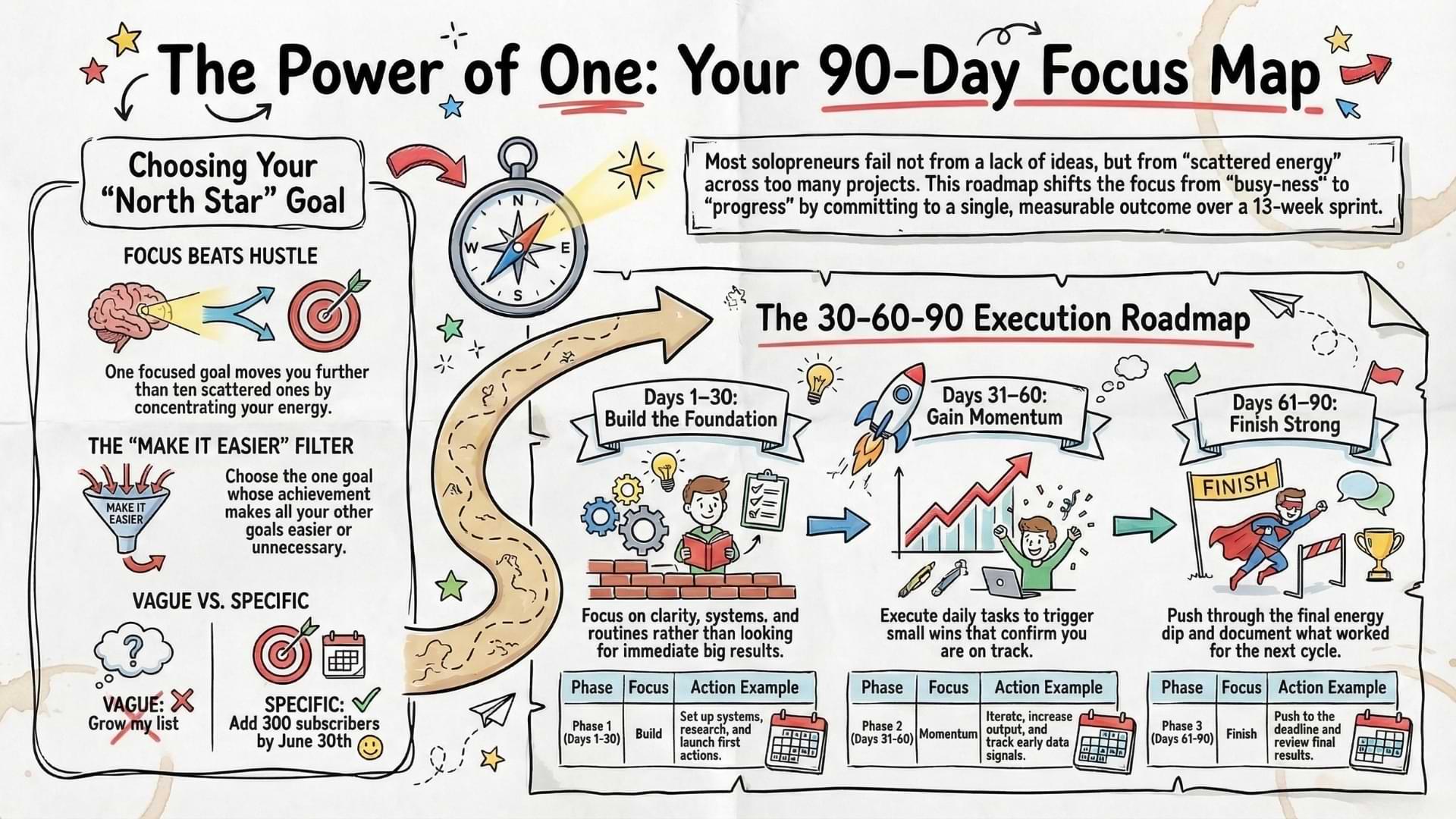
Here’s a simple decision rule: Choose the goal whose achievement would make the other goals easier or unnecessary.
Ask yourself:
- If I could only accomplish one thing in the next 90 days, what would have the biggest impact on my business or income?
- What’s the goal I keep pushing to “next quarter” because it feels too big?
- What would I regret most if I still hadn’t done it by the end of June?
That last question tends to cut through the noise fast.
Once you have your answer, make it specific. “Grow my email list” is not a goal. “Add 300 new subscribers to my email list by June 30, 2026” is a goal. The SMART framework (Specific, Measurable, Achievable, Relevant, Time-framed) works well here — not because it’s fancy, but because vague goals produce vague results.
How to Map a Simple 90-Day Plan Using One Goal Only: The 30-60-90 Breakdown
Once you have your one goal, the next step is to stop staring at the full 90 days and start building in phases. Trying to tackle everything at once is exactly what causes people to quit in weeks two and three.
Here’s the structure that works:
| Phase | Days | Focus | Example Milestone |
|---|---|---|---|
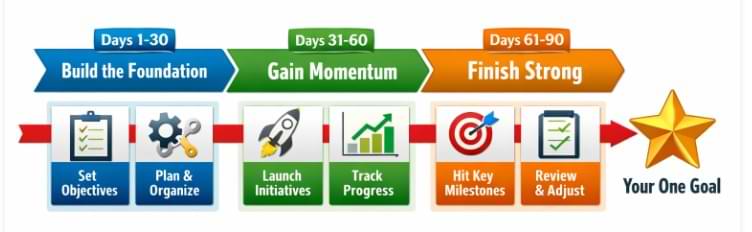
| Phase 1 | 1–30 | Build the foundation | Set up systems, do research, launch first action |
| Phase 2 | 31–60 | Gain momentum | Iterate, increase output, track early data |
| Phase 3 | 61–90 | Finish strong | Push hard, review results, prepare next cycle |
Phase 1 (Days 1–30): Build. This is your setup phase. Don’t expect big results here. Expect clarity. You’re building the habits, tools, and routines that will carry you through the next 60 days. If your goal is to grow your email list, Phase 1 might be setting up your opt-in page and writing your first five emails.
Phase 2 (Days 31–60): Momentum. Now you execute. You’ve got the foundation. This is where the work compounds. You should start seeing early signals — small wins that confirm you’re on the right track. Small daily wins matter more here than any single big push.
Phase 3 (Days 61–90): Finish Strong. This is the phase most people underestimate. Energy tends to dip right before the finish line. Knowing that in advance helps you push through it. This is also when you start documenting what worked, so your next 90-day cycle starts smarter.
For more on building content and communication systems that support this kind of plan, building a simple content calendar that works is a solid next read.
What Weekly Tasks Should Actually Look Like
Weekly tasks are where the plan meets reality. Most people write tasks that are too vague to act on.
Vague: “Work on my website.” Specific: “Write and publish the About page by Thursday.”
For each week, write 3–5 tasks that are directly connected to your 90-day goal. Not tangentially related. Directly connected. If a task doesn’t move you closer to your one goal, it doesn’t belong on this week’s list.
A good weekly task is:
- Completable in one sitting (under 2 hours)
- Clearly defined (you know exactly when it’s done)
- Tied to a milestone in your 30-60-90 breakdown
One common mistake: filling the weekly list with “maintenance” tasks (answering emails, posting to social media) and calling it goal work. Maintenance keeps the lights on. It doesn’t build the future.
If you want a system for using your time more intentionally, this piece on using time wisely in sales prospecting offers practical insights that apply well beyond sales.
How to Stay on Track Without Burning Out
Accountability is the part most planning guides skip. You can have the perfect 90-day plan and still drift by week four if you don’t build in check-ins.
Keep it simple:
- Weekly review (15 minutes): Did you complete your tasks? What got in the way? What do you carry forward?
- Monthly check-in (30 minutes): Are you on track for your milestone? Do you need to adjust your Phase 2 or 3 plan?
- One accountability partner or coach: Even a single person who asks “how’s it going?” once a week changes your follow-through rate significantly.
The review isn’t about judging yourself. It’s about staying honest. If you missed three tasks in a row, that’s data. Maybe the tasks were too big. Maybe your goal needs to be adjusted. That’s not failure — that’s the plan working as designed.
When you need a reset mid-quarter, this Tips Tuesday: Reset and Refocus post is exactly the kind of practical wisdom that helps you get back on track without drama.
Is a 90-Day Plan Right for Every Solopreneur?
A 90-day plan works best for solopreneurs and small business owners who have at least one clear goal they want to pursue — and who are willing to say no to everything else for 90 days.
It’s a great fit if:
- You tend to start strong and fade by week six
- You have too many ideas and struggle to prioritize
- You want a roadmap to success that’s simple enough to actually follow
It may not be the right tool if:
- Your business is in crisis mode and needs daily triage (in that case, a 30-day survival plan comes first)
- You genuinely don’t know what your goal should be yet (spend a week on that before building the plan)
- You’re in a highly unpredictable industry where 90-day commitments are unrealistic
For most solopreneurs reading this in 2026, the 90-day framework is the right size. It’s short enough to stay urgent, long enough to see real results.
Conclusion: One Goal, 90 Days, Real Results
Here’s the truth: you don’t need more strategies. You need more focus.
Learning to map a simple 90-day plan with a single goal is one of the most practical things a solopreneur or small business owner can do right now. It cuts through the noise, gives your daily disciplines a clear direction, and makes it possible to actually finish something meaningful.
Your action steps starting today:
- Write down your one goal for the next 90 days. Make it specific and measurable.
- Break it into three 30-day milestones using the phase structure above.
- Write your first week’s 3–5 tasks before you go to bed tonight.
- Schedule a 15-minute weekly review every Sunday or Monday morning.
- Tell one person about your goal, so you have some skin in the game.
That’s it. No complicated system. No expensive software. Just one goal, a clear roadmap, and the discipline to show up every week.
Focus beats hustle. Always has. Start the clock.
Frequently Asked Questions
Q: Can I have two goals in a 90-day plan?
A: You can, but it’s not recommended for most solopreneurs. Two goals split your attention and slow progress on both. If you must have two, designate one as primary and one as secondary — and only work on the secondary goal after your primary goal tasks are done for the week.
Q: How do I pick between two goals that both feel equally important?
A: Ask which goal, if achieved, would make the other goal easier or less necessary. That’s your primary goal. The other one waits for the next 90-day cycle.
Q: What if I fall behind in the first 30 days?
A: Adjust your milestones, not your goal. Falling behind in Phase 1 is common. Reduce the scope of what “done” looks like for the month, but keep the 90-day goal intact.
Q: How specific does my goal need to be?
A: Specific enough that you can answer “did I achieve it?” with a clear yes or no on day 90. Vague goals produce vague results.
Q: Should I share my 90-day goal publicly?
A: Sharing with one or two trusted people tends to increase accountability without the pressure of public commitment. Full public announcements can sometimes backfire if the goal changes.
Q: How many weekly tasks are too many?
A: More than five specific, goal-related tasks per week is usually too many for a solopreneur managing a business alone. Three focused tasks were completed fully, beating seven tasks done halfway.
Q: What happens after 90 days?
A: Review what worked, document your results, and start a new 90-day cycle with either the same goal (if unfinished) or a new one. The system compounds over time.
Q: Is this the same as an OKR (Objectives and Key Results) system?
A: It’s similar in spirit but simpler. OKRs are typically used in team settings with multiple layers of tracking. This single-goal 90-day approach is designed specifically for solopreneurs who need something they’ll actually use.
References
- 90 Day Plan – https://taliakoren.com/2017/03/19/90-day-plan/
- How To Create A 90 Day Plan – https://oneuponedown.org/blog-post/how-to-create-a-90-day-plan/
- Big Goals Actionable Plans – https://hollybray.com/big-goals-actionable-plans/
- Why Successful People Plan Their Lives 90 Days At A Time – https://www.asianefficiency.com/productivity/why-successful-people-plan-their-lives-90-days-at-a-time/
>>> Read more Weekend Workshop lessons here
Note: Some links on this page are affiliate links, meaning that if you click on my link and make a purchase, I will receive a small commission. It does not, however, affect the price you pay. Plus, it’s a great way to support me and the content I’m providing.