Picture this: It’s Sunday evening, and while everyone else is dreading Monday, you’re relaxed because your entire week’s content is already done. No scrambling for post ideas at 11 PM. No guilt about inconsistent posting. No stress about what to share tomorrow.
Sound impossible? It’s not.
When you build a weekly content system that takes just 60 minutes, you transform from a perpetually overwhelmed solopreneur into a content-creating machine who actually has time to run their business.
The truth is, most small business owners spend 10-15 hours weekly on content creation—writing posts, designing graphics, scheduling updates—and still feel like they’re falling behind. But what if the problem isn’t your work ethic? What if it’s simply that you haven’t built a system yet?
In 2026, successful solopreneurs aren’t working harder on content—they’re working smarter. They’ve discovered that consistency beats perfection, and systems beat hustle every single time.
Key Takeaways
- Batching is your superpower: Creating all content in one focused session saves 40-60% of your time compared to daily posting
- Templates eliminate decision fatigue: Pre-designed frameworks mean you never start from a blank page again
- The 60-minute system is repeatable: Once established, your weekly content routine becomes automatic and stress-free
- Repurposing multiplies your output: One core piece of content can become 10+ posts across different platforms
- Consistency compounds results: Regular posting builds audience trust and algorithmic favor faster than sporadic “perfect” content

Why Most Content Strategies Fail for Solopreneurs
Sarah runs a virtual assistant business. Every Monday morning, she’d open her laptop with good intentions: “Today I’ll create content.” By noon, she’d written half a blog post, abandoned three social media captions, and felt completely drained. Sound familiar?
The problem wasn’t Sarah’s creativity or commitment. She simply didn’t have a system.
Here’s what typically goes wrong:
- Decision fatigue kills momentum: Choosing what to post, which platform to use, and what format to create drains mental energy before you even start
- Perfectionism creates paralysis: Without deadlines or frameworks, solopreneurs endlessly tweak content that’s already good enough
- Platform-hopping wastes time: Logging into Instagram, then LinkedIn, then Facebook throughout the day fragments focus
- Inspiration-dependent creation is unreliable: Waiting to “feel creative” means content only happens when the muse strikes
According to productivity research, task-switching can reduce efficiency by up to 40%. Every time you shift from writing to designing to scheduling, your brain needs recovery time. That’s why the scattered approach feels so exhausting.
When you create killer content fast, you’re not just saving time—you’re preserving the mental energy needed to actually grow your business.
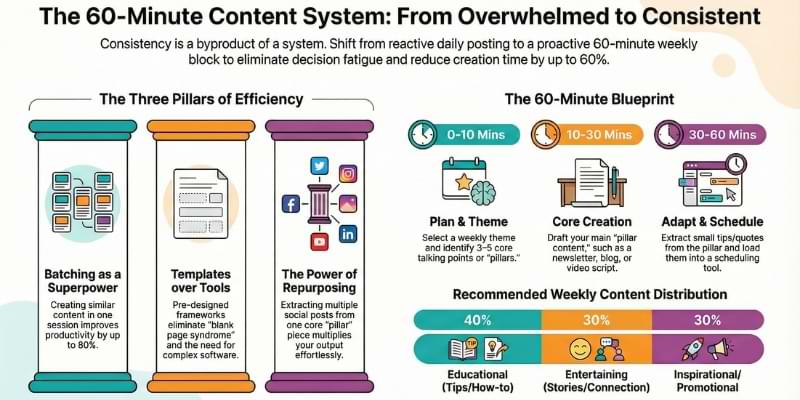
The 60-Minute Weekly Content System Framework
Let’s build a weekly content system that actually works. This isn’t theory—it’s a proven framework used by thousands of solopreneurs who’ve reclaimed their time without sacrificing their online presence.
The Three Pillars of Efficient Content Creation
Pillar 1: Batching
Batching means creating similar content in dedicated blocks. Instead of writing one post daily, you write seven posts in one sitting. Your brain stays in “writing mode” without constant context-switching.
Research shows that batching can improve productivity by 50-80% because you eliminate setup time and maintain creative flow. When you’re in the zone, you stay in the zone.
Pillar 2: Templates
Templates are pre-designed frameworks that remove the blank-page problem. They’re not about being formulaic—they’re about having a starting point that you customize.
Think of templates like cooking with a recipe versus improvising. Both can create great meals, but one is consistently faster and more reliable.
Pillar 3: Repurposing
One piece of content can become ten. A blog post becomes five social media posts, three email newsletter segments, and two video scripts. You’re not creating more—you’re extracting more value from what you’ve already created.
Smart entrepreneurs understand that content repurposing isn’t lazy—it’s strategic.
Your 60-Minute Blueprint (Step-by-Step)
Here’s exactly how to build a weekly content system that fits into one focused hour:
Minutes 0-10: Content Planning & Theme Selection
Start with your simple content calendar open. Choose your weekly theme based on:
- Customer questions you received this week
- Seasonal topics relevant to your industry
- Evergreen content that always performs well
- Product or service launches coming up
Write down 3-5 main talking points about this theme. Don’t overthink it—bullet points are fine.
Minutes 10-30: Core Content Creation
Create your “pillar content”—the main piece everything else stems from. This could be:
- A 500-word blog post
- A detailed LinkedIn article
- A script for a short video
- An email newsletter
Focus on value, not perfection. Your audience wants helpful information, not literary masterpieces. Write conversationally, like you’re explaining something to a friend over coffee.
Minutes 30-45: Content Adaptation & Repurposing
Now extract smaller pieces from your pillar content:
- Pull 3-5 quotable sentences for social media posts
- Identify 2-3 key statistics or facts for standalone posts
- Create a question post based on your main topic
- Draft a “tip” or “how-to” post from one section
Use a simple spreadsheet or document to track these variations. Copy and paste is your friend here—you’re not rewriting, you’re reformatting.
Minutes 45-55: Scheduling & Automation
Load everything into your scheduling tool. Most platforms (Buffer, Hootsuite, Later, Meta Business Suite) let you upload a week’s content in minutes.
Schedule posts for optimal times based on your audience:
- LinkedIn: Tuesday-Thursday, 8-10 AM
- Instagram: Weekdays, 11 AM-1 PM
- Facebook: Wednesday-Friday, 1-3 PM
- Twitter/X: Weekdays, 9 AM-12 PM
Minutes 55-60: Review & Adjust
Quick quality check:
- ✅ All posts have clear calls-to-action
- ✅ Images or graphics are attached
- ✅ Links are working and trackable
- ✅ Hashtags are relevant and not excessive
- ✅ Posting times are optimized
Done. Your entire week’s content is scheduled, and you still have 50+ hours to actually run your business.
Building Your Content Template Library
Templates are the secret weapon of efficient content creators. Here’s how to build yours:
Essential Template Types
1. The Value Post Template
Format:
- Hook (problem statement)
- 3-5 actionable tips
- Call-to-action
Example: “Struggling with email open rates? Try these 5 subject line formulas that consistently get 40%+ opens: [tips]. Which one will you test first?”
2. The Story Post Template
Format:
- Personal anecdote (2-3 sentences)
- Lesson learned
- How it applies to your audience
- Question to engage
Example: “Last year I wasted $3,000 on ads that didn’t convert. The problem? I skipped audience research. Now I spend 2 hours researching before every campaign, and my ROI has tripled. What’s your biggest marketing lesson?”
3. The Question Post Template
Format:
- Relevant question
- Context (why you’re asking)
- Invitation to share
Example: “What’s your biggest challenge with consistent content creation? I’m planning new resources and want to create something actually helpful. Drop your answer below 👇”
4. The Curated Tips Template
Format:
- Number-based headline
- Brief intro
- Bulleted tips (3-7 items)
- Engagement question
5. The Behind-the-Scenes Template
Format:
- What you’re working on
- Why it matters
- Sneak peek or insight
- Invitation to follow along
Creating these templates once means you never start from scratch again. Store them in a Google Doc, Notion page, or content management tool where you can easily copy-paste and customize.
When you’re building a simple content calendar that works, templates become the building blocks that make consistency effortless.
Advanced Strategies: Maximizing Your 60 Minutes
Once you’ve mastered the basics, these advanced tactics will help you build a weekly content system that delivers even better results:
The Content Matrix Approach
Create a simple 2×2 matrix for content planning:
| Educational | Entertaining |
|---|---|
| How-to guides, tutorials, tips | Stories, humor, relatable moments |
| Inspirational | Promotional |
| Success stories, motivational posts | Product features, offers, testimonials |
Aim for this weekly distribution:
- 40% Educational
- 30% Entertaining
- 20% Inspirational
- 10% Promotional
This balance keeps your audience engaged without constantly feeling sold to.
The Evergreen Content Bank
Dedicate one 60-minute session monthly to creating “evergreen” content—posts that remain relevant year-round. Build a bank of 20-30 evergreen posts you can recycle every 3-4 months.
Topics that work well as evergreen content:
- Industry fundamentals and basics
- Common mistakes and how to avoid them
- Tool recommendations and resources
- Mindset and motivation posts
- FAQ answers
The Engagement Multiplier Technique
Don’t just schedule and forget. Build 10 minutes of engagement time into your daily routine:
- Respond to comments on your posts
- Engage with 5-10 posts from your target audience
- Answer DMs and messages
This isn’t content creation time—it’s relationship-building time. But it dramatically increases the reach and impact of the content you’ve already created.
Leveraging AI Tools (The 2026 Advantage)
In 2026, AI has become an invaluable assistant for content creators. Here’s how to use it ethically and effectively:
For ideation: Ask AI for content angles, headline variations, or hook ideas based on your topic. For first drafts: Generate outline structures or rough drafts that you then personalize. For repurposing: Convert long-form content into multiple short-form variations. For optimization: Get suggestions for improving clarity, readability, or SEO
⚠️ Important: Always add your unique voice, experiences, and expertise. AI is a tool, not a replacement for an authentic human connection.
Understanding AI marketing strategy helps you leverage these tools without losing the personal touch that makes your content valuable.
Common Pitfalls and How to Avoid Them
Even with a solid system, solopreneurs often stumble. Here’s how to sidestep the most common traps:
Pitfall #1: Perfectionism Paralysis
The problem: Spending 45 of your 60 minutes perfecting one post instead of creating a week’s worth of content.
The solution: Set a timer for each phase. When time’s up, move on. Remember: published and imperfect beats perfect and invisible. Your audience wants consistency more than perfection.
Pitfall #2: Platform Overload
The problem: Maintaining a presence on every social platform while burning out.
The solution: Choose 2-3 platforms where your ideal customers actually spend time. Master those before expanding. It’s better to be excellent on two platforms than mediocre on six.
Pitfall #3: Ignoring Analytics
The problem: Creating content blindly without knowing what resonates with your audience.
The solution: Spend 5 minutes weekly reviewing your top-performing posts. What do they have in common? Double down on what works. Let data guide your content strategy, not just intuition.
Pitfall #4: Forgetting the Call-to-Action
The problem: Creating valuable content that doesn’t drive business results.
The solution: Every piece of content should have a purpose. What do you want readers to do? Visit your website? Book a call? Download a resource? Make it clear and easy.
Pitfall #5: Content Creation Without Distribution
The problem: Building great content that nobody sees because you’re not promoting it.
The solution: Build distribution into your system. Share new content in relevant groups, email it to your list, and mention it in conversations. Creation is half the battle—distribution is the other half.
Real-World Success Stories
Marcus, Fitness Coach: Before implementing a 60-minute content system, Marcus posted sporadically—maybe 2-3 times weekly when he “had time.” After building his system, he grew his follower count from 800 to 12,000 in eight months, with consistent weekly posting on Instagram and LinkedIn. His secret? Sunday mornings became his content hour, and he never missed a week.
Jennifer, Business Consultant: Jennifer was spending 12+ hours per week on content and felt exhausted. She built a weekly content system using the framework above and cut her time to 60-90 minutes. The surprising result? Her engagement actually increased by 40% because consistency mattered more than elaborate posts. She now uses those saved 10+ hours for client work, adding $4,000+ to her monthly revenue.
David, E-commerce Store Owner: David struggled with content because he “wasn’t a writer.” He built a template library of 15 proven post formats and now rotates through them weekly. His 60-minute sessions involve choosing a template, customizing it for his products, and scheduling. His store’s social media traffic increased 200% in six months.
Tools and Resources to Support Your System
The right tools make your 60-minute system even more efficient:
Scheduling Tools
- Buffer: Clean interface, great for beginners
- Hootsuite: Powerful for managing multiple brands
- Later: Excellent for visual-first platforms like Instagram
- Meta Business Suite: Free for Facebook and Instagram
Content Creation Tools
- Canva: Templates for social graphics (free tier is robust)
- CapCut: Video editing made simple
- Grammarly: Quick proofreading and clarity checks
- Hemingway Editor: Ensures readability at grade 7-8 level
Organization Tools
- Notion: All-in-one workspace for templates and calendars
- Trello: Visual content planning boards
- Google Sheets: Simple, shareable content tracking
- Airtable: Database-style content management
Content Ideas & Research
- AnswerThePublic: Discover what questions people ask
- BuzzSumo: See what content performs well in your niche
- Google Trends: Identify trending topics in real-time
You don’t need all of these—start with one scheduling tool, one creation tool, and one organization tool. Add more as your system matures.
For those looking to streamline even further, exploring workflow automation can take your efficiency to the next level.
Scaling Your System as You Grow
The beauty of a well-built weekly content system is that it scales with your business:
When You’re Just Starting (0-6 Months)
- Focus on 2 platforms maximum
- Use simple templates
- Aim for 3-5 posts weekly
- Keep your 60-minute commitment
When You’re Gaining Traction (6-12 Months)
- Add a third platform if capacity allows
- Expand your template library based on what’s working
- Increase to 5-7 posts weekly
- Consider extending to 75-90 minutes if needed
When You’re Established (12+ Months)
- Hire a VA to handle scheduling (you still create in 60 minutes)
- Develop platform-specific strategies
- Test new content formats (video, podcasts, webinars)
- Build systems for user-generated content
The core principle remains: batching, templates, and repurposing. You’re just applying it at a larger scale.
Measuring Success: Metrics That Matter
Don’t just create content—track whether it’s working. Here are the metrics worth monitoring:
Engagement Metrics
- Comments and replies (quality over quantity)
- Shares and saves (indicates valuable content)
- Click-through rates on links
- DM conversations started
Growth Metrics
- Follower/subscriber growth rate
- Email list growth from social traffic
- Website traffic from social channels
- New lead or client inquiries
Business Metrics
- Revenue attributed to social media
- Cost per acquisition from content
- Customer lifetime value of social-sourced clients
- Time saved on content creation
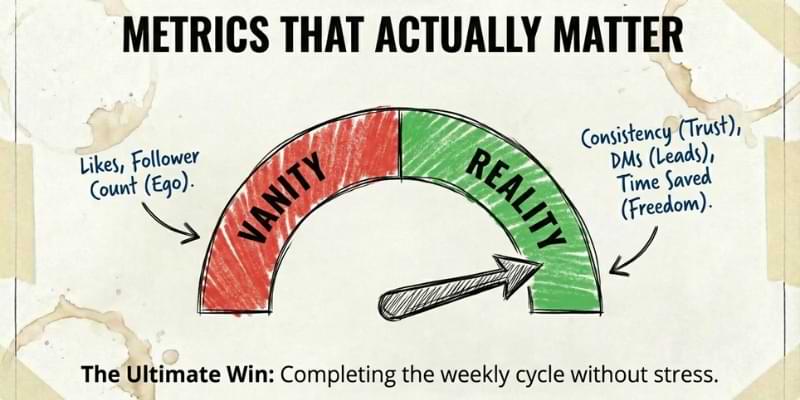
The most important metric? Consistency. If you’re completing your 60-minute session weekly and publishing regularly, you’re already ahead of 80% of your competitors.
Set a monthly review appointment with yourself. Fifteen minutes to look at what’s working, what’s not, and what to adjust next month.
Troubleshooting: When Your System Breaks Down
Even the best systems occasionally need maintenance. Here’s how to get back on track:
Problem: “I missed a week, and now I’m behind.” Solution: Don’t try to catch up. Start fresh with this week’s content. Consistency moving forward matters more than making up for missed posts.
Problem: “My content isn’t getting engagement anymore.” Solution: Refresh your templates, try new formats, or ask your audience directly what they want to see. Markets evolve—your content should too.
Problem: “60 minutes isn’t enough anymore.” Solution: Audit your process. Are you getting distracted? Overthinking? Being too perfectionistic? Often, the issue is focus, not time. If you’ve genuinely outgrown 60 minutes, extend to 90 minutes while maintaining the batching principle.
Problem: “I’m running out of ideas.” Solution: Build an idea capture system. Keep a running note on your phone where you jot down content ideas as they occur throughout the week. Customer questions, industry news, personal observations—everything is potential content.
Your 30-Day Implementation Plan
Ready to build a weekly content system? Here’s your roadmap:
Week 1: Foundation
- Choose your 2-3 primary platforms
- Set up your scheduling tool
- Create your first 5 content templates
- Schedule your weekly 60-minute content session
Week 2: First Run
- Complete your first 60-minute content creation session
- Schedule a full week of content
- Track how long each phase actually takes
- Adjust your process based on what you learned
Week 3: Refinement
- Review last week’s performance
- Identify which templates worked best
- Create 3-5 more templates based on successful formats
- Streamline any bottlenecks in your process
Week 4: Optimization
- Build your evergreen content bank (10-15 posts)
- Set up your analytics tracking
- Document your finalized process
- Celebrate your first month of consistent content!
By day 30, your 60-minute system should feel natural rather than forced. You’ll have momentum, data, and a repeatable process.
The Long-Term Mindset Shift
Building a weekly content system isn’t just about saving time—it’s about changing your relationship with content creation entirely.
Before the system: Content feels like a burden, something you “should” do but rarely have time for. It’s stressful, inconsistent, and guilt-inducing.
After the system: Content becomes a predictable part of your business operations, like checking email or invoicing clients. It’s scheduled, systematic, and stress-free.
This shift is profound. When content creation moves from “whenever I can squeeze it in” to “every Sunday at 9 AM,” you stop feeling behind. You stop comparing yourself to full-time content creators with teams. You start playing your own game, at your own pace, with your own system.
The solopreneurs winning in 2026 aren’t the ones creating the most content—they’re the ones who’ve built sustainable systems that support their business without consuming their life.
Final Thought: Your Next 60 Minutes Start Now
You’ve learned how to build a weekly content system that takes just 60 minutes. You understand the three pillars—batching, templates, and repurposing. You have the step-by-step blueprint, templates, tools, and a troubleshooting guide.
Now comes the most important part: implementation.
Content systems don’t work in theory—they work in practice. The difference between solopreneurs who succeed with content and those who don’t isn’t talent, budget, or even time. It’s commitment to the system.
Here are your immediate next steps:
- Right now: Block 60 minutes on your calendar for this week’s content creation session. Make it recurring.
- Today: Choose your 2-3 platforms and set up your scheduling tool.
- This week: Create your first 3-5 content templates using the frameworks in this article.
- This Sunday (or whenever you scheduled): Complete your first 60-minute content creation session. It won’t be perfect. Do it anyway.
- Next month: Review your progress, refine your templates, and celebrate your consistency.
Remember Sarah from the beginning of this article? She implemented this exact system. Six months later, she’s posting 5x per week across LinkedIn and Instagram; her engagement has tripled, and she’s landed four new clients directly from her content. Most importantly? She spends 60-75 minutes per week on content, rather than 10+ hours.
The system works. But only if you work the system.
Your 60 minutes start now. What will you create?
Learn how to build a weekly content system that takes only 60 minutes. Batching, templates, and repurposing strategies for busy solopreneurs in 2026. Share on X>>> Read more Weekend Workshop lessons here
Note: Some links on this page are affiliate links meaning that if you click on my link and make a purchase, I will receive a small commission. It does not however affect the price you pay. Plus, it’s a great way to support me and the content I’m providing.