How the right pricing strategy can boost your bottom line
Pricing is one of the trickiest parts of running a small business. Set your prices too high, and you risk scaring away potential customers. Set them too low, and you might be working harder than ever but still struggling to cover expenses. For solopreneurs and small business owners, getting pricing right isn’t just about making money—it’s about building a sustainable business.
The good news is that smart pricing isn’t about guessing or copying what competitors are doing. It’s about understanding the value you provide, your costs, and what your target customers are willing to pay. In today’s article, we’ll explore a practical approach to pricing that can help you improve profitability without losing clients.
You’ll learn why many small business owners undervalue their services, how to avoid common pricing pitfalls, and a step-by-step process to confidently set and adjust your prices. By the end, you’ll have a clear path to pricing that supports your business growth while delivering value to your customers.
The Pricing Problem
Many solopreneurs fall into the trap of underpricing. According to a FreshBooks survey, 52% of self-employed professionals admit they don’t charge enough for their work. Often, this comes from fear—fear of losing customers, fear of being seen as “too expensive,” or fear of competing with cheaper options.
The problem is that underpricing leads to burnout and stagnation. You might work longer hours just to make ends meet. Worse, undervaluing your services can make customers perceive them as less valuable. For example, if you’re a consultant charging $30 an hour when others charge $75, potential clients may question your expertise, even if you’re just as qualified.
On the flip side, some business owners swing too far in the other direction and price based on what they “wish” people would pay, without grounding it in costs or market research. That can backfire too, resulting in lost sales and damaged trust.
So the challenge is clear: you need a pricing strategy that reflects your value, covers your costs, and positions your business for growth.
Smart Pricing Explained
Smart pricing is about more than covering costs—it’s about value-based pricing. Instead of focusing only on what it costs you to deliver a product or service, you consider the value it provides to your customers.
For instance, a website designer could charge $1,000 for a project based on hours and materials. But if that website helps the client generate $50,000 in new sales, its value is much higher. Value-based pricing allows you to capture a portion of that benefit, not just your time spent.
Here’s why it works:
- Customers are willing to pay more when they clearly see the benefit.
- You attract clients who appreciate quality, not just low cost.
- It builds confidence in your expertise and brand.
Of course, value-based pricing doesn’t mean ignoring costs. You must know your numbers—expenses, time, and profit goals. Then, combine that with market research and customer insights. Tools like ProfitWell offer deeper insight into how businesses can set pricing strategies that align with customer value.
Ultimately, smart pricing is about balance. It’s not about being the cheapest. It’s about finding the sweet spot where your prices reflect your expertise, support your financial goals, and deliver real value to your clients.
Step-by-Step Implementation
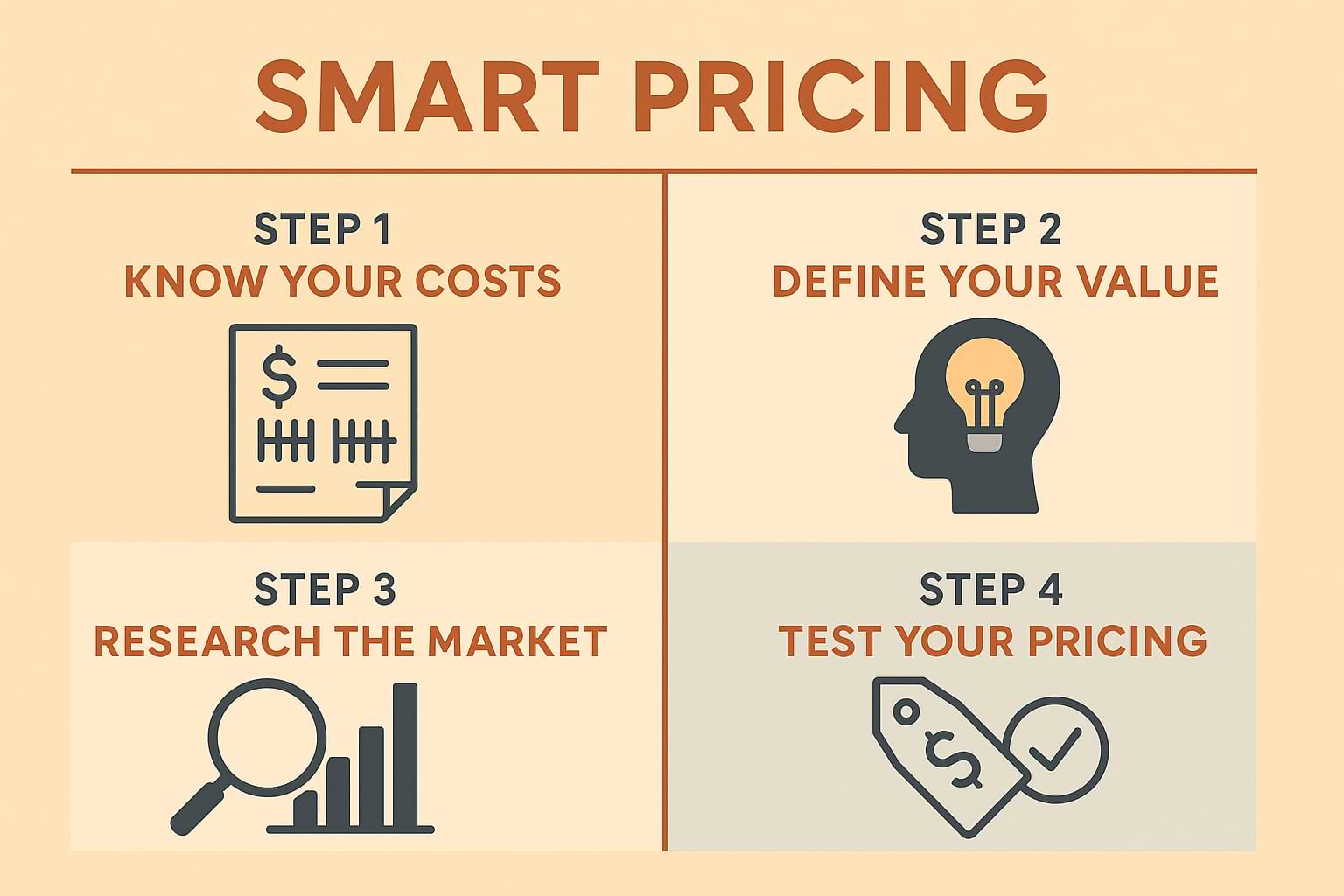
Step 1: Know your costs
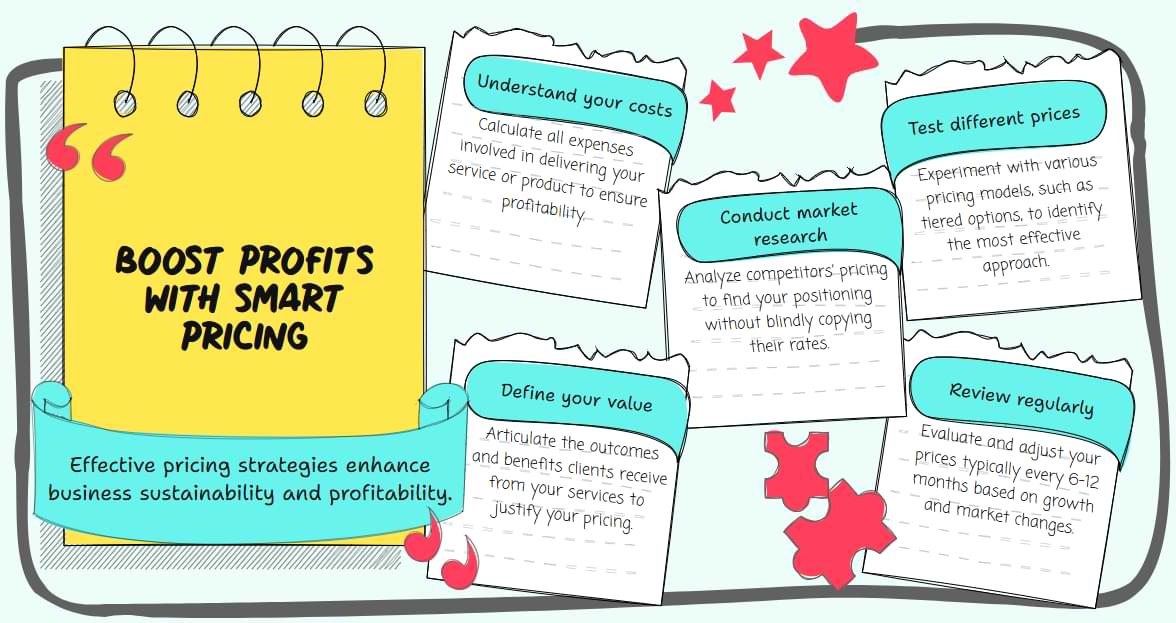
Start with the basics: what does it cost you to deliver your service or product? Factor in direct costs like materials and software, plus indirect costs like your time, marketing, and overhead. This gives you a baseline—you can’t charge less than this and remain profitable.
Step 2: Define your value
Ask: what outcome do clients get from working with you? Quantify it if possible. For example, if you help small businesses save 10 hours a week, what is that worth in dollar terms? This helps you position your service as an investment, not just an expense.
Step 3: Research the market
Look at what others charge in your space. This isn’t about copying—it’s about understanding where you fit. If competitors charge between $500 and $2,000 for similar work, that gives you a reference point.
Step 4: Test your pricing
Don’t be afraid to experiment. You can test pricing with new clients or adjust packages. For example, offer three tiers: basic, standard, and premium. Many customers naturally choose the middle option, giving you flexibility.
Step 5: Review regularly
Pricing isn’t set once and forgotten. Review it every 6–12 months. As your skills, portfolio, or demand grows, so should your prices. Communicate changes clearly to clients by explaining the added value you provide.
Common Mistakes to Avoid
One big mistake is pricing based on fear. Many business owners assume clients will leave if prices rise, but often, good clients respect fair increases when explained properly. Another mistake is failing to raise prices over time. Inflation, increased expertise, and higher demand should all influence pricing. Finally, avoid overcomplicating your pricing structure. Too many options confuse customers. Keep it simple and focused on value.
Action Step
This week, take one small step toward smart pricing: pick one service or product and review its pricing. Ask yourself: does this price reflect the value I deliver? If not, adjust upward, even if it’s just by 10%. Then, test it with your next client. You’ll be surprised how often customers are willing to pay more when you confidently stand behind your value.
Recap & Benefits
Smart pricing means aligning what you charge with the value you deliver. It helps you attract better clients, earn more money, and run a healthier business. Instead of chasing volume, you focus on delivering quality. For solopreneurs, this is key to sustainable growth. By knowing your costs, defining your value, researching the market, testing, and adjusting regularly, you build a pricing strategy that supports long-term success.
Final Thoughts
Pricing is one of the most powerful tools in your business toolkit. It can shape how clients perceive you and directly impacts your financial health. Start small, stay confident, and remember that your expertise has value.
As Warren Buffett once said, “Price is what you pay. Value is what you get.”
When you align your pricing with the value you deliver, you’ll build a stronger, more profitable business.
Struggling with pricing? Today’s Tips Tuesday shows you how to set smart, value-based prices that attract better clients and increase profits. Share on XSee my archive of Tips Tuesday articles.
his Blog Post is Brought to You by Blubrry
If you’re in need of a podcast host, let me recommend Blubrry podcast hosting. No contracts and you can cancel at any time. Plus they’ve redesigned their dashboard and it’s a beautiful and simplified. Competitive prices too! And if you already have a podcast host, migrate to Blubrry for free!