How to Trigger Deep Work When Your Brain Wants to Scroll
If you have been following along this month, you have ditched the annual resolutions for a 90-day sprint plan. You have also (hopefully) started practicing time blocking to defend your schedule from chaos.
You have the plan. You have the time blocked on your calendar. Tuesday morning rolls around, your 9:00 AM block for “Strategic Planning” begins, and you sit down at your desk.
Then, it happens.
You stare at the blank screen. You suddenly feel the urge to check your email, just for a second. You remember a text you forgot to return. You decide you need another cup of coffee. Before you realize it, low-value distractions have consumed your precious two-hour block.
For today’s Tuesday Tip, we are talking about the missing link between scheduling your work and actually doing it. We are talking about how to trigger deep work.
The Battle for Your Attention
The problem usually isn’t laziness. The problem is that your brain has been trained to despise boredom and crave quick hits of dopamine.
As solopreneurs working alone, we are incredibly susceptible to what researchers call “popcorn brain.” Our attention jumps around rapidly from thought to thought, never settling long enough to do significant cognitive work. We gravitate toward “shallow work”—like replying to emails or tweaking our website footer—because it feels productive but requires very little mental strain.
The work that actually moves your business forward is almost always difficult. It requires sustained concentration, or deep work. If you rely solely on willpower to switch from a distracted state into a deep-focus state, you will fail nine times out of ten. You don’t need more willpower. You need a ritual.
Creating a Deep Work Ritual
A ritual is a set of behaviors you perform the exact same way every time before you begin difficult work. It acts as a signal to your brain that it is time to shift gears from reactive mode to focused mode.
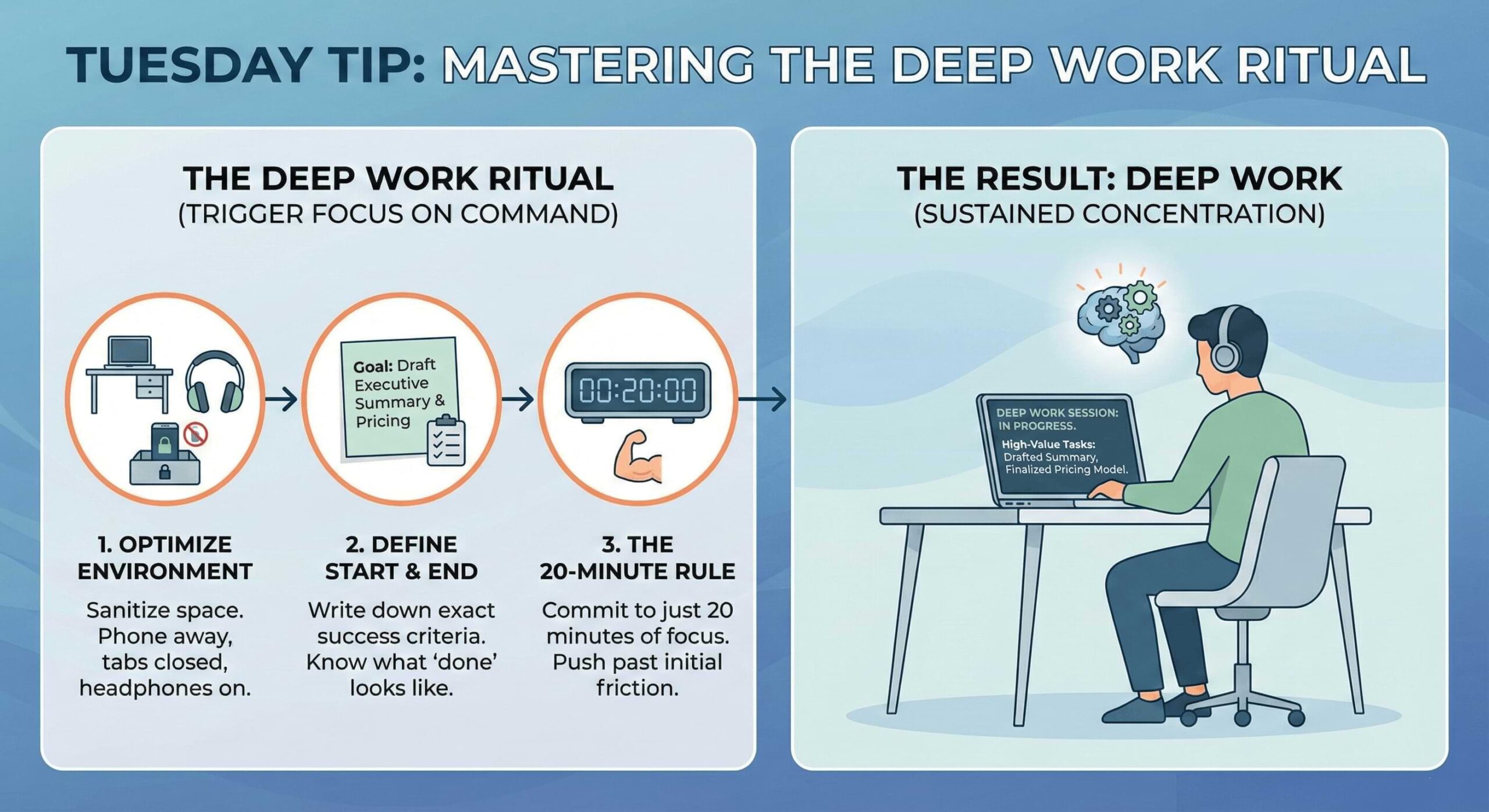
Here is a simple three-step ritual you can adapt to trigger focus on command.
1. Optimize the Environment. You cannot do high-level thinking with low-level distractions buzzing around you. Before your time block starts, sanitize your space.
-
Put your phone in another room. Not just face down. Keep your phone out of sight.
-
Close every browser tab that is not directly related to the task at hand.
-
Put on noise-canceling headphones. Some people find that listening to the same specific playlist or white noise track every time they work helps trigger the focus habit.
2. Define the Start and End. Uncertainty breeds procrastination. Before you start, write down exactly what success looks like for this specific block on a sticky note. Don’t write “Work on client proposal.” Write, “Draft the executive summary and the pricing section.” When you clearly understand what “done” looks like, starting becomes easier.
3. The 20-Minute Rule. The hardest part of deep work is the first fifteen minutes. Your brain will scream for distraction. Make a deal with yourself: you only have to focus for twenty minutes. Anyone can do twenty minutes.
Set a timer. Usually, once you push past that initial friction, you will find a groove and want to keep going long after the timer goes off.
The Bottom Line
Time blocking protects your schedule, but rituals protect your attention. Mastering the ability to enter a state of deep work on command is the ultimate competitive advantage for a small business owner in a distracted world.
Time blocking fails if you get distracted. Learn how to trigger Deep Work on command to hit your goals. Share on XSee my archive of Tips Tuesday articles.
his Blog Post is Brought to You by Blubrry
If you’re in need of a podcast host, let me recommend Blubrry podcast hosting. No contracts and you can cancel at any time. Plus they’ve redesigned their dashboard and it’s a beautiful and simplified. Competitive prices too! And if you already have a podcast host, migrate to Blubrry for free!