Drowning in Repetitive Work. Build Custom GPTs.
It is late March. By now, you should have your first quarter review completed and your Q2 goals locked in. You have likely optimized your general workflows based on our previous discussions.
But as you look at your daily schedule, you might notice a glaring problem. You are still the primary bottleneck for every small decision, specialized review, and niche process in your business. You built a system to scale your operations, but you are still doing the heavy lifting yourself.
This is the exact moment when ambitious solopreneurs burn out. You cannot scale if your specialized knowledge lives only inside your head. Every time you manually review a client proposal or format a highly specific report, you are losing valuable time.
You are operating as a technician instead of a strategist.
For today’s Tuesday Tip, we are discussing custom GPTs for niche business tasks.
The Power of Specialized Automation
General artificial intelligence models are powerful, but they are generic by design. They require extensive prompting every single time you need a specific output. This repeated prompting wastes time and leads to inconsistent results.
Custom models solve this problem entirely. By configuring a dedicated assistant for a highly specific task, you embed your exact parameters, brand voice, and logical frameworks into the tool. You create a digital clone of your specialized expertise.
This is not about replacing your core value. It is about offloading the cognitive load of repetitive, niche tasks so you can focus on high-impact growth. When you build a specialized assistant, you are building a lasting business asset.
You are effectively creating an invisible team member who works exactly as you want them to. This frees up your mental bandwidth for high-level strategic thinking. Let us break down the exact framework to implement this in your business today.
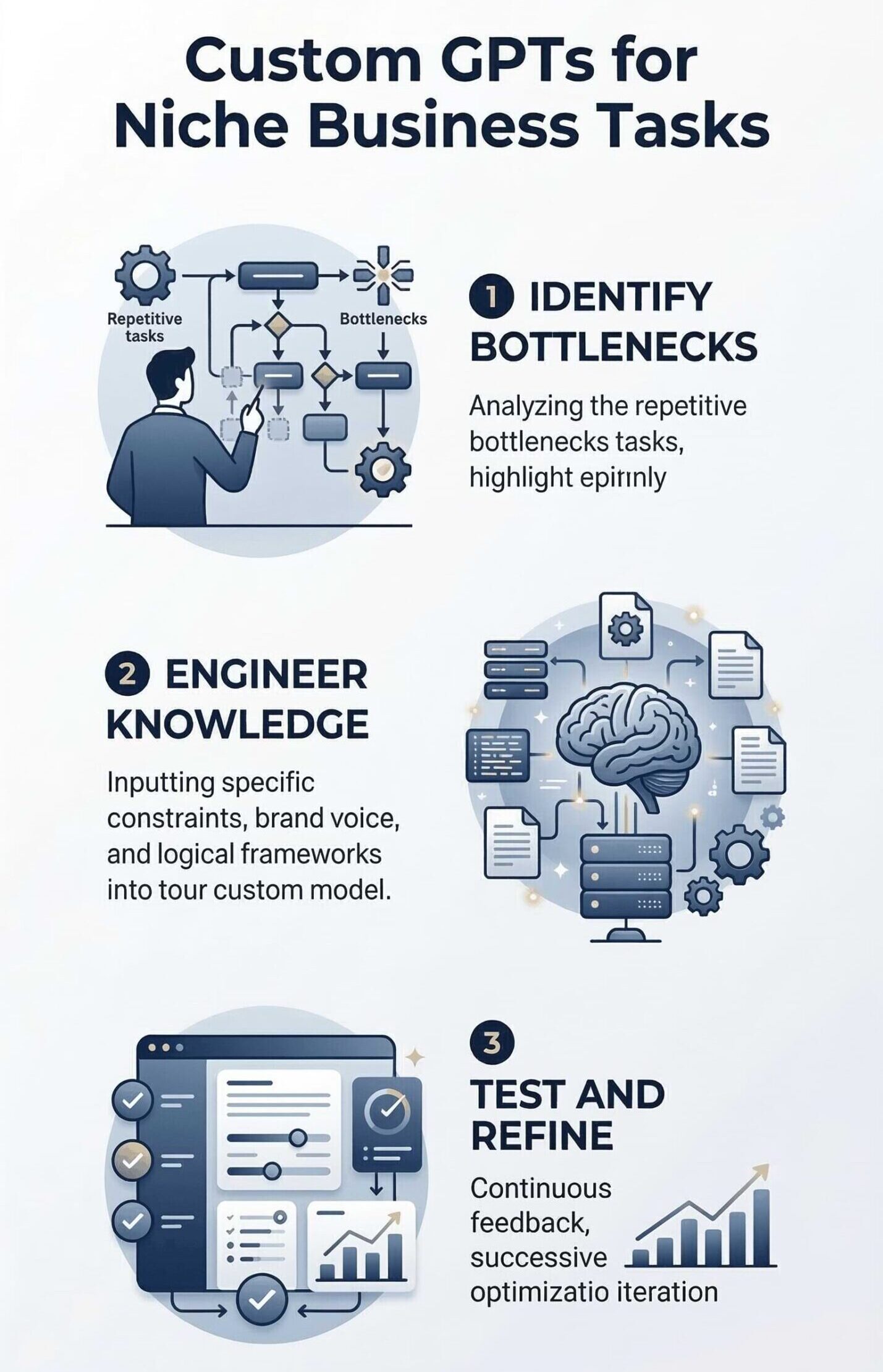
Step 1: Identify Your Bottleneck Tasks
Do not try to automate everything at once. Start by auditing your weekly workflow to find the highly specific tasks that drain your energy. Look for tasks that require a specific format, a rigid set of rules, or a consistent tone of voice.
A great candidate is a task you perform at least three times a week that takes more than fifteen minutes. It might be drafting responses to specific types of client inquiries. It could be formatting raw data into your proprietary weekly report structure.
Write down exactly what steps you take to complete this task manually. Documenting your organic process is the foundation of building a good automated assistant. If you cannot write down the rules, you cannot train a system to follow them.
Keep your initial list to just three potential tasks. We want to start small, validate the system, and then expand your automation framework later.
Step 2: Engineer the Knowledge Base
A specialized assistant is only as good as the instructions and data it receives. You must provide a robust knowledge base to ensure accurate and consistent outputs. This is where most solopreneurs fail when building their own internal tools.
Gather your best examples of completed work. If you are building an assistant to write specialized client updates, gather ten of your best past updates. Put these into a single, clean reference document.
Next, write out your absolute constraints. Tell the system exactly what it must do and what it must never do. For example, instruct it to never use industry jargon or to always output the final result in a specific bulleted format.
Upload this reference document and the constraints to your custom assistant’s configuration settings. This transforms the tool from a generic writer into a specialized expert trained on your unique methodology.
Step 3: Test and Refine the Output
Do not expect perfection on the very first try. Building an effective system requires a dedicated period of testing and careful iteration. Treat your new custom assistant like a brand new employee who needs clear feedback.
Run your next three real-world tasks through the new system. Carefully review the output against your standard of excellence. Note exactly where the assistant deviated from your preferred style or formatting.
Go back to the configuration settings and adjust the instructions to account for these minor deviations. If the tone was too formal, add a rule to use conversational language. If it missed a step, explicitly state that step in the core prompt.
Within three iterations, you will have a highly reliable tool. This single tool will save you countless hours over the coming months.
Real-World Implementation Examples
To spark your thinking, consider how other high-performance business owners use this exact strategy. A specialized consultant might build an assistant solely to analyze specific financial ratios from clients’ balance sheets. This eliminates their manual calculation phase completely.
A niche content creator could build an assistant trained specifically on their hook-writing formulas. Instead of staring at a blank screen, they feed the system a topic and instantly receive ten perfectly formatted options.
A software developer might create a specialized code reviewer trained on their specific security compliance checklists. This ensures no minor errors slip through before a major product deployment. The possibilities are entirely dictated by your unique bottlenecks.
Scaling Your Digital Infrastructure
Once you have successfully deployed your first custom assistant, you will understand the true power of this system. You can begin stacking these tools to create a comprehensive digital infrastructure.
Imagine having a dedicated assistant for initial client triage, another for drafting technical proposals, and a third for summarizing specific industry newsletters. Each one operates independently and flawlessly, in accordance with your strict rules.
This is how you break the linear relationship between your time and your output. You stop working on the process and start managing the system. This is the definition of scaling as an independent solopreneur.
You must commit to maintaining these tools as your business evolves. Update their knowledge bases quarterly to ensure they reflect your most current strategies and methodologies. A stagnant system will eventually produce obsolete results.
The Bottom Line
You cannot scale a business if your specialized knowledge is trapped inside your own head. Building custom GPTs for niche business tasks transforms your personal expertise into a scalable, tireless operational asset.
Stop wasting your mental energy on repetitive manual processes. If you want to scale your solo business this quarter, you need to offload specialized work to dedicated systems. Learn how to build custom GPTs for niche business tasks. Share on XSee my archive of Tips Tuesday articles.

If you need a podcast host, I recommend Blubrry. No contracts, and you can cancel at any time.
Competitive prices too! And if you already have a podcast host, migrate to Blubrry for free!