How to Get More Mileage from Your Marketing Content
As a solopreneur, your time and energy are limited. You work hard to create blog posts, newsletters, or social media updates, but often those pieces only get used once before fading into the background. That’s a lot of effort for a short burst of attention.
This is where content repurposing comes in.
By reusing and reshaping what you’ve already created, you can stretch your ideas further, save time, and reach more people. In this article, we’ll look at what content repurposing is, why it works, and how you can start using it in your business right away. You’ll also learn what mistakes to avoid and leave with a clear action step you can try today.
The Problem
Creating fresh content every week or even every day is overwhelming. Many solopreneurs feel like they’re on a treadmill that never stops.
According to HubSpot, 60% of marketers say creating content consistently is their biggest challenge. Add in the constant pressure to post on multiple platforms—LinkedIn, Instagram, X, YouTube, and more—and it’s easy to burn out.
Even worse, much of your audience may never see the original piece you worked so hard on. Algorithms, timing, and sheer content overload mean your great blog post might only get read by a fraction of your followers.
The result? Wasted effort, missed opportunities, and frustration. Solopreneurs can’t afford to keep reinventing the wheel. They need a smarter way to maximize their time and extend their reach.
Content Repurposing Explained
Content repurposing means taking one piece of content and reusing it in different ways.
For example, you might write a long blog post, then break it into short tips for social media, turn the main points into a podcast episode, or design an infographic that summarizes the key data.
Repurposing isn’t about recycling old ideas in a lazy way—it’s about adapting your message so it reaches people in the formats they prefer. Some people like to read, others prefer video, and still others listen while commuting. By reshaping your content, you meet your audience where they are without starting from scratch every time.
This approach works because it multiplies the life span of your work. Instead of one blog post getting attention for a week, you can spin it into posts, videos, and graphics that last months.
You also increase visibility. Not everyone follows your blog, but they might catch a post on LinkedIn or watch a clip on Instagram. Plus, repurposing saves time. You don’t have to constantly come up with brand new ideas—you can focus on quality and consistency.
Even large companies like HubSpot and Buffer rely on repurposing to keep their content marketing efficient and effective. If it works for them, it can work for solopreneurs too.
Step-by-Step Implementation
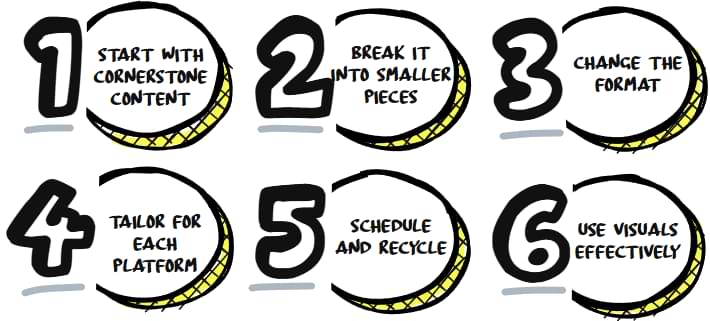
Step 1: Start with cornerstone content
Choose one solid piece of long-form content as your base. This could be a blog post, webinar, podcast episode, or case study. Make sure it’s rich in value and covers a topic in depth.
Step 2: Break it into smaller pieces
Extract key ideas, quotes, or statistics. A 1,500-word article can easily be split into five to ten social media posts, each focusing on one tip or insight.
Step 3: Change the format
Not everyone likes to read. Record a short video explaining your article’s main points. Turn your tips into a carousel post for Instagram. Use free tools like Canva to create graphics or infographics.
Step 4: Tailor for each platform
Adjust the tone and length depending on where you post. A quick one-liner might work well on X, while LinkedIn allows for more detail. Keep visuals consistent with your brand.
Step 5: Schedule and recycle
Use a scheduling tool like Buffer or Hootsuite to plan posts in advance. Repost high-performing content every few months—most of your audience won’t remember the first time they saw it.
Common Repurposing Mistakes to Avoid
One mistake is copying and pasting the same content across every channel. Each platform has its own style and audience. Instead, tweak your content so it fits naturally.
Another mistake is over-repurposing, where you stretch one piece so thin that it loses impact. Quality matters more than quantity. Finally, some solopreneurs repurpose without strategy. They create random posts without tying them back to their larger goals.
Always connect repurposed content to your business objectives, whether that’s building awareness, generating leads, or driving sales.
Action Step
Pick one piece of content you created in the past month. Maybe it’s a blog post or a long LinkedIn article. This week, repurpose it into at least two different formats.
For example, make a short video summarizing the key takeaways and a set of three quick social posts. Share them on different platforms. Notice how much easier it feels than starting from scratch—and how many more people you can reach with the same core idea.
Recap & Benefits
Content repurposing is a smart way to get more value from the work you’ve already done. Instead of constantly creating new material, you reshape what you have to fit different formats and platforms.
The benefits are clear: you save time, expand your reach, and build consistency without burning out. For solopreneurs, this means more visibility, stronger engagement, and a more sustainable marketing system.
By focusing on quality content and repurposing it strategically, you turn one good idea into many opportunities for growth.
Final Thoughts
Content repurposing is not about doing more—it’s about working smarter with what you already have. Start small, experiment with formats, and build a rhythm that works for your business. Over time, you’ll find that repurposing gives you both breathing room and better results.
As marketing expert Ann Handley once said, “Good content always has an encore.” Let your best ideas live longer and work harder for you.
Stop reinventing the wheel. Repurpose your content into new formats to save time and expand your reach. Today’s Tips Tuesday explains how. Share on XSee my archive of Tips Tuesday articles.
his Blog Post is Brought to You by Blubrry
If you’re in need of a podcast host, let me recommend Blubrry podcast hosting. No contracts and you can cancel at any time. Plus they’ve redesigned their dashboard and it’s a beautiful and simplified. Competitive prices too! And if you already have a podcast host, migrate to Blubrry for free!