Welcome to March. We have officially transitioned into our Q2 roadmap focused on scaling and optimization. If you have been following along in February, you have mastered your project shutdown and reclaimed your mental energy. Now is the time to upgrade how you handle information.
As a solopreneur, you are likely the CEO, the lead technician, and the secretary for every meeting you attend. You spend forty minutes on a Zoom call or a coffee meeting, and then you spend another twenty minutes trying to remember exactly what you promised to do. This is a massive cognitive leak.
The manual act of taking notes while trying to be present in a conversation is a recipe for mediocrity. You either miss the nuance of the conversation or you miss the details of the action items. In 2026, there is no reason to rely on your biological memory for business data.
For today’s Tuesday Tip, we are discussing Building an AI Second Brain for Meeting Notes and Action Items.
The Information Friction Cost
Most small business owners underestimate the cost of “information friction.” This is the time lost between receiving a piece of information and acting on it. When you take manual notes, that information stays trapped on a piece of paper or in a static document. It is not searchable, not actionable, and certainly not scalable.
An AI Second Brain acts as a digital layer between your conversations and your project management system. It ensures that every insight, deadline, and decision is captured with 100% accuracy. This allows you to focus entirely on the human element of the meeting: building rapport and solving problems.
By implementing this system, you are essentially hiring a full-time executive assistant for the price of a software subscription. You are moving from a “capture and forget” model to a “capture and execute” model.
The 3-Step AI Second Brain Framework
To build a high-performance system, you need to move beyond simple transcriptions. You need a workflow that filters noise and extracts value automatically.
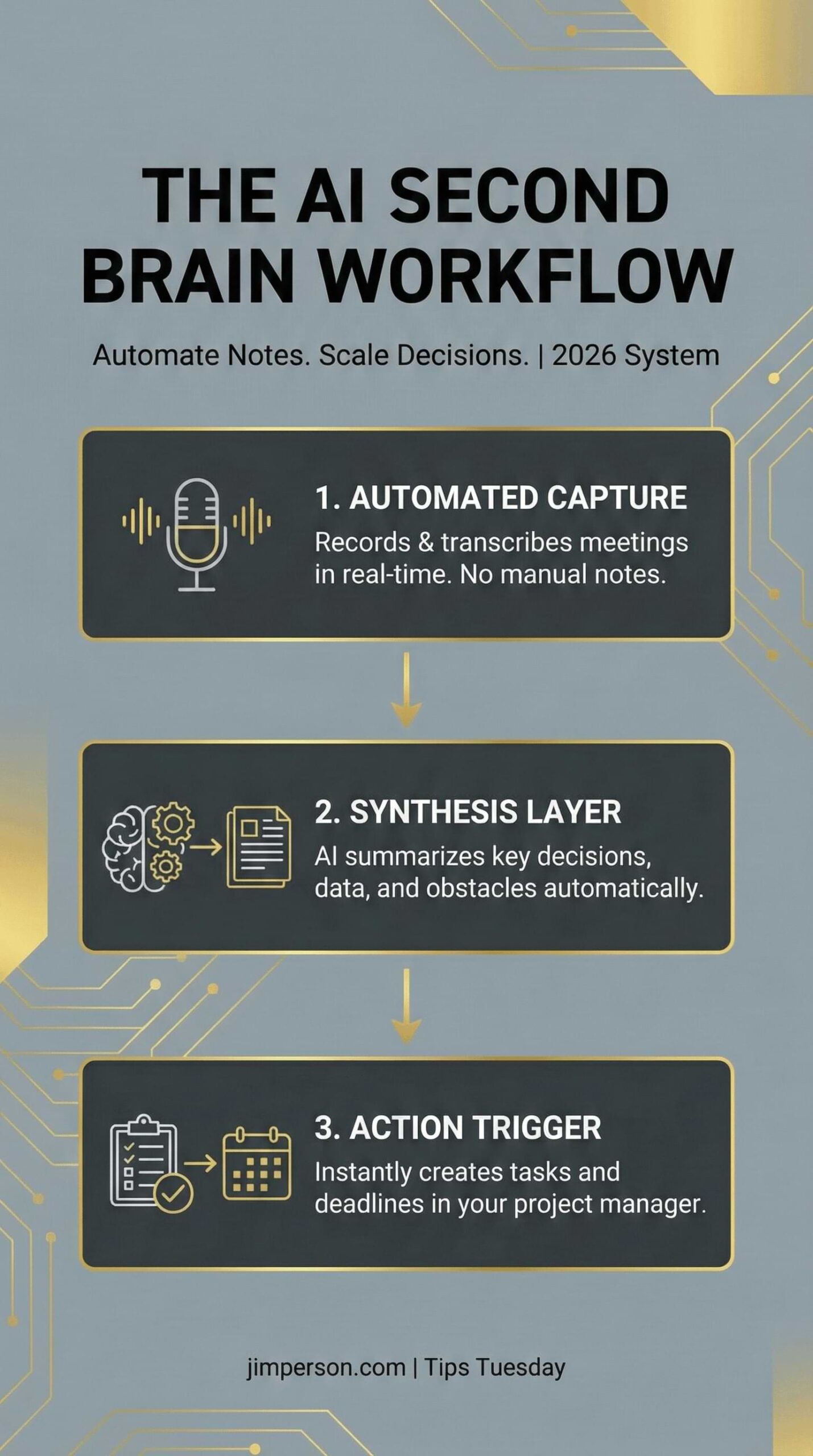
1. The Automated Capture Layer. You must stop taking manual notes. Use an AI meeting assistant to attend your digital calls or record your in-person meetings. Tools like Fireflies or Otter have evolved significantly by 2026: they now recognize different voices with near-perfect accuracy and can even detect the “emotional temperature” of a call. This tool should be set to “Auto-Join,” so you never have to remember to hit record.
2. The Triage and Synthesis Layer. A transcript is just a wall of text. It is useless without synthesis. Your AI Second Brain should be configured to automatically summarize the transcript into four specific categories: Key Decisions, Data Points, Potential Obstacles, and Immediate Action Items. This summary should then be automatically pushed to your primary knowledge base, such as Notion or Obsidian. This creates a searchable library of every conversation you have ever had.
3. The Automated Action Trigger. This is where most solopreneurs stop, but it is the most important step for scaling. Use a tool like Zapier or Make to connect your AI summary to your task manager. If the AI detects a sentence that sounds like a commitment, such as “I will send that invoice by Friday,” it should automatically create a task in your project management tool with a due date. This removes the “human error” factor from your follow-up process.
Common Pitfalls: Why AI Brains Fail
The most common mistake is “The Dumping Ground” syndrome. Solopreneurs often set up the capture layer but never review the output. If you have five thousand unread meeting summaries, you don’t have a Second Brain: you have a digital landfill. You must set aside five minutes after every meeting to “audit” the AI’s task list to ensure accuracy.
Another pitfall is the lack of a “Privacy Protocol.” In 2026, data privacy is a major competitive advantage. You must ensure that your AI tools do not use your client data to train their public models. Always inform your clients that you use an AI assistant for note-taking. Most will appreciate the professionalism and the fact that you are ensuring nothing falls through the cracks.
Finally, avoid “over-automation.” Not every casual chat needs to be indexed into your second brain. If you automate the capture of every single interaction, you will create notification fatigue. Be intentional about which “meeting types” trigger the full Second Brain workflow and which ones stay off the record.
The Bottom Line
Your biological brain is for having ideas, not for storing them. Building an AI second brain ensures that every meeting you have becomes a permanent asset for your business growth.
Stop letting your best business ideas die in unread meeting notes. In 2026, manual note-taking is a bottleneck. You need an AI Second Brain to capture, summarize, and assign tasks automatically. Focus on human connection. Share on XSee my archive of Tips Tuesday articles.

If you need a podcast host, I recommend Blubrry. No contracts, and you can cancel at any time.
Competitive prices too! And if you already have a podcast host, migrate to Blubrry for free!