Stop Drowning in Drafts. Build the AI Editor Workflow.
You sit down at your desk after a long day of client work. You have a rough draft for your weekly newsletter, but it feels clunky. You spend the next two hours moving sentences around. You delete adjectives and second-guess your tone.
It is late March, and as we head into the second quarter of 2026, your time is your most valuable asset. Now that you have your custom GPTs handling niche business tasks from last week, you should not be bogged down in the minutiae of line editing.
The content creation phase is only half the battle. The real friction happens when you try to turn a rough brain dump into a polished piece of thought leadership. When you operate as a solopreneur, you do not have a dedicated editorial team to review your work.
You are the writer, the editor, and the publisher. This creates a massive bottleneck that slows down your output and drains your creative energy. You need a system that acts as your editorial assistant.
For today’s Tuesday Tip, we are discussing the AI Editor Workflow.
The Cost Of Manual Editing
Many solopreneurs pride themselves on their authentic voice. They mistakenly believe that using artificial intelligence to edit their work will strip away their unique perspective. This fear leads to hours of unnecessary manual labor.
You read the same paragraph five times to check the flow. You run it through basic spell checkers. You still miss obvious typos because you are too close to the material.
This is not a scalable way to run a content engine. Your job as a high-performance business owner is to generate the core ideas. Your job is to provide the raw strategic insight that your audience craves.
Your job is not to agonizingly hunt for misplaced commas or passive voice. Manual editing consumes high-value cognitive bandwidth that should be directed toward client acquisition and product development. By systemizing your editing process, you reclaim hours of your week. You also ensure a higher baseline of quality across all your published materials.
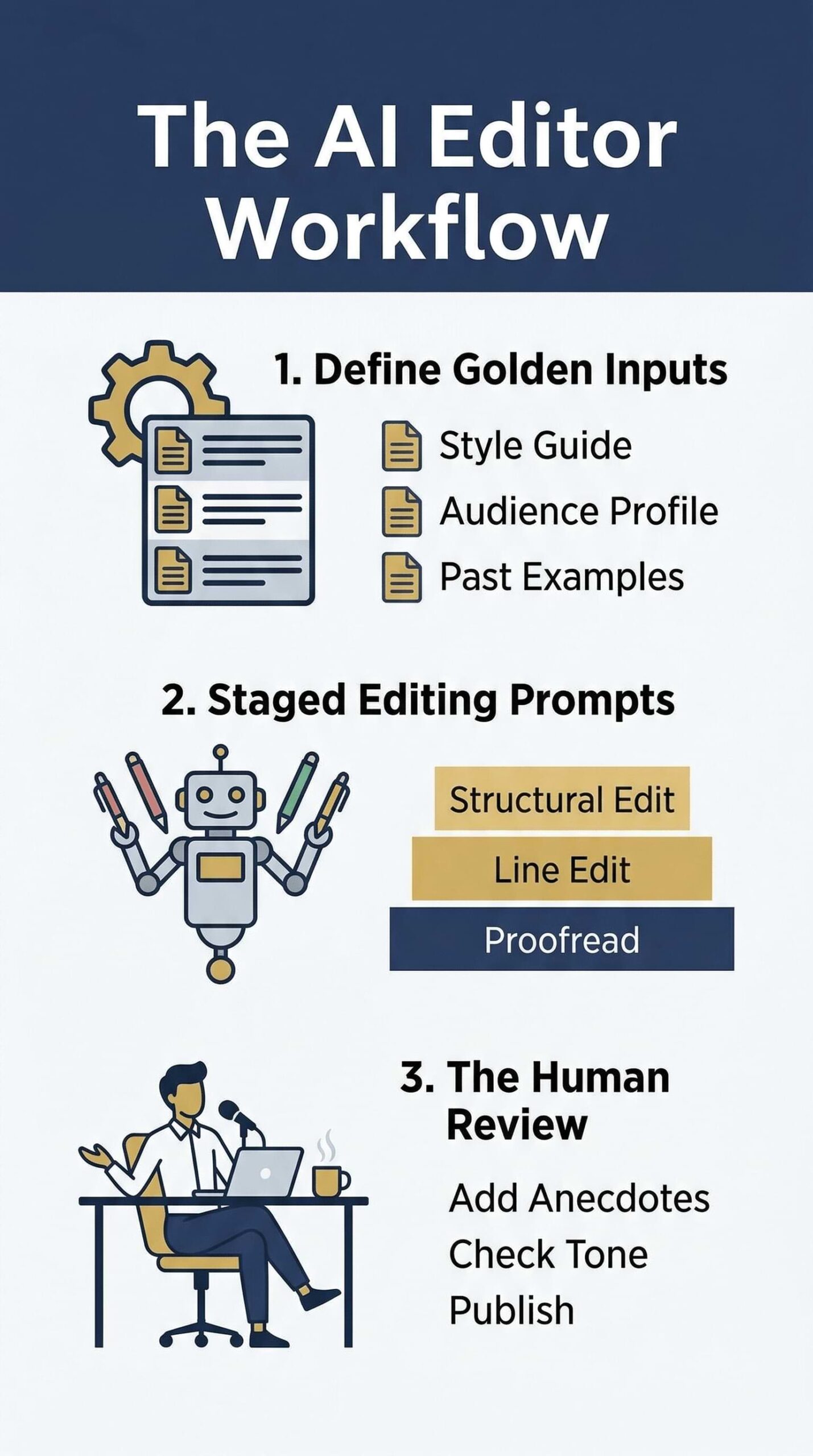
The Framework: Creating Your AI Editor Workflow
1. Define Your Golden Standard Inputs
The biggest mistake solopreneurs make is handing a raw draft to an AI and asking it to simply fix it. This results in generic, soulless text. The first step in your new workflow is building a comprehensive style guide prompt.
This prompt acts as the foundational knowledge base for your digital editor. You must clearly define your target audience, your desired reading level, and your core brand values. Provide the AI with three examples of your best past writing.
Instruct the system to analyze these examples for sentence length, vocabulary choices, and overall rhythm. Tell the AI exactly what to avoid. If you hate corporate jargon, explicitly list the words you refuse to use.
If you prefer short paragraphs, make that a strict parameter. Save this extensive prompt in a dedicated text document. You will use this master prompt to initialize your AI editor every single time you sit down to refine a draft.
2. Implement The Staged Editing Prompts
A professional human editor does not fix everything in one pass. They do a structural edit, a line edit, and a final proofread. Your AI Editor Workflow must mimic this exact staged approach.
Trying to force the AI to do all three at once leads to hallucinations and a loss of meaning. First, run your structural edit prompt. Ask the AI to evaluate the logical flow of your arguments. Tell it to point out missing transitions or weak introductions.
Once you adjust the structure based on that feedback, proceed to the line-edit prompt. Ask the AI to tighten sentences, remove passive voice, and punch up the verbs. Instruct it to suggest three different variations for any weak headlines.
Finally, run the proofreading prompt. This is a strict command to only fix grammar, spelling, and punctuation errors without altering the style. This three-step prompt sequence guarantees a methodical and thorough refinement of your work.
3. The Ten-Minute Human Review
Automation is powerful, but total abdication is dangerous. The final step in the AI editor workflow is the human polish. You must never publish blindly.
Set a timer for ten minutes. Read the final AI-edited output out loud. Reading aloud is the ultimate test of rhythm and conversational flow. If you stumble over a sentence, the reader will stumble over it too.
During this ten-minute window, inject your specific personal anecdotes. Add the nuanced industry references that an AI might miss. Ensure the final emotional resonance aligns with your exact intent for the piece.
Because the AI handled the heavy lifting of structure and grammar, your mind is fresh. You can focus entirely on the artistic finish rather than the mechanical construction. When the timer goes off, you hit publish. You step away from the keyboard and move on to your next high-impact task.
Scaling Your Output Without Sacrificing Quality
The true power of this system becomes apparent after a few weeks of consistent use. You will notice that your initial rough drafts actually improve. Because you receive immediate, structured feedback from your AI editor, you internalize better writing habits.
You stop writing in passive voice before the AI even has to correct it. You naturally structure your arguments with greater clarity. This creates a positive feedback loop of continuous improvement.
Furthermore, this workflow allows you to double or triple your content output. You can turn a quick voice memo recorded during your commute into a polished newsletter in under twenty minutes. You can take a lengthy webinar transcript and slice it into a dozen high-quality social posts with ease.
You build a formidable digital presence without working longer hours. You achieve true leverage by separating the act of ideation from the act of refinement.
Maintaining Control Over Your Voice
A common objection to this workflow is the fear of sounding robotic. This only happens when you lack discipline in your prompt engineering. You are the director, and the AI is merely the technician.
If the output sounds generic, your instructions were too broad. Regularly audit your master style guide. As your business evolves, your voice will naturally mature.
Update your baseline examples every quarter to reflect your best current work. Treat your AI editor like a new employee who needs occasional realignment. If you catch it using cliches, add a strict rule against them in your master prompt.
The goal is not to replace your unique perspective. The goal is to amplify it by removing the mechanical barriers to publication. You remain the sole author of your success.
The Bottom Line
The AI Editor Workflow removes the friction between a great idea and a published piece of content. By staging your editing prompts and protecting your brand voice, you can scale your output without sacrificing quality.
Stop acting as your own copyeditor and start building systems that work for you. Learn how to implement The AI Editor Workflow to protect your brand voice while tripling your content output. Share on XSee my archive of Tips Tuesday articles.

Turn your art into profit. Become a seller on TeePublic!