You are currently navigating the final stretch of the first quarter. If you have been following our previous workflows, your AI second brain is now capturing every meeting nuance, and your support triage is handled by autonomous agents. Your internal operations are finally lean. You have regained the time lost to administrative friction. However, internal efficiency is only half of the equation for a high-performance solopreneur.
The other half is external awareness. Many founders fall into the trap of “building in a cave.” They focus so intently on their own systems that they lose sight of the market. They wake up one morning to find that a competitor has launched a feature that makes their current offer redundant. Or they notice a sudden drop in lead quality because a rival is bidding on their exact keywords with a more compelling promise.
Reacting to these shifts after they happen is expensive. It forces you into a defensive posture where you are constantly playing catch-up. You lose the “Pro-Focus” that allows you to lead your niche. You become a commodity rather than a category of one. To scale with systems, you must treat market intelligence as a recurring background process rather than a frantic annual event.
For today’s Tuesday tip, we are discussing AI-driven competitor analysis.
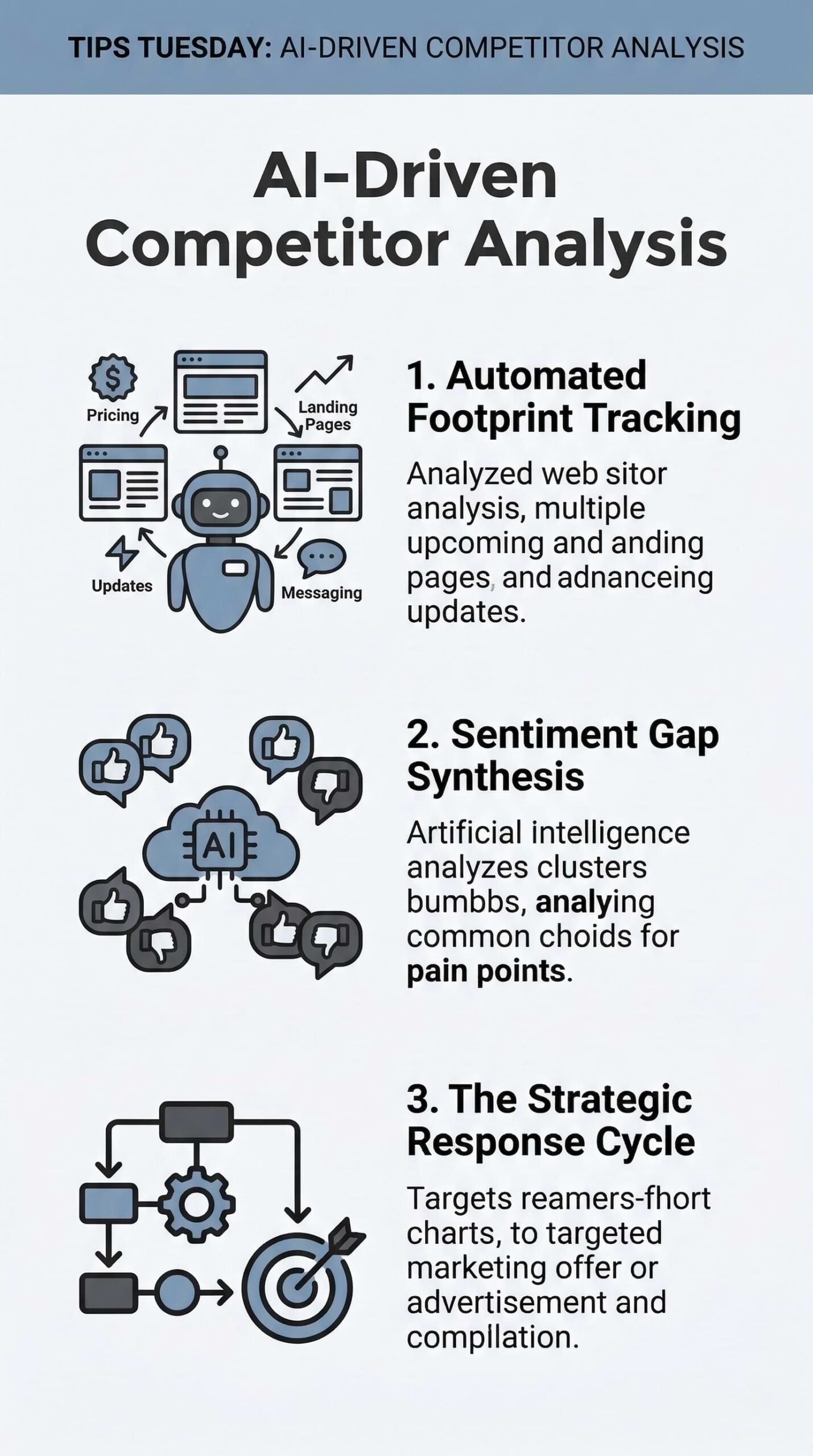
Step 1: Automated Digital Footprint Tracking
The first step in a superior workflow is removing the need for manual browsing. You should never have to visit a competitor’s website just to see what has changed. In 2026, we will use “Watcher” agents to monitor the digital footprint of your top five rivals. These agents are programmed to look for specific triggers: pricing updates, new landing pages, and changes in hero section messaging.
You can set up these monitors using tools that integrate browser scraping with LLM summarization. Every Monday morning, your system should deliver a “Delta Report” to your inbox. This report does not just show you what changed. It uses AI to interpret why the change happened. For example, if a competitor shifts their copy from “budget-friendly” to “premium performance,” the AI notes a strategic move up-market.
This automation allows you to maintain awareness without the emotional drain of constant comparison. You are not “checking up” on people. You are receiving data points that inform your own roadmap. By keeping this at the system level, you remove the procrastination that comes with manual research. You turn a chore into a high-leverage data stream.
Step 2: The Sentiment Gap Synthesis
Knowing what your competitors do is basic. Understanding where they are failing is where you find your leverage. Traditionally, this required reading hundreds of Trustpilot reviews, Reddit threads, and social media comments. It was a grueling task that most solopreneurs simply skipped. Now, we use AI to perform a sentiment gap synthesis.
You can feed your AI agent a list of URLs for your competitors’ review pages or social feeds. The goal is to identify “The Unmet Need.” You are looking for recurring complaints or features that users are begging for. The AI categorizes these into clusters: reliability issues, poor customer support, or missing integrations.
When you see a cluster of users complaining about a specific friction point in a rival’s product, you have found your Blue Ocean. This synthesis tells you exactly what to emphasize in your own marketing. If they are slow, you talk about your speed. If they are complex, you highlight your simplicity. You are no longer guessing what your audience wants: you are providing the solution to their documented frustrations.
Step 3: The Strategic Response Cycle
Data without action is just noise. The final piece of this system is the Strategic Response Cycle. Once your AI has identified a market shift or a gap in a competitor’s service, you must have a workflow to implement changes. We call this the 48-hour pivot.
When a significant competitor move is detected, your system should automatically generate a “strategy brief.” This brief outlines three potential responses: a counteroffer, a messaging adjustment, or a new content angle. You spend thirty minutes reviewing these options on Tuesday afternoon. You decide which path yields the highest ROI for your specific goals.
This prevents the “analysis paralysis” that kills many small businesses. You have a predefined system for handling external threats. Instead of worrying about what others are doing, you have a process that tells you exactly how to respond. You are moving from uncertainty to strategic execution. This is how you outpace the competition: you simply have a faster feedback loop.
The Bottom Line
AI-driven competitor analysis transforms market research from a manual burden into an automated strategic advantage. By building systems that track, synthesize, and suggest responses, you ensure your business remains the dominant choice in your niche.
Stop playing defense in your market. Use AI-Driven Competitor Analysis to automate your market intelligence and find the gaps your rivals are missing. Turn data into a strategic pivot and scale your operations. Share on XSee my archive of Tips Tuesday articles.

Turn your art into profit. Become a seller on TeePublic!
Note: Some links on this page are affiliate links, meaning that if you click on my link and make a purchase, I will receive a small commission. It does not, however, affect the price you pay. Plus, it’s a great way to support me and the content I’m providing.