Marketing Monday: Discover What’s Next
Every Columbus Day, we celebrate the boldness of daring to sail into the unknown. As marketers and solopreneurs, we share that same adventurous spirit—charting new paths, testing new ideas, and discovering what works in a crowded marketplace.
Today, let’s lean into that energy. Let’s learn how to use the theme of exploration as a metaphor—and a framework—for daring marketing experiments, reinvigorating your strategies, and pushing your brand into new territory.
We’ll start by defining the problem many small businesses face (stagnation disguised as safety). Then we’ll dig into marketing experimentation explained—why testing new ideas matters more than ever. You’ll get a practical, step-by-step roadmap to run your own experiments. We’ll also cover common pitfalls and wrap up with a quick action you can take Monday morning. Let’s set sail.
The Problem
Over time, many businesses settle into “what works.” You may stick to your existing channels, content types, or offers because they feel safe. But that often leads to diminishing returns. Audiences evolve, algorithms change, competition intensifies—and what worked yesterday might underperform today.
A few real-world signals: your engagement plateaus, your ad performance drops, or your conversion rate stalls. If you’re resisting change because “this has always worked,” you’re actually drifting backwards. You risk becoming invisible, not just consistent.
Furthermore, when you try something new without a plan—launching a new campaign or investing in a new tool. It can feel like gambling. You spend money, cross your fingers, and hope. That’s risky, and often discouraging when you don’t see immediate returns.
The solution? Adopt the explorer’s mindset in your marketing: test boldly, pivot fast, and learn always.
Marketing Experimentation Explained
Marketing experimentation is a structured approach to testing hypotheses, measuring impact, and iterating based on data. It’s not random “try this, see if it works.” It’s about choosing variables, isolating changes, and learning what truly moves the needle.
- It reduces risk. Instead of placing one big bet, you test in smaller, controlled ways.
- It turns guesswork into insight. You learn what your audience responds to.
- It builds momentum. Each experiment, win or fail, teaches you something.
- It fosters agility. The marketing landscape changes fast; experimentation keeps you adaptive.
In 2025, experimentation is becoming central to marketing—not just “nice to have.” Top organizations are using holistically integrated experimentation (linking SEO, conversion rate optimization, creative testing, and cross-channel attribution) to push growth.
Examples:
- A brand tests two different ad creative styles (humorous vs. informative) to see which boosts click-through.
- You run an A/B test on email subject lines: “Get Your Free Guide” vs. “Unlock Your Growth Strategy.”
- You try launching on a new platform (e.g., a rising social network) with a small budget before scaling.
- You reorganize your homepage layout and compare conversion rates before/after.
When Columbus set off, he didn’t know what to expect—but he had a plan, a direction, and the courage to adjust course. That’s the mindset your marketing needs.

Step-by-Step Implementation
Here’s a roadmap to bring that explorer’s spirit into your marketing this week:
1. Choose Your “New Frontier”
Pick one area to experiment with—a channel, creative style, offer, messaging theme, or format. Don’t try to overhaul everything at once. For example: test a new ad format (e.g. short video instead of static image) or run a pilot on a platform you haven’t used.
2. Formulate a Hypothesis
Clearly define your expectations. For example: “If I use short-form vertical video instead of static images for my ad, I will increase click-through rate by 20%.” Have a measurable metric (CTR, conversion, leads, etc.).
3. Design the Experiment
- Divide your audience (or traffic) into test and control groups
- Only change one variable at a time (e.g. creative, call to action)
- Determine how long to run the test (enough data for statistical confidence)
- Monitor results daily, but avoid jumping to conclusions too early
4. Analyze and Decide
Once the test has sufficient data, compare the performance. Ask: Did the change improve results? Did it hurt? Or was the impact negligible? Use those insights.
- If it won: scale it
- If it lost: learn and either discard or refine
- If neutral: maybe run a variation or test under different conditions
5. Iterate and Explore Again
Even successful experiments can be improved. Use what you learn to run the next test. Keep a list of ideas ready—new angles, audiences, and offers.
Common Mistakes to Avoid
Mistake 1: Changing multiple variables at once.
If you alter creative and offer and headline in one test, you won’t know which change drove the result. Always isolate one variable.
Mistake 2: Ending the test too soon.
Don’t draw conclusions from small sample sizes or short durations. Wait until you have statistical confidence.
Mistake 3: Only running safe tests.
If your experiments are always incremental (e.g. only changing button color), you’ll miss breakthrough results. Mix conservative tweaks with bolder bets.
Action Step
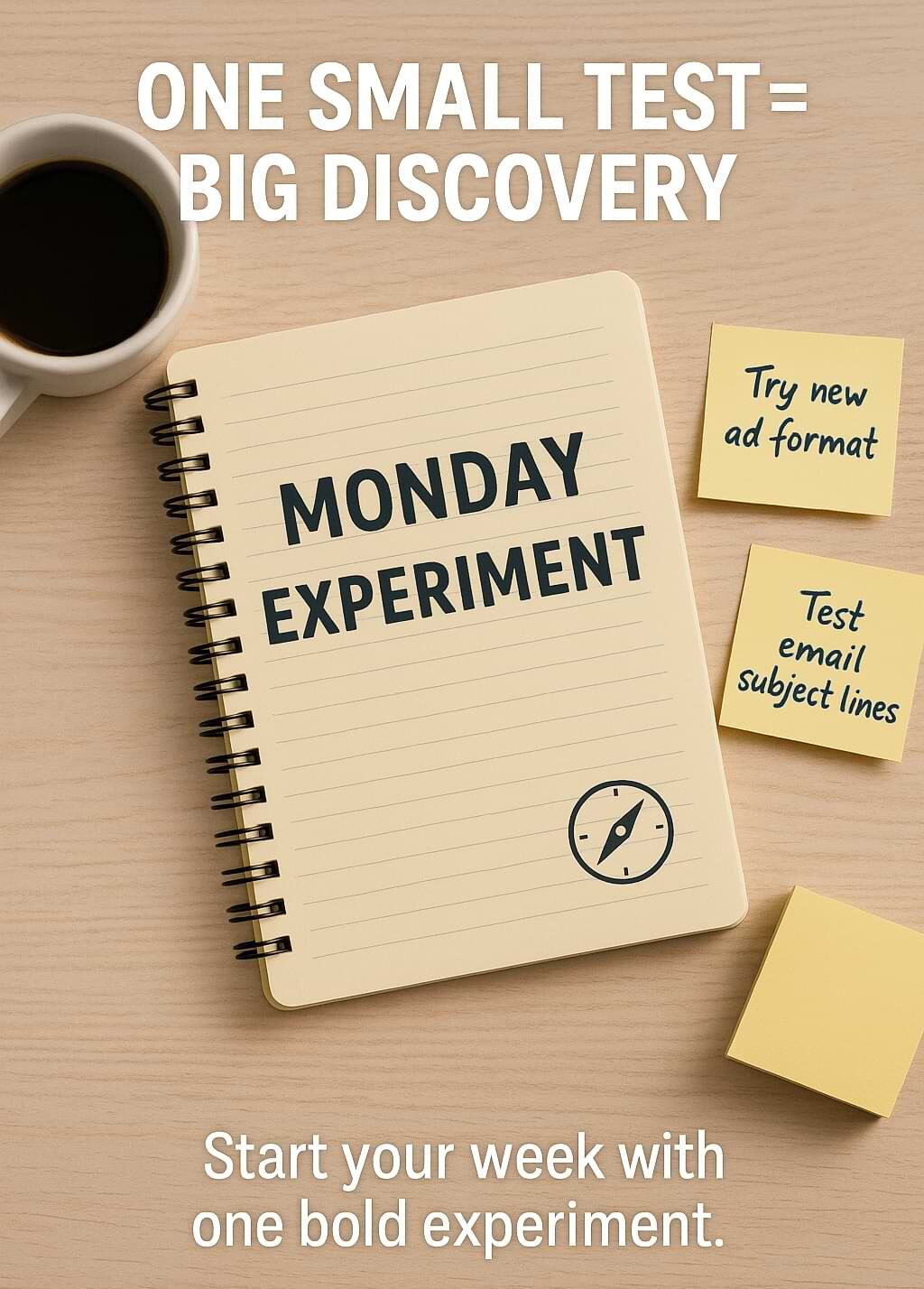
Right now (this Monday morning), commit to one small “exploration test.” It can be as simple as:
- Writing two versions of your next email subject line and splitting your send
- Creating one experimental ad creative (a different image, message, format)
- Posting on a new social platform with a small push to see what kind of engagement you get
Set a timer for 30 minutes, sketch the idea, define the metric, and schedule it. That small leap begins your journey.
Final Thoughts
Columbus Day gives us a metaphor: exploration, courage, charting unknown paths. Your marketing should embrace the same spirit. Experimentation isn’t just a tool — it’s a mindset. As you test and learn, you uncover new routes to growth, stronger strategies, and a more responsive brand.
“You can never cross the ocean unless you have the courage to lose sight of the shore.”
— Christopher Columbus
Keep exploring. Keep testing. Keep discovering what’s next.
On Columbus Day, marketing is our exploration. Try one bold experiment today — test a new ad, email subject, or format. Discover what works. Share on X“Marketing Monday” articles archive.

Note: Some links on this page are affiliate links meaning that if you click on my link and make a purchase, I will receive a small commission. It does not however affect the price you pay. Plus, it’s a great way to support me and the content I’m providing.