The Rise of the Solopreneur Economy: A Guide to Growth, Freedom, and the Future of One-Person Businesses
Report Commissioned for the Modern Solopreneur
Publication Date: 2026-03-28
An Introduction to Your Era: The Age of the Solopreneur
Welcome to the forefront of a global economic revolution. If you are reading this, you are likely not just a witness to this transformation but an active architect of it. You are a solopreneur—a founder, a creator, a consultant, an innovator—driving a one-person business in an era where independence is the new currency. This report is crafted for you. It is not merely an analysis of a market trend; it is a validation of your journey, a roadmap for your ambitions, and a testament to the collective power of individuals choosing to build on their own terms.
For decades, the narrative of business success was written in the language of headcounts, office spaces, and hierarchical structures. Today, you are rewriting that narrative. The rise of the solopreneur is not a fringe movement; it is a seismic shift reshaping the very definition of work, success, and economic contribution. Fueled by a potent combination of technological liberation, a deep-seated desire for autonomy, and a pragmatic response to a changing world, the solopreneur economy has emerged as a formidable force. Millions of individuals like you are proving that a one-person business can be dynamic, resilient, and profoundly impactful.
This report delves into the multifaceted world you inhabit. We will explore the staggering growth and economic scale of the solopreneur movement, providing the data that confirms what you feel intuitively: you are part of something massive. We will dissect the innovative business models and revenue strategies that are enabling solopreneurs to move beyond the simple exchange of time for money and build scalable, sustainable enterprises. We will illuminate the technological enablers—the artificial intelligence, automation, and no-code platforms—that have become your competitive advantage, allowing you to operate with the power and efficiency of a much larger organization.
Furthermore, we will analyze the very DNA of solopreneurial success, moving beyond the tools to the intrinsic qualities and strategic decisions that separate the thriving from the struggling. We will survey the industries where solopreneurs are not just participating but dominating, and, finally, we will address the challenges of this path honestly and provide actionable solutions. This is your comprehensive guide to navigating the opportunities and obstacles of the solopreneur journey in 2026 and beyond. You are the new face of the economy; this is your report.
The Unstoppable Ascent: Growth and Market Size of the Solopreneur Economy
The solopreneur movement has transcended the status of a niche career path to become a dominant and defining feature of the modern economic landscape. The scale of this shift is no longer a matter of anecdotal evidence but is substantiated by a wealth of data that paints a clear picture of explosive growth and significant economic impact. This is not a fleeting trend but a fundamental restructuring of the workforce, driven by a confluence of technological, economic, and cultural forces. The numbers confirm that the solopreneur is a central player in the story of 21st-century commerce.
The sheer size of this cohort is staggering. As of the mid-2020s, the United States is home to a vast and growing population of solopreneurs, with estimates ranging from 28.5 million to 41 million individuals running one-person businesses [4, 6, 7]. This formidable group now accounts for a remarkable 27% of the U.S. workforce, underscoring the mainstream nature of this professional path [7]. Globally, the phenomenon is just as pronounced, with an estimated 150 million solopreneurs charting their own course [6]. This is a worldwide movement, a collective declaration of independence from traditional employment structures.
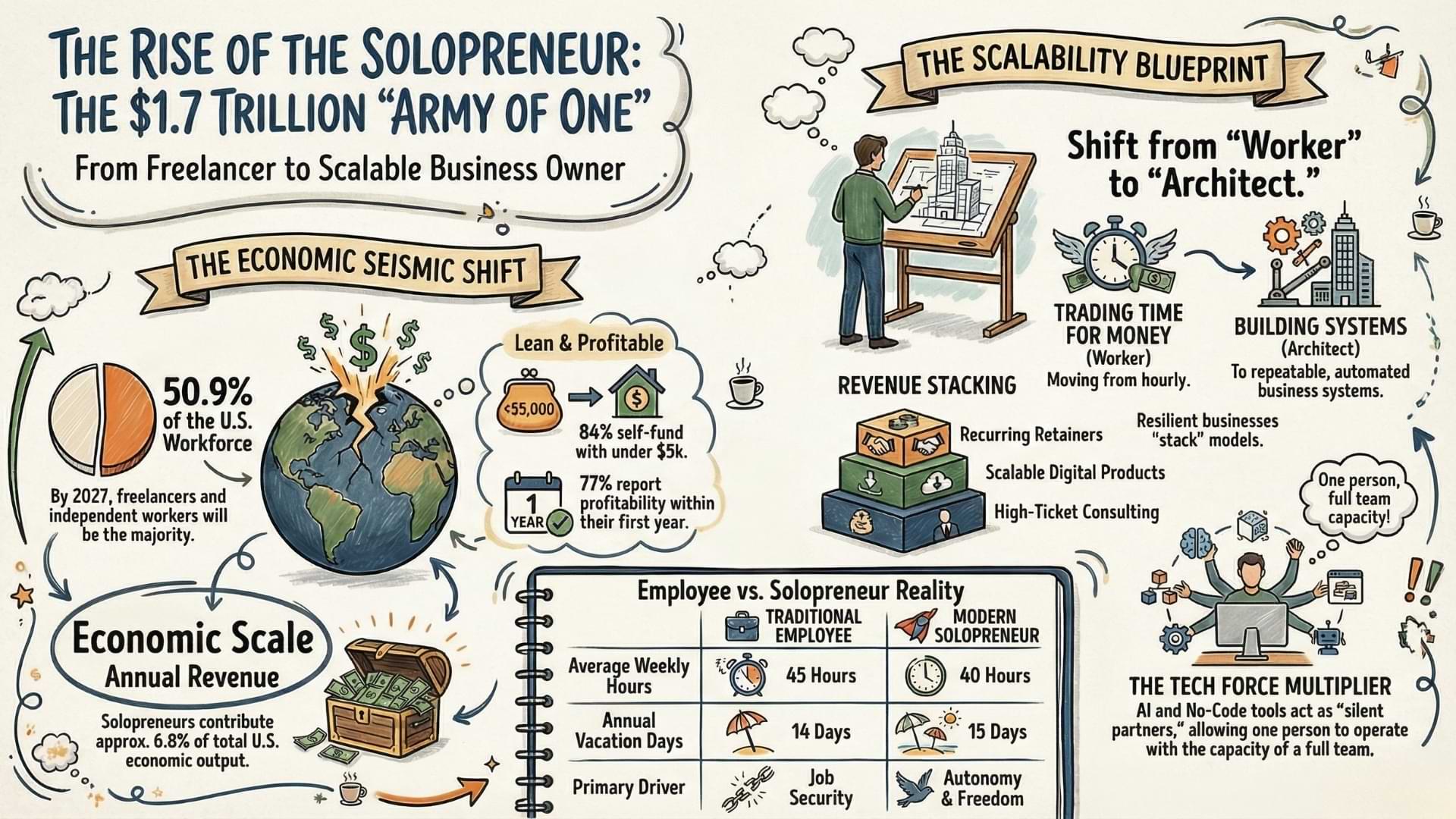
The economic contribution of this army of one is equally impressive. In the United States alone, solopreneurs generate between $1.3 trillion and $1.7 trillion in annual revenue [2, 7]. This colossal sum represents approximately 6.8% of the nation’s total economic output, making the solopreneur economy larger than the entire economies of many developed nations [7]. This is not peripheral activity; it is a core component of national prosperity, driven by the ambition and ingenuity of individuals. The growth trajectory indicates that this influence is only set to expand. Projections suggest that the number of self-employed individuals in the U.S. will reach 42 million by the end of 2026, and by 2027, freelancers and independent workers are on track to constitute over half—a stunning 50.9%—of the entire U.S. workforce [2, 4].
The velocity of this transformation is particularly noteworthy in the post-pandemic era. The period after 2020 served as a powerful accelerant, with a remarkable 56% of currently active solopreneurs having launched their ventures during this time [1]. In 2020 alone, the number of self-employed individuals in the U.S. surged by 9.6% to 15.3 million [2]. This momentum has continued, with new business applications being filed at a rate over 90% faster than pre-pandemic averages, the vast majority of which are non-employer firms [9]. This reflects a broader, long-term trend: the share of U.S. businesses without any employees grew from 76% in 1997 to 84% by 2020, demonstrating a sustained shift toward leaner, more agile business structures [1].
The motivations driving this exodus from traditional employment are as diverse as the solopreneurs themselves. A primary catalyst has been economic pressure and the pursuit of financial empowerment. The inflationary environment of the early 2020s prompted 57% of solopreneurs to start their businesses, seeking either a supplementary income stream or a complete career pivot to manage rising costs [1]. The potential for higher earnings is a significant draw, motivating nearly 23% of individuals, while for 8%, the need to address student loan debt was a key factor [4].
Beyond financial necessity, a profound and powerful driver is the deep-seated human desire for freedom, flexibility, and control. A majority of solopreneurs—52%—cite the ambition “to be my own boss” as their primary reason for taking the leap [1]. This quest for autonomy is echoed by the 34.4% who were driven by a desire for more freedom in their lives [4]. This is not just a perception; it is a lived reality. On average, solopreneurs report working slightly fewer hours per week (40) and taking more vacation days per year (15) than their counterparts in traditional employer roles (45 hours/week, 14 days/year), indicating a successful recalibration of work-life balance [1, 4].
This revolution would not be possible without the democratizing force of technology. Digital tools have been a great enabler, with half of all solopreneurs stating that technologies such as e-commerce platforms, social media, and remote collaboration software have made it possible for them to launch their businesses [1]. The advent of cloud services has dramatically lowered the barrier to entry, reducing infrastructure costs by up to 90% [3]. Simultaneously, the rise of artificial intelligence and no-code platforms has empowered non-technical founders to build sophisticated digital products and services, a feat once reserved for those with extensive resources and specialized skills.
The demographic profile of the modern solopreneur defies outdated stereotypes. This is not a movement confined to a single generation or gender. While millennials currently represent the largest cohort of independent workers, the landscape is remarkably age-diverse [4]. Nearly two-thirds (64%) of solopreneurs are over 45, with Gen X (30%) and Baby Boomers (31%) leading the charge, leveraging decades of professional experience to build their ventures [2, 5]. At the same time, a vibrant 14.8% of solopreneurs are young adults between 18 and 24, challenging the notion that entrepreneurship requires a long preceding career [2, 10].
Gender representation is also undergoing a significant and positive shift. In 2024, women constitute the majority of solopreneurs at 54.4%, a clear indicator of the path’s appeal to women seeking career autonomy and flexibility [4, 10]. This aligns with broader data showing that women own 42.7% of all non-employer businesses in the U.S. [7]. Furthermore, solopreneurs are a highly educated group, with 49% to 53% holding a bachelor’s degree or higher, compared to just 33% of the general population [2, 7]. This suggests that many are leveraging specialized knowledge and expertise to create high-value businesses. The solopreneur community also reflects America’s diversity, with immigrants accounting for 14% of new solopreneurs, double their share in traditional employer businesses [11].
Geographically, the solopreneur is no longer tethered to a specific location. While urban centers like New York City and Los Angeles historically held high concentrations of independent professionals, the normalization of remote work has untethered business from geography [6]. This has led to a more dispersed distribution of talent and enterprise across suburban and rural areas, with states like California leading in the sheer number of solo businesses and Florida boasting the highest number of solo start-ups per capita [9]. The modern solopreneur’s office is wherever they choose it to be. A commanding 76% work remotely at least some of the time [1, 3], with about a third (34%) operating primarily from a home office and another quarter (24%) utilizing dedicated workspaces like stores, studios, or co-working spaces [4]. This geographic and operational flexibility is a hallmark of the new economy you are building.
The Solopreneur’s Blueprint: Modern Business Models and Revenue Strategies
The success of the modern solopreneur lies in a fundamental mindset shift: from trading time for money to building a scalable business system. This evolution from a freelancer’s mentality to that of a business owner is the cornerstone of sustainable growth and financial independence [14]. It involves creating repeatable processes, diversifying income, and leveraging technology to amplify your impact far beyond what a single person’s hours would traditionally allow. Building a one-person empire is not about working harder; it is about working smarter, with a strategic blueprint designed for scale from day one [12].
At the heart of this blueprint are several core principles. First and foremost is the concept of scalability. A scalable business model is one that can accommodate a significant increase in demand and revenue without a proportional increase in your time, effort, or operational costs [14]. This means moving away from models that are inextricably linked to your personal output and toward those that can function, at least in part, without your direct, moment-to-moment involvement.
This scalability is made possible by the second principle: the aggressive adoption of automation and technology. Digital tools are your silent partners, your tireless employees. They handle lead generation, manage customer communications, process sales, and streamline marketing efforts, freeing you to focus on high-value activities like strategy, innovation, and client relationships [15].
The third principle is the diversification of revenue streams. Relying on a single service or client creates fragility. Successful solopreneurs build resilience by creating a portfolio of offerings [12]. This could involve adding complementary services, creating digital products, establishing subscription models, or generating passive income, all of which protect your business from market fluctuations and unlock new avenues for revenue growth.
Finally, all of this is underpinned by a commitment to continuous learning and adaptation. The digital marketplace is in a constant state of flux. The strategies that work today may be obsolete tomorrow. The most resilient solopreneurs are those who remain curious, embrace change, and continually hone their skills and refine their business models to stay ahead of the curve [12].
With these principles in mind, solopreneurs can choose from and combine a variety of proven business models, each with its own unique advantages and challenges.
1. The Project-Based Model: This is often the entry point for many solopreneurs. You solve a specific, well-defined problem for a client for a fixed fee, an hourly rate, or an outcome-based price [13]. It is an excellent way to build a portfolio and generate cash flow quickly. However, income can be unpredictable, and the model is inherently difficult to scale as it is directly tied to your active involvement in each project [13].
2. The Advising and Coaching Model: Here, you offer tailored guidance, expertise, and strategic counsel to clients. This model positions you as a thought leader and can command high rates due to its perceived value [13]. Building deep, trusted relationships is key. The primary challenge is scalability, as your income is limited by the number of hours you can dedicate to one-on-one or small-group sessions [13].
3. The Fractional or Interim Model: In this model, you embed your expertise within a client’s organization on a part-time, contract basis. This could be a fractional CMO, a temporary project manager, or an interim specialist [13]. It offers reliable, recurring income and deep industry credibility without the constraints of full-time employment. The main risk is the potential for income gaps between contracts [13].
4. The Retainer and Subscription Model: This is a powerful step toward scalability. Clients pay a fixed monthly fee for ongoing access to your services, support, or content. This model creates predictable, recurring revenue and fosters long-term client relationships [13]. The key to success is establishing crystal-clear deliverables and boundaries to avoid “scope creep” and ensure the arrangement remains profitable.
5. The Training and Workshop Model: You package your knowledge and deliver it through live or virtual training sessions, either to corporate teams or open-enrollment groups. This model positions you as an expert and can be scaled by recording sessions for on-demand purchase [13]. It requires strong presentation skills and the energy to perform and engage an audience.
6. The Digital Products Model: This is the epitome of a scalable solopreneur business. You create an asset once—an e-book, a set of templates, a comprehensive online course—and sell it an infinite number of times [13, 14]. This model decouples your income from your time, creating streams of passive revenue. Some solopreneurs report that digital products account for up to 75% of their total income [14]. The trade-off is the significant upfront investment of time and effort required to create a high-quality product, along with the ongoing need for marketing to drive sales [13].
7. The Media and Content Creation Model: You build an audience around a specific niche through a newsletter, podcast, or YouTube channel. This model builds immense trust, authority, and reach over time [13, 15]. Monetization comes from sponsorships, advertising revenue, affiliate marketing, or selling your own premium products and subscriptions to your dedicated audience. It is a long-term play that requires consistency, patience, and a genuine passion for your topic [13].
8. The Affiliate and Referral Model: You earn a commission by recommending the products and services of other companies to your audience. This works best when you have an established platform and an engaged following that trusts your judgment [13]. Authenticity is paramount; you must only recommend products you genuinely believe in to maintain that trust.
These models are not mutually exclusive. The most sophisticated solopreneur businesses often stack them, creating a multi-layered revenue strategy. A consultant (Advising Model) might write an e-book (Digital Product), offer a monthly group coaching call (Subscription Model), and earn commissions from recommending software (Affiliate Model). This layered approach creates a robust and resilient business.
To maximize revenue, solopreneurs employ several key strategies. One is to choose between a high-ticket or high-volume approach. You can build a six-figure business by securing a few high-paying clients for premium packages (e.g., five clients paying $4,000 per month) or by selling thousands of low-priced digital products [12]. Another strategy is to create tiered service offerings that cater to different client budgets and needs, allowing you to capture value from a wider segment of the market [14].
A particularly powerful example of a modern, scalable solopreneur model is in the telehealth space. A licensed practitioner can build a global practice with minimal overhead. The virtual nature of telehealth eliminates the costs of a physical office, while specialized platforms provide the necessary HIPAA-compliant infrastructure for patient management, video consultations, and secure payments [14]. This allows the solopreneur to focus on providing care, reaching a wider patient base, and building a highly profitable and scalable business of one.
Ultimately, the modern solopreneur’s success is defined by their ability to architect a business, not just perform a job. By strategically selecting and combining these models, leveraging technology, and focusing on scalability, you can build a thriving enterprise that delivers both financial success and the freedom you seek.
Competitive Enablers: The Solopreneur’s Technological Arsenal
In the modern economy, technology is the great equalizer. It is the force multiplier that allows a single individual to compete with, and in many cases outperform, larger, more established organizations. For the solopreneur, a well-curated suite of technological tools is not a luxury; it is the very foundation of efficiency, scalability, and competitive advantage. Artificial intelligence (AI), workflow automation, and no-code development platforms have converged to create a powerful arsenal that transforms the one-person business into a lean, agile, and formidable operation [18, 20]. Mastering this tech stack is essential for any solopreneur looking to thrive in the 2026 landscape.
The core promise of these technologies is the liberation of your most valuable asset: your time. They automate the repetitive, time-consuming tasks that once bogged down small business owners, freeing you to concentrate on strategy, creativity, client relationships, and revenue-generating activities [19]. By effectively delegating work to your digital toolkit, you can operate with the capacity of a small team without the associated overhead of salaries and management.
Let’s dissect the key functional areas of your business and explore the specific technologies that are empowering solopreneurs to excel in each.
1. Business Process and Workflow Automation: This is the engine room of the efficient solopreneur. Automation platforms act as the central nervous system of your business, connecting disparate applications and executing multi-step tasks without your intervention.
- Workflow Automation: Tools like Zapier and Make are indispensable [18]. They allow you to create automated “if-this-then-that” workflows between thousands of business applications. For example, you can automatically add a new e-commerce customer to your email list, create a task in your project management tool when a client fills out a form, and send a notification to your phone when a payment is received—all seamlessly and instantly.
- Sales and Lead Generation: The entire sales funnel can be automated. Tools like LinkedIn Sales Navigator, Apollo, and Phantombuster help you prospect for leads, build targeted lists, and execute outreach campaigns [18]. You can set up automated email sequences for follow-ups, A/B test your messaging, and track engagement, all while you focus on closing deals.
- Meeting Management: AI has revolutionized how we handle meetings. Services like Otter.ai, Fireflies, and Fathom can join your virtual calls, transcribe the entire conversation in real-time, generate concise summaries, and even identify key action items and create follow-up plans [18]. This eliminates the need for manual note-taking and ensures no detail is missed.
2. Design, Branding, and Marketing: Creating a professional brand identity once required significant investment in graphic designers. Today, AI-powered tools put a virtual design studio at your fingertips.
- Brand Creation: Need a business name? Namelix uses AI to generate creative and available options. Ready for a logo? Platforms like Brandmark and Looka can generate a complete brand kit—including logos, color schemes, and font pairings—in minutes [18].
- Visual Content: Canva has become an essential tool for solopreneurs, using AI to help create stunning social media graphics, presentations, and marketing materials without any formal design training [20]. For more advanced work, Figma provides a collaborative platform for interface design and mood boards [18].
- Presentations: Instead of spending hours formatting slides, tools like Gamma and Beautiful.ai can generate entire professional presentations from a simple text prompt [16, 18].
3. Content Marketing, Research, and Strategy: Content is the currency of trust online, and AI has become a powerful co-creator and strategist.
- Content Generation: AI writing assistants like ChatGPT, Jasper AI, and Claude are game-changers [16, 20]. They can help you brainstorm ideas, draft blog posts, write marketing copy, create social media updates, and even generate simple code snippets. Jasper is particularly tailored for marketing, with built-in templates and SEO integrations [16, 20].
- Content Repurposing: Maximize the value of your content with tools like OpusClip, which can take a long-form video or podcast and automatically edit it into multiple short, shareable clips for platforms like TikTok and Instagram Reels [18].
- Market Research: Understanding your market is critical. Perplexity AI acts as a research assistant, providing real-time competitor intelligence and consumer trend analysis with verifiable citations [16, 20]. Tools like Exploding Topics and MeetGlimpse help you identify rising trends before they become mainstream [18].
- SEO and Analytics: To ensure your content is discovered, platforms like Semrush or Ahrefs provide deep insights into keywords, competitor strategies, and backlink opportunities [18].
4. Website and Application Development (No-Code): The no-code revolution has democratized development, allowing solopreneurs to build sophisticated digital assets without writing a single line of code [17].
- Websites and Landing Pages: Platforms such as WordPress, Webflow, Wix, and Durable offer drag-and-drop interfaces for building beautiful, professional websites and landing pages quickly and affordably [18].
- Web and Mobile Applications: For more complex projects, Bubble enables the creation of robust web applications with databases and user logic. Glide and FlutterFlow allow you to build mobile apps for both iOS and Android from a simple spreadsheet or visual interface [20].
- Specialized Platforms: The no-code ecosystem also includes platforms tailored to specific business models: Shopify for e-commerce, Kajabi for online courses, and Substack or Beehiiv for paid newsletters [18].
5. Productivity and Project Management: To manage the multifaceted demands of a solo business, organization is key.
- Task Management: Trello offers a simple, visual way to track tasks on Kanban boards. Notion provides an all-in-one workspace where you can manage projects, take notes, build databases, and even host a public-facing knowledge base. Motion uses AI to intelligently schedule your tasks and build your daily calendar for optimal productivity [20].
The future of this technological partnership is even more integrated. The rise of “agentic AI”—autonomous AI collaborators like Lindy—points to a future where you can delegate not just tasks, but entire business objectives to an AI that can reason, plan, and execute on your behalf [20].
The key for the solopreneur is not to use every tool, but to thoughtfully “stack” and integrate a select few that best serve their specific business model. Start with a no-code platform to quickly build your digital presence, layer in automation to handle routine processes, and use AI to enhance your creativity and strategic insight. By continuously learning and adapting your tech stack, you build a business that is not just run by one person but is empowered by a legion of digital assistants working 24/7 to secure your success.
The Anatomy of a Successful Solopreneur: Beyond the Business Plan
While innovative business models and a sophisticated tech stack are critical components of success, they are ultimately just tools. The true engine of a thriving one-person business is the solopreneur themselves. The journey is demanding, requiring a unique blend of personal attributes, strategic mindsets, and a deep understanding of what success truly means at the individual level. The most successful solopreneurs are defined not just by what they build, but by who they are and how they approach their work and life.
At the core of successful solopreneurship is a specific set of personal traits that enable solopreneurs to navigate the inherent uncertainties and pressures of building a business alone. Self-discipline is paramount; without a boss to set deadlines or a team to provide external motivation, the drive to execute must come from within. This is complemented by a growth mindset, the belief that abilities and intelligence can be developed. This mindset fosters a love of learning and resilience essential for adapting to market changes and overcoming setbacks [15].
Resilience is the ability to bounce back from the inevitable challenges, rejections, and failures that are part of any entrepreneurial venture. It is the grit to persist when a product launch falls flat or a key client departs. This is closely tied to initiative—the proactive drive to seek out opportunities, solve problems without being asked, and continuously push the business forward. Strong time management skills are the practical application of this discipline, allowing the solopreneur to effectively juggle the roles of CEO, marketer, salesperson, and accountant. Finally, a clear vision acts as a north star, providing direction and purpose that fuels motivation through difficult periods and guides strategic decision-making [15].
Beyond these personal traits, several key success factors and strategic approaches distinguish thriving solopreneurs. One of the most significant is a culture of financial prudence. The data reveals a stark contrast to the venture capital-fueled startup narrative. Almost half of all solopreneurs start their businesses with less than $5,000 in capital, and a commanding 84% use their own money, deliberately avoiding the pressures and equity dilution of external loans or investments [7, 11]. This lean approach fosters discipline and a focus on profitability from day one. Remarkably, this strategy pays off: 77% of solopreneurs report being profitable within their first year, a success rate significantly higher than that of traditionally funded employer businesses [7, 11].
Another defining characteristic is a nuanced definition of success. While the ambition for a high income is present—solopreneurs report needing to earn an average of $219,000 per year to feel successful—the ultimate goal is often not endless, exponential growth [1, 7]. For nearly half of all solopreneurs (47%), the number one long-term goal is stability [1]. They seek to combine the flexibility and autonomy of self-employment with a steady, reliable income. This pursuit of sustainable equilibrium over relentless expansion is a core tenet of the solopreneur ethos, prioritizing quality of life alongside financial reward.
Building a strong personal brand is another non-negotiable factor. In a business of one, you are the brand. Trust, recognition, and authority are built through consistent, authentic engagement. This can be achieved through sharing expertise on a blog or podcast, showcasing personality and process on social media, or delivering exceptional client work that generates word-of-mouth referrals. A strong personal brand attracts ideal clients and opportunities, reducing the need for constant, outbound marketing efforts.
Perhaps counterintuitively, a key success factor for a solopreneur is knowing when not to be solo. The most strategic solopreneurs understand the value of their time and the limits of their expertise. While they may never hire a full-time employee, they are adept at strategic outsourcing and delegation. This is reflected in the finding that over six in ten solopreneurs plan to hire at least one contractor or freelancer in the coming year [1, 3, 4]. They do this to offload routine administrative tasks, bring in specialized expertise for a specific project, reduce their own stress, and free up their time to focus on the high-impact activities that only they can do. This is not a failure of the solo model but a sophisticated application of it.
Ultimately, the journey is sustained by a profound sense of satisfaction and security that often eludes those in traditional career paths. Despite the challenges, an overwhelming 76% of independent workers report being satisfied with their circumstances [4]. Even more tellingly, 56% feel more secure in self-employment than in traditional employment [4]. This security does not come from a guaranteed paycheck from a single employer, but from the confidence of having a diversified client base, a valuable skill set, and direct control over one’s own economic destiny. This psychological reward is perhaps the most powerful success factor of all, providing the fuel to build a business and a life on one’s own terms.
Industry Analysis: Where Solopreneurs Thrive
The solopreneur movement is not confined to a single sector of the economy; it is a widespread phenomenon that has taken root across diverse industries. However, certain fields have proven to be particularly fertile ground for one-person businesses, offering a combination of low barriers to entry, high demand for specialized skills, and structures that are naturally conducive to independent operation. Understanding these key industries can help aspiring and current solopreneurs identify promising niches and position themselves for success.
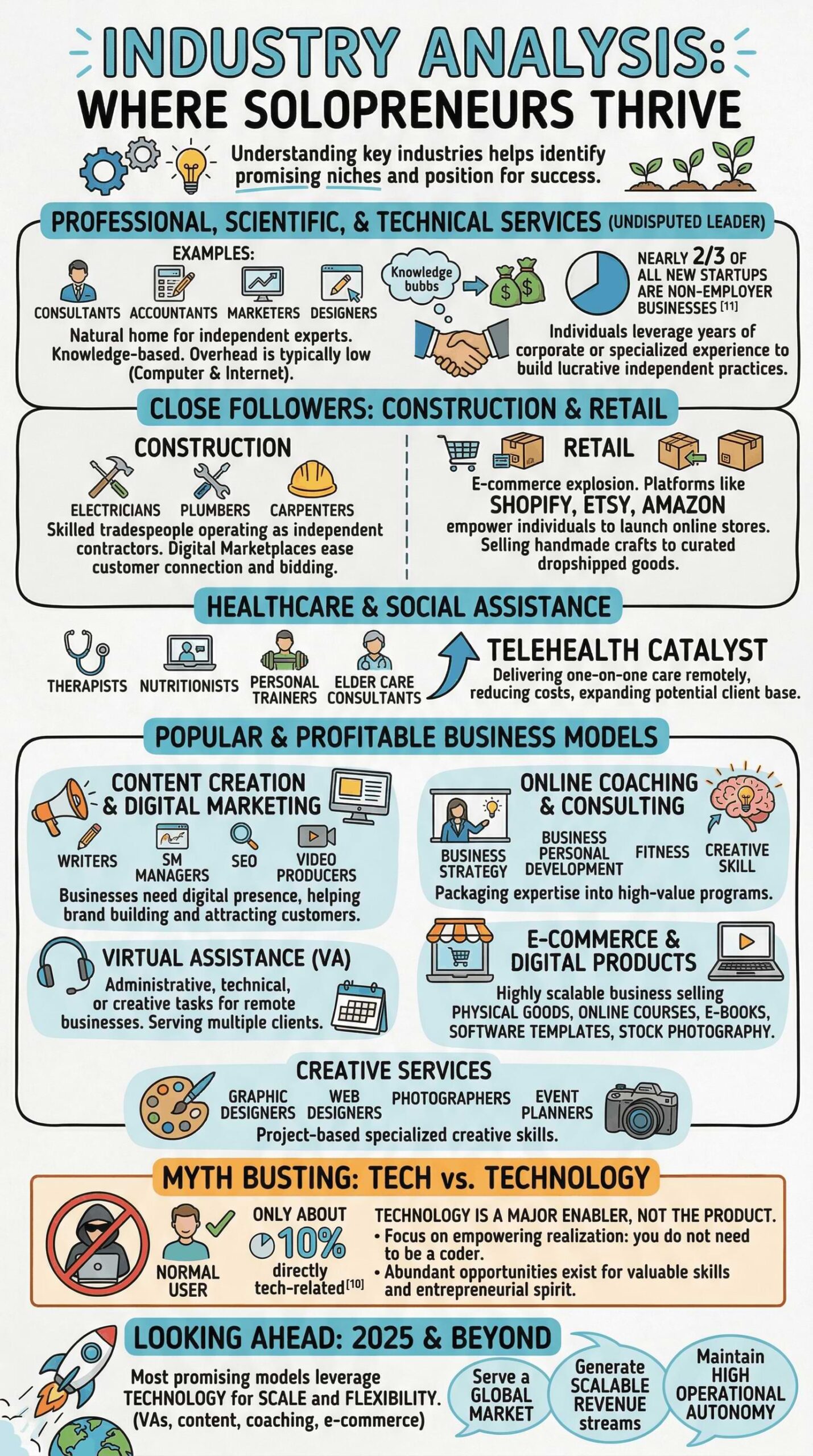
The undisputed leader in the solopreneur landscape is the Professional, Scientific, and Technical Services sector [2, 11]. This broad category, which includes consultants, accountants, marketers, and designers, is a natural home for independent experts. These are knowledge-based businesses in which the primary asset is the solopreneur’s expertise and experience. The model is straightforward: clients pay for specialized advice, execution, and problem-solving. The overhead is typically low, often requiring little more than a computer and an internet connection. The data underscores this dominance, with nearly two-thirds of all new startups in the professional services sector launching as non-employer businesses [11]. This is the quintessential solopreneur domain, where individuals leverage years of corporate or specialized experience to build lucrative independent practices.
Following closely are the Construction and Retail industries [6]. In construction, this often takes the form of skilled tradespeople—electricians, plumbers, carpenters—who operate as independent contractors, managing their own projects and client relationships. The rise of digital marketplaces has made it easier than ever for these professionals to connect with customers, manage bidding, and run their operations. In retail, the explosion of e-commerce has been the primary driver. Platforms like Shopify, Etsy, and Amazon have empowered individuals to launch online stores, selling everything from handmade crafts to curated dropshipped goods, all from a home office or small warehouse without the need for a physical storefront or a large staff.
The Healthcare and Social Assistance sector is another area experiencing significant growth among solopreneurs [2]. This includes a wide range of professionals such as therapists, nutritionists, personal trainers, and elder care consultants. The rise of telehealth, as previously noted, has been a massive catalyst, allowing these practitioners to deliver one-on-one care remotely, dramatically reducing costs and expanding their potential client base beyond their immediate geographic area.
Beyond these broad sectors, several specific business models and fields have emerged as particularly popular and profitable for solopreneurs. These include:
- Content Creation and Digital Marketing: As every business now needs a digital presence, the demand for skilled content creators and marketers has soared. This includes freelance writers, social media managers, SEO specialists, and video producers who help businesses build their brand and attract customers online.
- Online Coaching and Consulting: Individuals with deep expertise in a specific area—be it business strategy, personal development, fitness, or a creative skill—are packaging their knowledge into high-value coaching programs and consulting services.
- Virtual Assistance (VA): As more businesses operate remotely, the demand for skilled virtual assistants to handle administrative, technical, or creative tasks has skyrocketed. VAs operate as independent contractors, often serving multiple clients and building a stable, diversified business.
- E-commerce and Digital Products: These remain powerhouses for solopreneurs. It encompasses not only selling physical goods online but also the highly scalable business of creating and selling digital products like online courses, e-books, software templates, and stock photography.
- Creative Services: Graphic designers, web designers, photographers, and event planners continue to thrive as solopreneurs, offering specialized creative skills to both individual and corporate clients on a project basis [6].
It is crucial to address a common misconception about the solopreneur economy: that it is dominated by the tech industry. While technology is a major enabler of this movement, the data show that only about 10% of American solopreneurs work in directly tech-related fields [10]. The vast majority come from a wide range of other sectors, using technology as a tool to build their businesses rather than as the product itself. This is an empowering realization: you do not need to be a coder or a software developer to build a successful one-person business. Abundant opportunities across countless industries await those with valuable skills and an entrepreneurial spirit.
Looking ahead, the most promising models for 2025 and beyond continue to be those that leverage technology for scale and flexibility. Virtual assistance, content creation, online coaching, and e-commerce are consistently cited as top solo business models because they allow individuals to serve a global market, generate scalable revenue streams, and maintain a high degree of operational autonomy [3].
Navigating the Journey: Challenges and Solutions for the Modern Solopreneur
The path of the solopreneur is one of immense reward, offering unparalleled freedom and the satisfaction of building something from the ground up. However, it is also a path fraught with unique challenges that demand resilience, strategic planning, and a proactive approach to problem-solving. Acknowledging these hurdles is the first step toward overcoming them. For every common struggle, there is a practical solution, a mindset shift, or a tool to help you navigate the complexities of the solo journey and build a more sustainable and fulfilling business.
One of the most significant and pervasive challenges is financial instability. The shift from a predictable bi-weekly paycheck to an income that can fluctuate dramatically from month to month is a source of considerable stress. Over 70% of solopreneurs who consider abandoning their business cite inconsistent income as a primary factor [7]. The average solopreneur in the U.S. earns a modest $39,273 annually from their business, and a significant portion—36%—make less than $25,000 per year [7]. This reality can be daunting.
The solution lies in a multi-pronged financial strategy. First, build a cash buffer. Before you even launch, or as you grow, prioritize creating a financial safety net that can cover several months of business and personal expenses. This cushion provides peace of mind and the stability needed to make strategic rather than desperate decisions. Second, diversify your income streams. As discussed in the business models section, relying on a single client or service is a recipe for fragility. Actively work to build a portfolio of income sources: a mix of project work, a retainer client, a digital product, and affiliate income. This diversification smooths out the peaks and valleys of your cash flow. Finally, master your finances. Use accounting software like QuickBooks to track every dollar, understand your profit margins, and proactively plan for taxes. Financial clarity is the antidote to financial anxiety.
The second major challenge is the immense burden of wearing all the hats. Over 60% of solopreneurs admit to underestimating the difficulty of managing every aspect of their business single-handedly, from marketing and sales to accounting and customer service [7]. This leads directly to the most cited challenge: time management, which 41% of solopreneurs identify as their biggest struggle [7]. The result is often burnout and high stress levels, with 35% of solopreneurs reporting high stress compared to just 26% of business owners with employees [1, 7].
The solution is to embrace the dual mantras of automation and delegation. You must ruthlessly audit your time and identify low-value, repetitive tasks that can be automated. Use the technological enablers at your disposal—workflow automation tools, social media schedulers, and AI assistants—to offload this work to your digital toolkit. For tasks that require a human touch but do not require your unique expertise, do not hesitate to strategically outsource. Hire a virtual assistant for a few hours a week to manage your inbox and scheduling. Contract a bookkeeper to handle your quarterly finances. Engage a freelance designer for a specific project. The cost of this help is an investment that recoups your most precious resource—your time—allowing you to focus on growing your business.
A third, more insidious challenge is the loneliness and isolation that can accompany the solo journey. While the freedom to work alone is a major draw, the absence of colleagues to bounce ideas off, celebrate wins with, or commiserate with during tough times can take a toll. Approximately 13% of solopreneurs report feeling isolated, which can stifle creativity and motivation [1, 7].
The solution is to proactively build your community. Your business may be solo, but your professional life doesn’t have to be. Join industry-specific online forums, Slack communities, or local meetup groups. Form a “mastermind group” with a small, trusted circle of fellow solopreneurs to meet regularly, share challenges, and hold each other accountable. Attend virtual or in-person conferences. These connections provide not only a vital social outlet but also an invaluable network for referrals, collaboration, and shared learning. You must intentionally build the support system that a traditional job once provided automatically.
Finally, solopreneurs often struggle with marketing and customer acquisition, which 34% name as a top challenge [7]. Without a dedicated sales team, the responsibility for keeping the client pipeline full rests squarely on your shoulders.
The solution is to build a growth system. Do not rely on sporadic, random marketing efforts. Develop a consistent content marketing strategy—a weekly blog post, a bi-weekly newsletter, a daily social media presence—that establishes your expertise and builds trust over time. Implement an automated sales funnel to capture leads from your website and nurture them with an email sequence. Most importantly, focus on delivering an exceptional experience to your existing clients. A happy client is your most powerful marketing asset, leading to glowing testimonials, case studies, and valuable word-of-mouth referrals that bring new business to your door with far less effort.
The solopreneur journey is a marathon, not a sprint. By anticipating these challenges and implementing these strategic solutions, you can build a business that is not only profitable but also resilient, sustainable, and deeply rewarding. You have chosen a path of autonomy; empower yourself with the strategies to walk it successfully.
References
- Self-Employment Trends Report 2024 – QuickBooks
- Solopreneur Statistics (2024) – Side Hustle Science
- Solo Business Trends 2025 – Solo Business Hub
- Solopreneur Statistics You Need to Know in 2024 – HIGO Creative
- The Rise of the Solopreneur – Branch
- Solopreneur Market Size: A Detailed Market Analysis – BizStack
- Solopreneur Statistics (2026): Income, Success Rates, & More – FounderReports
- Solopreneurs are Changing the Face of the Economy – Entrepreneur
- Own your income: America’s ‘solopreneur’ business model is booming, from Florida to California – CNBC
- Solopreneur Statistics: The Rise of One-Person Businesses – Leapmesh
- New Business Formation: Solopreneurs Will Drive the Economy in 2025 – Gusto
- How Solopreneurs Can Build a Business Empire in 13 Steps in 2025 – Invoicefly.com
- 10 Business Models for Solopreneurs – IMMA Collective – Substack
- Solopreneur Business Model: How to Build a Scalable One-Person Business – Bask Health
- How to Run a 6-Figure Business as a Solopreneur in 2025? – GoTechFlash
- Which AI tools are actually useful for solopreneurs/small teams? – Reddit
- AI Tools for No-Code Entrepreneurs – Graphic Eagle
- Launch & Grow Your Solo Business with No-Code, A.I. & D.I.Y. Automation – Berkeley Startup Studio
- 7 AI Tools Solopreneurs Are Using to Build 7-Figure Businesses With No Team and No Stress – Entrepreneur
- The Solo AI Tech Entrepreneur in 2025: Top AI Tools Every Solo AI Startup Founder Should Know – Nucamp