Launching a business is exciting, but it is easy to get lost in ideas and tools. As a solo owner, your best advantage is focus. When you chase too many paths, you dilute your time and energy.
The simple path works best. Find one real problem that people already have. Test a small solution quickly. If people respond, keep going. If they do not, change fast. This approach cuts risk, gives you steady feedback, and helps you grow with confidence. You will spend less time guessing and more time serving real needs.
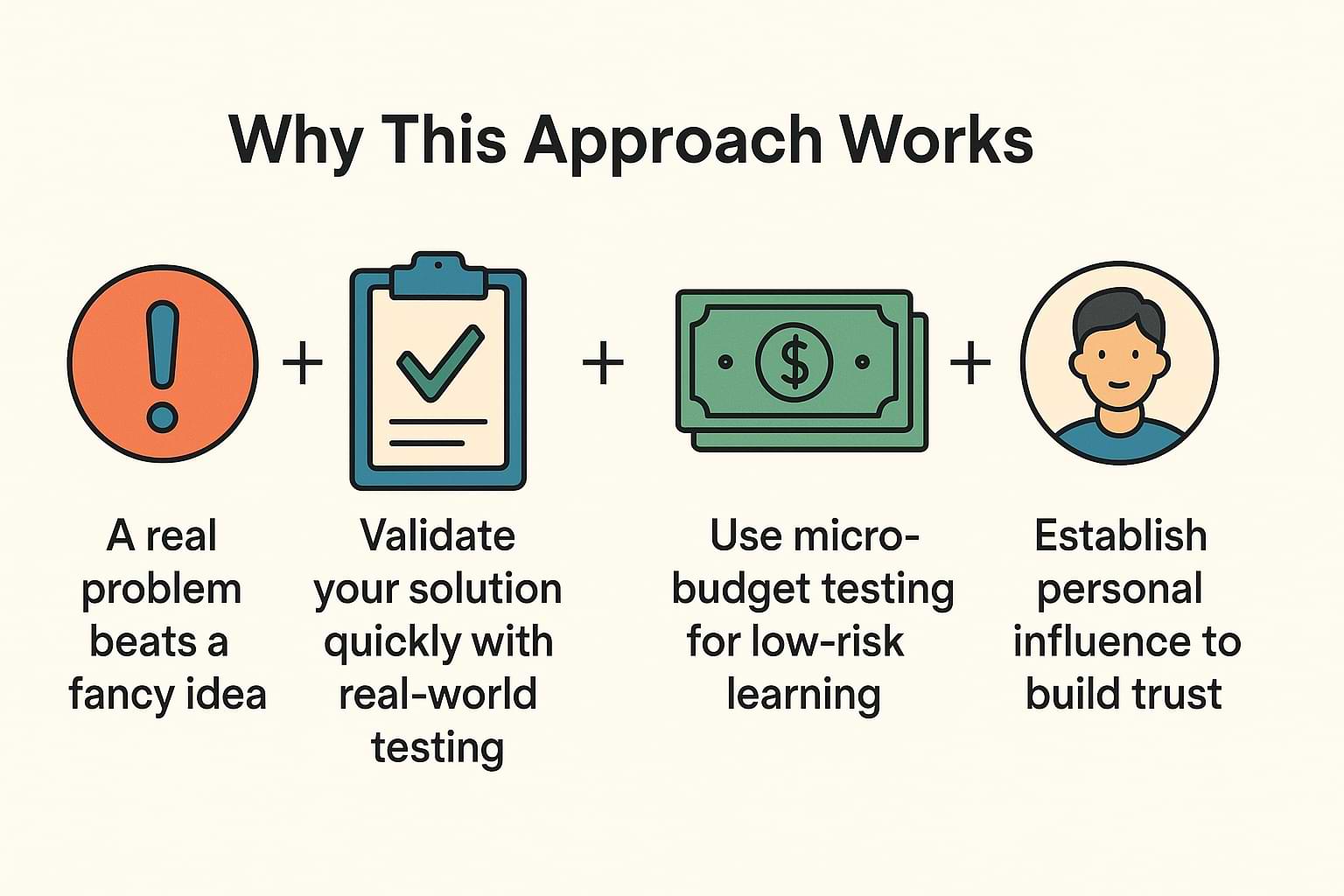
Why This Approach Works
1. A real problem beats a fancy idea
Many projects start with a clever idea but forget the pain that makes someone buy. Buyers act when your solution eases pain, saves time, or saves money. The retention thread in the startups community repeats this lesson. Pick a clear pain, like “I waste time collecting news I care about,” and write it in one plain sentence. Then show a small proof that you can remove that pain. If people lean in, you are on the right track.
2. Validate your solution quickly with real-world testing
You do not need months of research to learn if people care. Talk to five to ten potential customers. Ask how they solve the problem today, what they tried, and what would make them switch. Offer the smallest version of your solution so they can try it. You can do this with a simple landing page, a one-page PDF, or a short video demo. Charge a small amount if you can. Buyers tell you the truth with their wallets.
3. Use micro-budget testing for low-risk learning
You can learn a lot with a hundred to two hundred dollars. Members in the entrepreneur community suggest buying and reselling items to practice pricing, photos, delivery, and service. The point is not the items. The point is learning how to find demand, make an offer, and close a sale. You can do the same with services. Offer a small starter package. Keep the scope tight and measure results.
4. Establish personal influence to build trust
People like to buy from people. If you show up with useful tips, quick wins, and honest stories, you build trust. That trust lowers the barrier to your offers. Even a small newsletter or a helpful thread can move the needle. Share what you learn and invite questions. When others feature your story, it acts as social proof.
5. Focus on practical, reliable niches for steady income
Flashy ideas get attention, but practical services pay the bills. Threads in the entrepreneur community highlight “boring” businesses such as cleaning, lawn care, laundry, and hauling. These solve clear needs, have repeat demand, and let you start lean. You can add simple marketing and strong service to grow in your area.
Start by Solving Real Problems and Validating Quickly!
What To Do First
Write one sentence that names your customer and their problem. For example: “Busy parents want healthy dinners they can make in under 20 minutes.” List three ways you can help right now. Turn each into a small proof. Record a 30-second demo. Create a one-page checklist. Or make a before-and-after photo. Choose one platform where your audience spends time. Post one piece of proof with a clear call to action, like “Reply for the checklist” or “DM for the recipe plan.” Your goal is to see who engages and what they ask next.
Step-by-Step Plan
-
Define the pain and the person. Write the one-sentence problem and who has it. Keep it simple and real.
-
Craft a short value promise. In 12 to 15 words, say how you reduce time, cost, or hassle. Example: “Healthy dinners prepped in 10 minutes with three ingredients.”
-
Create one tiny proof. Record a 30-second screen or phone video. Show the result, not the features.
-
Set up a simple capture. Use a form or a pinned comment to collect replies, DMs, or emails.
-
Post once per day for seven days. Share the same core promise in different angles: a tip, a demo, a before-and-after, a checklist, a mini case.
-
Track strong signals. Prioritize direct replies, DMs, and opt-ins. Views and likes matter less than conversations.
-
Republish your winner. Take the best post and adapt it to a second channel. Keep the promise, change the format and headline.
-
Make a micro-offer. Sell a tight outcome for a small price, for example $29 for a starter call, $49 for a local visit, $99 for a setup kit.
-
Close the loop with every responder. Thank them, ask one follow-up question, and log their words. Use those words in the next post.
-
Improve activation. If people sign up but do not use your product, cut steps, simplify the first screen, or add a quick-start guide. Tie the first session to a clear win.
-
Remove vanity work. Skip awards or activities that do not bring buyers, even if they look good on social. Put time into content and offers that create conversations.
-
Build a light listening habit. Create two or three alerts for your niche, join one small community, and scan once a day. Use what you learn to guide your next post or offer.
Examples and Quick Wins
- A local fitness coach posts a 20-second video showing a chair workout. The call to action is “Comment ‘chair’ for a 3-move plan.” Ten people comment. The coach sends the plan, books three paid sessions, and uses the client words in the next post.
- A bookkeeping freelancer shares a before-and-after of a messy spreadsheet and a simple dashboard. The offer is “First five replies get a free 10-minute review.” Four sign up. Two become monthly clients.
- A home cleaning service posts a checklist for a 30-minute kitchen reset. The call to action is “DM ‘kitchen’ for the printable.” Fifteen DMs arrive. Five book a one-time clean. Two become biweekly clients.
Simple Metrics To Track
Track weekly with a simple sheet. First, conversations started, which includes replies and messages. This shows real interest. Second, opt-ins or emails collected. This gives you a way to follow up. Third, micro-offer sales. Even small purchases prove that your message maps to money. Fourth, activation rate for product users. Count the share of new users who complete the first key action in the first week. Fifth, repeat actions, such as a second purchase or a booked follow-up. That points to trust.
7-Day Action Plan
Day 1: Write your one-sentence problem and value promise. Draft three proof ideas and one micro-offer.
Day 2: Record a 30-second demo or before-and-after. Post it with a clear hook and a call to action. Set up a way to capture replies or emails.
Day 3: Share a checklist or tip that removes one step for your customer. Ask for replies to get the file.
Day 4: Post a mini case. Describe one result in plain language, even if it is your own test. Invite DMs for a starter session.
Day 5: Review signals. Identify the post with the most conversations. Rewrite the hook. Post a stronger version.
Day 6: Republish the winner on a second channel in a native format. Keep the same promise and call to action.
Day 7: Offer your micro product or service to people who engaged. Keep it small and clear, and book the next step on a calendar link.
Why This Matters
- Focus: One clear problem lines up your content, offers, and product changes. That creates compounding gains.
- Efficiency: Small proofs and micro-offers teach you faster than long research. You save time and money.
- Credibility: Showing useful results in public builds trust. Third-party features, even small ones, add social proof.
- Stability: Practical niches and repeatable wins create steady income you can grow over time.
Final Thought
You do not need perfect plans. You need a clear problem, a small proof, and the courage to ask for a response. Do that every day for a week and your next steps will become obvious. What is the one problem you will commit to solving for the next 30 days, and what is the one post you will publish today to prove you can solve it?
Editor’s Note: This article draws primarily from the r/startups thread about a personalized news reader that struggles with retention. It also references the r/Entrepreneur discussion on “boring” businesses, the r/marketing debate about vote-driven awards, the r/startups spotlight offer for small newsletters, and the r/smallbusiness check-in on how owners keep up with news.
Sources
-
What “boring” business would you start today? — r/Entrepreneur: https://www.reddit.com/r/Entrepreneur/comments/1lp0ybs/what_boring_business_would_you_start_today/
-
Is my SaaS cooked? I built a personalized news reader, but no one’s sticking around—r/startups: https://www.reddit.com/r/startups/comments/1m9wswe/is_my_saas_cooked_i_built_a_personalized_news/
-
I will not promote—looking for a startup to spotlight—r/startups: https://www.reddit.com/r/startups/comments/1mh3lkv/i_will_not_promote_looking_for_ai_startup_to/
-
Is USA TODAY’s 10Best just ad farming? — r/marketing: https://www.reddit.com/r/marketing/comments/1kxndch/is_usa_todays_10best_just_ad_farming/
-
How do you keep up with business and tech news? — r/smallbusiness: https://www.reddit.com/r/smallbusiness/comments/1mckfgn/how_do_you_guys_keep_up_with_business_and_tech/
See my archive of Tips Tuesday articles.
This Blog Post is Brought to You by Blubrry
If you’re in need of a podcast host, let me recommend Blubrry podcast hosting. No contracts and you can cancel at any time. Plus they’ve redesigned their dashboard and it’s a beautiful and simplified. Competitive prices too! And if you already have a podcast host, migrate to Blubrry for free!