Beyond the 5-Star Fluff: The Power of the Transformation Testimonial
It is Monday morning. You open your laptop, ready to share your work, but you feel that familiar weight in your chest. The digital world is louder than ever.
We are drowning in a sea of AI-generated reviews, “perfect” testimonials that sound suspiciously like a robot wrote them, and endless scrolling. Your potential clients are tired. They are skeptical. They are looking for a reason to believe you are a real human who can actually help them, not just another polished avatar in their feed.
In this era of “AI slop,” traditional social proof has lost its edge. A simple “They were great to work with!” no longer moves the needle. People have developed a sixth sense for manufactured praise.
To break through the noise in 2026, you do not need more reviews. You need better ones. You need social proof that tells a story of change. You need the Transformation Testimonial.
Why “Good” Isn’t Good Enough Anymore
For years, we were told to collect as many five-star ratings as possible. We put those gold stars on our websites like participation trophies. But here is the truth: a five-star rating with no context is just data. Data does not build trust. Stories do.
The human brain is wired to look for patterns of survival and success. When a prospect evaluates your service, they are not asking whether you are “good.” They are asking, “Can this person take me from where I am now (pain) to where I want to be (peace)?”
Standard testimonials focus on the “now.” They mention how kind you are or how quickly you replied. While those are great traits, they do not prove you can facilitate a result. The Transformation Testimonial is different because it focuses on the journey. It bridges the gap between your prospect’s current struggle and their future success.
The Anatomy of a Transformation Testimonial
A transformation testimonial is a three-act play captured in a few sentences or a short, unedited video. It does not need high production value. In fact, in 2026, the more “lo-fi” it looks, the better. A video shot on a phone in a kitchen often converts better than a studio-produced case study because it feels real.
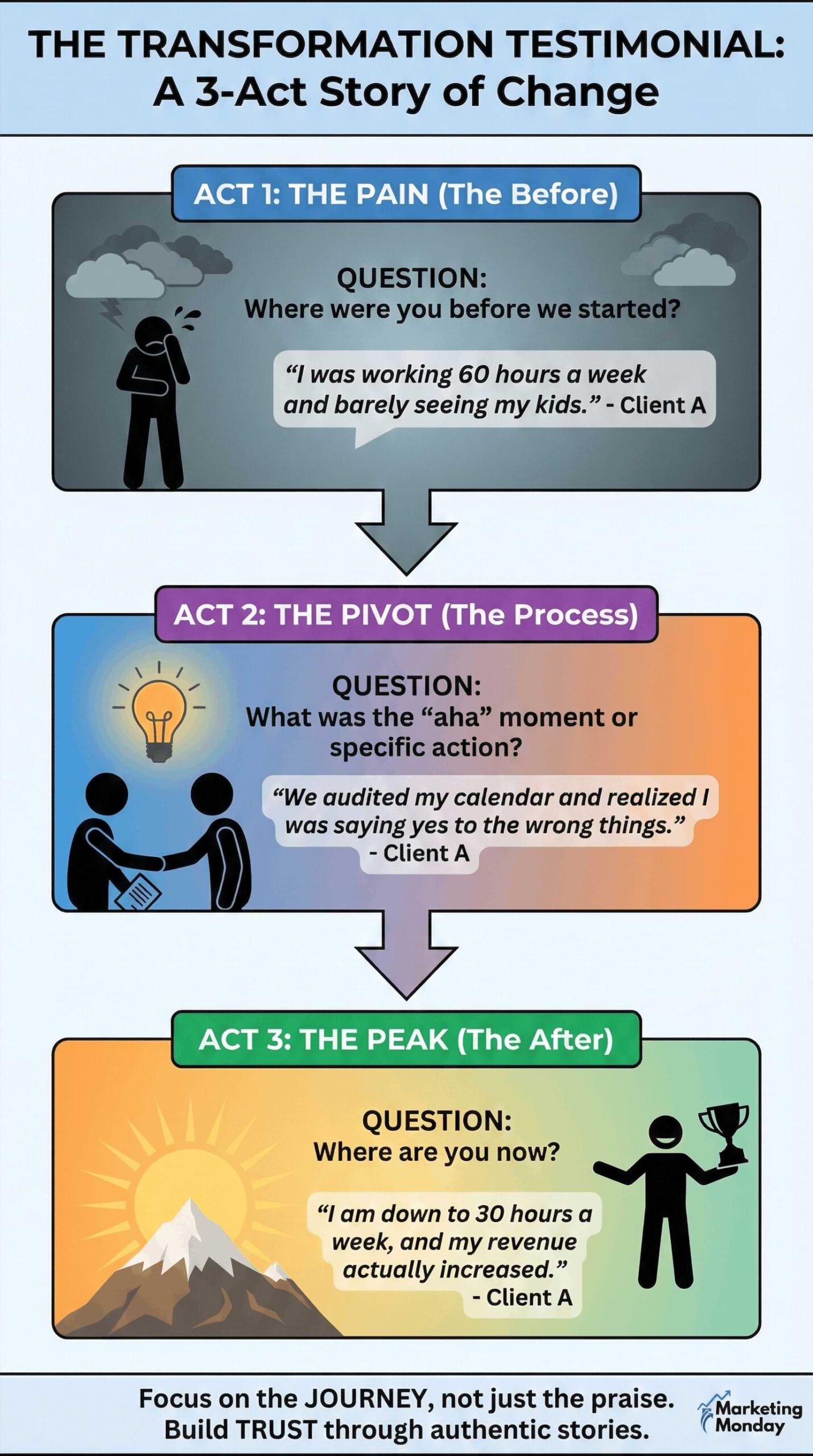
To create this, you need to guide your clients to answer three specific questions:
-
The Pain (The Before): Where were you before we started? (e.g., “I was working 60 hours a week and barely seeing my kids.”)
-
The Pivot (The Process): What was the “aha” moment or the specific thing we did together? (e.g., “We audited my calendar and realized I was saying yes to the wrong things.”)
-
The Peak (The After): Where are you now? (e.g., “I am down to 30 hours a week, and my revenue actually increased.”)
When a prospect reads that, they do not just see a recommendation. They see a roadmap. They see themselves in the “Before,” and they crave the “After.”
The Anti-Hustle Approach to Social Proof
As a solopreneur, you do not have a marketing department to chase down leads and film documentaries. That is okay. Our “Pro-Focus” philosophy means we do less, but better. You do not need 100 generic reviews. You need three to five deep transformation testimonials.
Stop sending automated “Please leave a review” emails that go to everyone. Instead, identify three clients who have had a genuine breakthrough in the last quarter. Send them a personal note. Tell them you loved seeing their progress and ask if they would mind sharing that specific story.
Owning your audience means building deep, human connections. A single, heartfelt story on your email list is worth more than a thousand “likes” from strangers on a rented social platform.
Human Authenticity Over Polished Perfection
If a client sends you a video with background noise or their dog barking midway through, do not edit it out. In 2026, those are “trust signals.” They prove that a real person took time out of their real life to talk about you.
We are moving away from the “minimalist aesthetic” of the early 2020s. People are craving the “cringe” and the “raw.” They want to see the effort. When you show a testimonial that feels unscripted, you are telling your audience, “I have nothing to hide. This is real.”
How to Ask Without Feeling “Salesy”
Most solopreneurs avoid asking for testimonials because it feels like a favor. Shift your mindset. You are not asking for a favor; you are asking for a success story that might inspire someone else who is currently struggling, as your client once was.
Use this simple script for your next check-in:
“I am so proud of the progress you made on [specific goal]. I know there are others out there feeling exactly how you felt three months ago. Would you be open to sharing a quick ‘before and after’ of your experience? It helps me show people that change is actually possible.”
This positions the request as a way to help others, which makes most clients much more willing to participate.
Your Assignment: The Three-Email Challenge
You do not need a new software tool or a complex funnel to fix your social proof. You just need to start the conversation.
Your Action Step: Identify three past or current clients who have experienced a visible change because of your work. Send them a personalized email or voice note today. Ask them those three core questions: Where were you? What did we change? Where are you now?
Collect these stories and place them prominently on your “About” page or in your next email broadcast. Watch how the tone of your inquiries changes from “What do you do?” to “Can you do for me what you did for them?”
The era of generic five-star reviews is over. In 2026, people are exhausted by AI-generated praise and polished marketing. If you want to build real trust as a solopreneur, you must focus on the transformation testimonial. Share on X“Marketing Monday” articles archive.

Note: Some links on this page are affiliate links meaning that if you click on my link and make a purchase, I will receive a small commission. It does not however affect the price you pay. Plus, it’s a great way to support me and the content I’m providing.