Happy New Year (almost)!
If you are like most solopreneurs, you are likely staring at a fresh planner, a blank Notion board, or a pristine Google Calendar with a mix of genuine excitement and absolute dread.
The “gurus” and the algorithms are already shouting at you. They’re telling you that in 2026, you must be using the latest AI agents to auto-post, you must be publishing vertical video three times a day, you must start a video podcast, and you must be on the newest social platform that launched last month.
Stop. Breathe.
Here is the truth about marketing in early 2026 that few people will tell you: We have reached peak noise.
With the explosion of generative AI over the last two years, creating content has become free and instant. The result? The internet is flooded with average, “good enough” content. Your customers are overwhelmed. They are skeptical of “perfectly polished” brands because they can’t tell what’s real and what’s synthetic.
If you try to do everything this year, you’ll just be background noise. You will burn out by March, and your bank account won’t show the difference.
So, for our first Marketing Monday of the year, we are doing something different. We aren’t making a list of things to add to your plate. We are making a list of things to remove.
Welcome to the Anti-Resolution Marketing Plan.
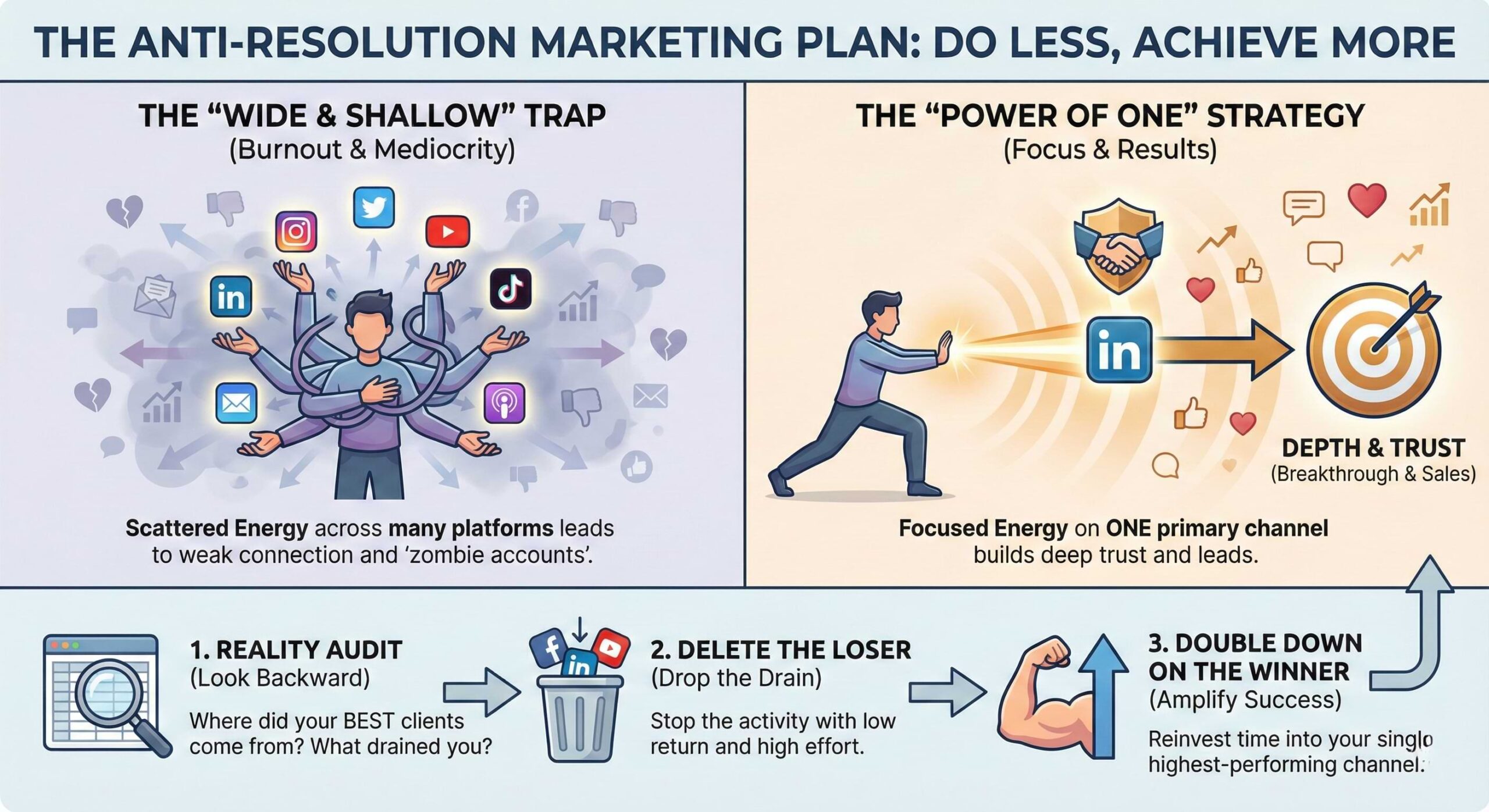
The Trap: The “Omnichannel” Myth
The biggest mistake small business owners made in 2025 was trying to be omnipresent.
There is a pervasive myth that to be successful, you must be “omnichannel”—meaning you need to be active on Instagram, LinkedIn, YouTube, TikTok, Threads, and email simultaneously.
What does this mean for a Fortune 500 company that employs 20 people in its marketing department? For you, the solopreneur wearing every hat in the business? It’s a trap.
When you try to run five channels by yourself, you don’t end up with five strong streams of leads. You end up with five mediocre ones. You end up with “zombie accounts”—profiles that haven’t been updated in three weeks, which actually hurts your brand credibility more than not having an account at all.
In 2026, the market rewards depth and trust. It favors the creator who shows up consistently and authentically in one place, rather than the brand that reposts generic, reposted content everywhere.
The Strategy: The Power of One
To win Q1, I want you to embrace the “Power of One.”
This isn’t about laziness; it’s about physics. If you poke a wall in ten different spots, nothing happens. If you hit the wall ten times in the exact same spot, you break through.
A Tale of Two Solopreneurs
Let’s look at a hypothetical example to illustrate this.
Solopreneur A (The “Spread Thin” Strategy): They decide to post daily on Instagram, weekly on LinkedIn, and start a YouTube channel. They spend 15 hours a week creating content. Due to their rushed approach, the captions end up being generic. They don’t have time to reply to comments because they are too busy editing the next video.
-
Result: They gain followers slowly across all platforms, but engagement is low. They get zero qualified leads because they haven’t built deep trust with anyone.
Solopreneur B (The “Power of One” Strategy): They decide their audience is primarily on LinkedIn. They delete Instagram from their phone. They spend 5 hours a week on LinkedIn content, and—crucially—5 hours a week commenting on other people’s posts and sending personal DMs.
-
Result: They become a known face in their specific niche. Their inbox is full of inquiries because people feel like they know them. They worked 10 hours instead of 15, and they made sales.
Your Assignment: The 2025 Reality Audit
Before you write a single social media post or spend a dime on ads this week, you need to look backward.
Ignore the “vanity metrics.” I don’t care how many views your Reel got in October. You can’t pay your mortgage with views. I want you to look at your bank account and your CRM (or spreadsheet).
Ask yourself these three difficult questions:
1. Where did my best clients actually come from? Trace the dollar back to the source. Did your three highest-paying clients come from referrals? Then perhaps your “marketing” strategy shouldn’t be social media at all—it should be a weekly email to your past clients asking for introductions. Did they come from Instagram? Then stay there, and ignore LinkedIn.
2. Which marketing task made me want to quit my business? Did you spend hours fighting with video editing software only to get 50 views? If a marketing activity drains your energy and returns no money, it is not “hustling.” It is self-sabotage.
3. If I could only use ONE app for the next 90 days, which would I keep? If you were forced to delete everything else, what is the one tool that connects you to the people who actually buy from you?
The “Permission to Quit” List
Here is your permission slip for Q1 2026. You are allowed to:
-
Quit a platform that you hate using. (If you hate it, your audience can tell).
-
Stop doing video if you express yourself better through writing.
-
Stop posting daily. Three high-quality, thoughtful posts are worth more than seven “filler” posts generated by ChatGPT.
-
Ignore the trends. You don’t need to use the trending audio. You need to solve your client’s problem.
The Action Step: This week, identify your One Channel and your One Offer. Write them on a sticky note and put it on your monitor. Everything else is a distraction.
Permit yourself to do less so you can achieve more.
Let’s make 2026 the year of focus.
Stop trying to be everywhere this year and instead read my Anti-Resolution Marketing Plan which explains why deleting half your to-do list is the best way to build trust and grow your business in 2026. Share on X“Marketing Monday” articles archive.

Note: Some links on this page are affiliate links meaning that if you click on my link and make a purchase, I will receive a small commission. It does not however affect the price you pay. Plus, it’s a great way to support me and the content I’m providing.