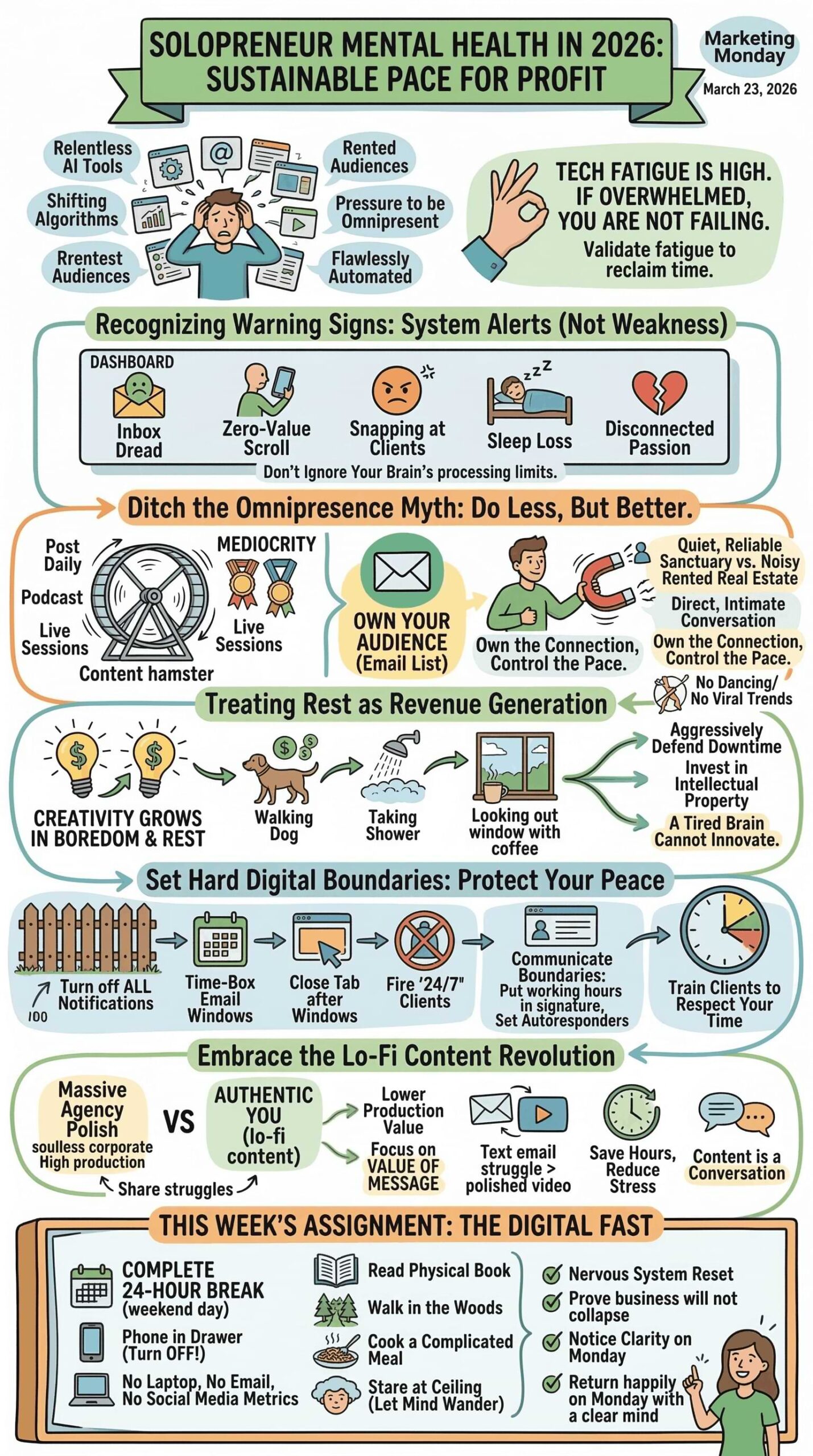
Let us talk about the exhaustion. You sit down at your computer, open your email, and immediately feel the weight of a dozen different platforms demanding your attention. Between the relentless pace of new AI tools launching every week and the shifting algorithms that make rented social media audiences feel increasingly fragile, tech fatigue is at an all-time high.
We live in a digital ecosystem designed to extract our attention at all costs. The pressure to be omnipresent, hyper-productive, and flawlessly automated is breaking solopreneurs left and right.
If you are feeling overwhelmed right now, you are not failing. You are experiencing the natural, human result of a deeply unnatural digital environment. Validating this fatigue is the first step toward reclaiming your time.
Recognizing the Warning Signs of Tech Fatigue
Before you can implement a sustainable pace, you have to recognize the symptoms of burnout. It rarely happens all at once. It creeps in slowly. Maybe it feels like a sudden, intense dread when you open your inbox. Perhaps it manifests as spending hours “researching” on social media without actually producing anything of value. You might find yourself snapping at clients, losing sleep over minor technical glitches, or feeling entirely disconnected from the original passion that made you start your business in the first place.
These are not signs of weakness. They are system alerts. Just as your car’s dashboard flashes a warning light when the engine overheats, your brain signals when it has reached its processing limit. Ignoring these signals in the name of “hustle” is the fastest route to a complete shutdown.
The Myth of the Omnipresent Brand
We have been sold the lie that doing more inevitably leads to making more. Industry gurus constantly preach the necessity of being everywhere at once. They tell you to post daily on three platforms, run a podcast, write a blog, and host weekly live sessions. The reality is quite the opposite. Spreading yourself thin across five different channels guarantees mediocre performance on all of them.
This is why we advocate for doing less, but doing it with exceptional focus. It is time to step off the content-hamster wheel. Focus entirely on owning your audience. Your email list is a quiet, reliable sanctuary compared to the noisy, rented real estate of social media feeds. An email is a direct, intimate conversation with someone who actually raised their hand and asked to hear from you. Nurturing that list requires deep focus and genuine empathy. It does not require dancing on camera, chasing viral audio trends, or burning yourself out for a brief spike in vanity metrics. When you own the connection, you control the pace.
Treating Rest as a Revenue-Generating Activity
So how do we build a truly sustainable pace in practice? We start by fundamentally redefining what “work” looks like. We must begin treating rest as a revenue-generating activity. Think about the last time you had a brilliant idea for a new product, a perfect pivot for a client, or a deeply resonant piece of content. Chances are high that the idea did not come to you while you were staring at a spreadsheet at two in the morning. It probably arrived while you were walking the dog, taking a shower, or simply looking out the window with a cup of coffee.
Boredom and rest are the fertile soil where creativity grows. By aggressively defending your downtime, you are actually investing in your business’s future intellectual property. If you want to produce high-value insights for your clients, you need the mental bandwidth to synthesize information. A tired brain cannot innovate.
Setting Hard Digital Boundaries
To protect your peace, you must set ruthless digital boundaries. Turn off the notifications on your phone. All of them. Create specific, time-boxed windows where you check your email, and close the tab completely when those windows are over. If a client expects you to be available twenty-four hours a day, they are not the right client for a sustainable solopreneur. Let them go find someone else to text at midnight.
Communicate your boundaries clearly and unapologetically to everyone you work with. Put your working hours in your email signature. Set autoresponders that let people know exactly when they can expect a reply. You will be amazed at how quickly people respect your time when you show them that you respect it first. Training your clients to respect your schedule is a fundamental part of managing your mental health.
The Lo-Fi Content Revolution
Finally, embrace the lo-fi revolution. Your audience does not want hyper-polished, over-produced corporate content from you. If they wanted that, they would follow a massive agency. They follow you because they want you. They want the messy, human, authentic reality of your creative process. A simple text-based email sharing a genuine struggle or a quiet realization will always outperform a heavily edited video that lacks a soul.
Give yourself permission to lower the production value. Focus exclusively on the value of the message instead. This one shift alone will save you hours of editing time and buckets of unnecessary stress. It brings the joy back into content creation and makes your marketing feel less like a chore and more like an ongoing conversation with friends.
This Week’s Assignment: The Digital Fast
Your task this week is to take a complete 24-hour break from your business and digital devices. Choose a day this weekend. Turn your phone off and put it in a drawer. Do not open your laptop. Do not check your email. Do not look at your social media metrics.
Spend that time doing absolutely anything else. Read a physical book. Go for a long walk in the woods. Cook a complicated meal from scratch. Stare at the ceiling and let your mind wander. The goal is to let your nervous system reset and to prove to yourself that your business will not collapse if you step away for one single day. Take note of how much clearer your mind feels on Monday morning when you return to your desk.
The hustle culture of the past is burning out independent creators. In 2026, the most successful business owners recognize that treating rest as a priority is not lazy. It is a calculated solopreneur mental health strategy. Share on X“Marketing Monday” articles archive.

Note: Some links on this page are affiliate links, meaning that if you click on my link and make a purchase, I will receive a small commission. It does not, however, affect the price you pay. Plus, it’s a great way to support me and the content I’m providing.