People buy from people, which is why your founder story marketing is the most powerful asset you have in a world of AI-generated noise.
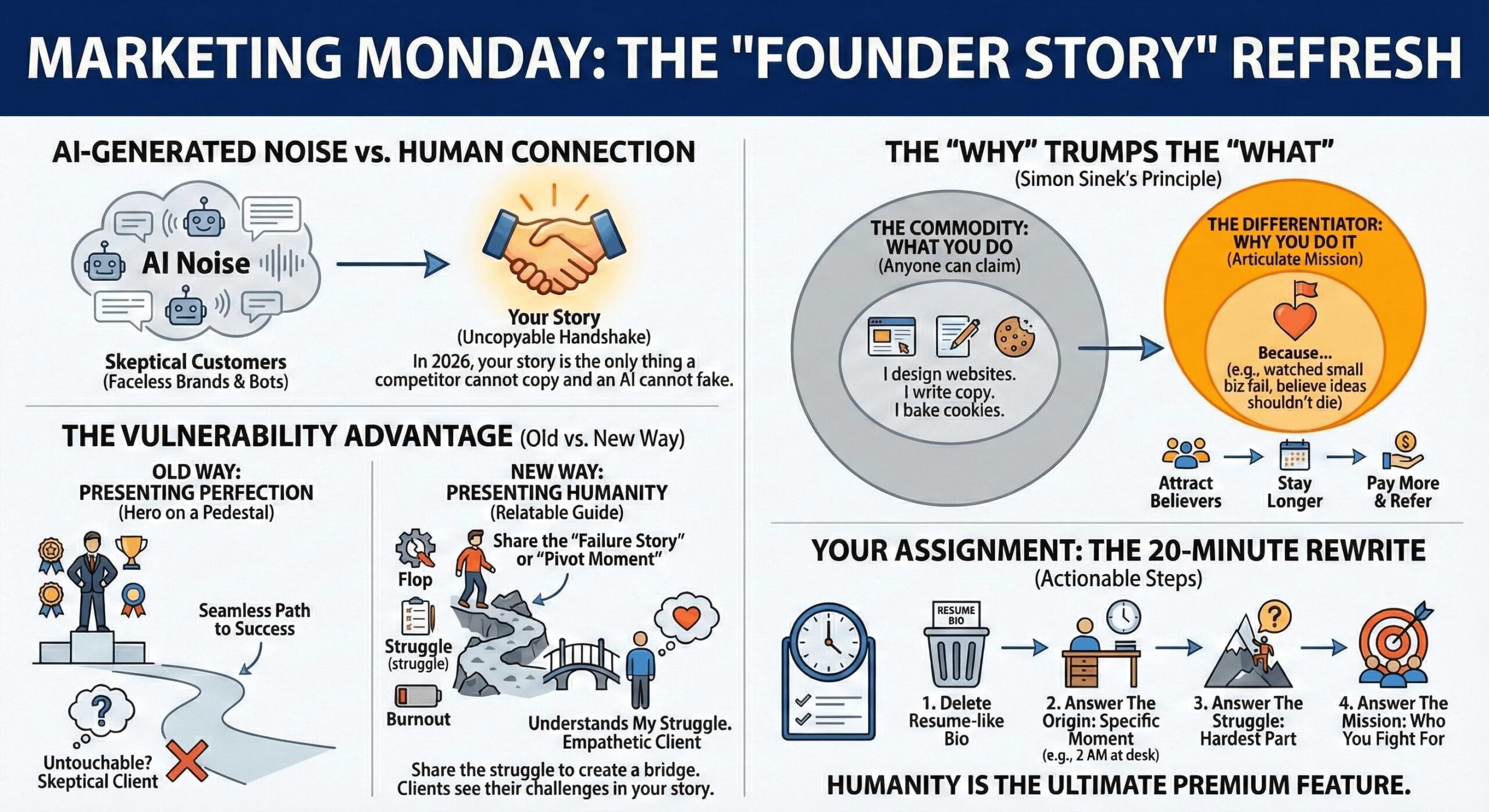
We often think of our “About” page or bio as something we write once and never update. We treat it like a static resume. But in 2026, when customers are skeptical of faceless brands and automated support bots, your story is your handshake. It is the only thing a competitor cannot copy and an AI cannot fake.
If you haven’t updated your story in the last year, it is likely gathering dust. It might list your credentials or your history, but does it tell the truth? Does it explain the why?
The Vulnerability Advantage
The old way of writing a founder story was to present yourself as a hero. You listed your awards. You talked about your seamless path to success. You tried to look untouchable.
The new way is to present yourself as a human.
Clients today are not looking for a perfect hero on a pedestal. They are looking for a guide who understands their struggle. The most effective marketing strategy right now is vulnerability.
This doesn’t mean you need to treat LinkedIn like a therapy session. It means sharing the “failure story” or the “pivot moment.”
Did you launch a product that flopped? Did you struggle to find your first five clients? Did you leave a corporate job because you were burnt out?
When you share the struggle, you create a bridge. The reader sees their own challenges in your story. They stop thinking of you as a business entity and start seeing you as a person who has overcome what they are currently facing.
The “Why” Trumps the “What”
Simon Sinek said it years ago, but it is even more true now. People don’t buy what you do; they buy why you do it.
Most solopreneurs focus entirely on the “what.” I design websites. I write copy. I bake cookies.
That is a commodity. Anyone can claim to design websites.
Your “why” is your differentiator. I design websites because I watched my parents’ small business fail due to poor visibility, and I don’t want that to happen to you. I write copy because I believe great ideas shouldn’t die just because the founder doesn’t know how to sell them.
When you articulate your mission, you attract believers, not just buyers. Believers stay longer. They pay more. They refer their friends.
Your Assignment: The 20-Minute Rewrite
This week, I want you to read your current bio or “About” section. If it reads like a resume, delete it.
Draft a new version that answers these three questions:
-
The Origin: What specific moment made you start this business? (Be specific. “I was sitting at my desk at 2 AM…” is better than “I wanted freedom.”)
-
The Struggle: What was the hardest part of the journey so far?
-
The Mission: Who are you fighting for?
You don’t need to be dramatic. You just need to be real. In a digital world, humanity is the ultimate premium feature.
People buy from people, which is why your founder story marketing is the most powerful asset you have in a world of AI-generated noise so stop writing your bio like a resume and start sharing the real reason you do this work. Share on X“Marketing Monday” articles archive.

Note: Some links on this page are affiliate links meaning that if you click on my link and make a purchase, I will receive a small commission. It does not however affect the price you pay. Plus, it’s a great way to support me and the content I’m providing.