Email marketing is both a foundational channel for digital communication and one of the highest‑performing tools for driving revenue, with global usage, engagement, and ROI stats that underscore its importance.
What is email marketing?
Email marketing is a form of digital and direct marketing that uses emails to send commercial and relationship-focused messages to people who have opted in to hear from a business or creator. These messages range from newsletters and product launches to promotions, educational content, and transactional emails like receipts, onboarding sequences, or reminders.
At its core, email marketing aims to build and maintain trust, move people through a customer journey, and drive specific actions such as clicks, purchases, event registrations, or replies. Because subscribers actively choose to receive messages, this channel often converts better than many “interruption” channels like untargeted ads or organic social posts.
Why email still matters
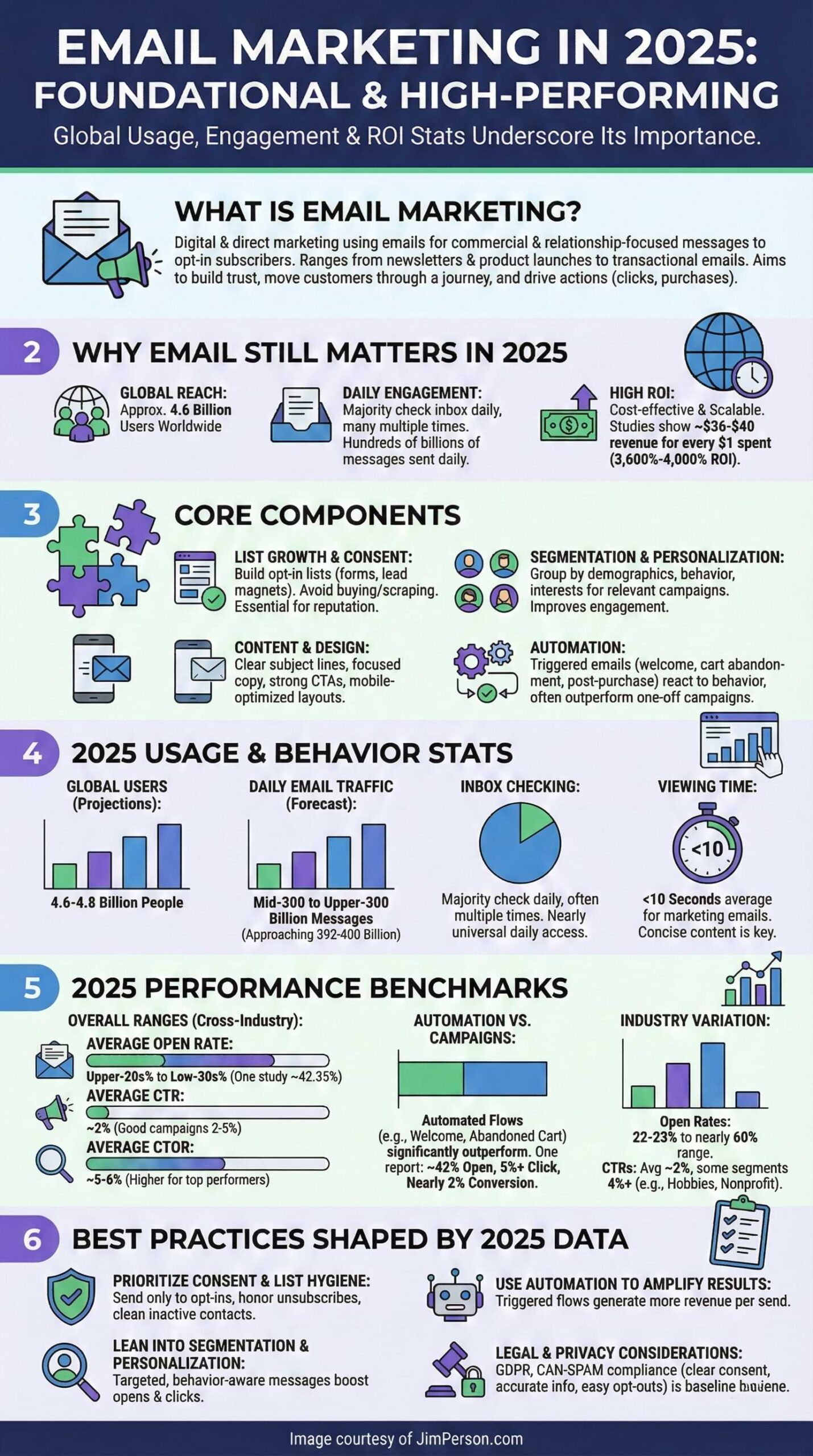
In 2025, email remains central to online communication, with global user counts projected at roughly 4.6 billion people and daily volumes in the hundreds of billions of messages. Studies show that the vast majority of users check their inbox at least once a day, and a large share check it multiple times per day, making email one of the most consistently accessed digital touchpoints.
From a business perspective, email is highly cost‑effective and scalable, allowing organizations of all sizes to reach small segments or very large lists with minimal incremental cost per message. Several studies from 2024 to 2025 say that email marketing brings in about 36 to 40 units of revenue for every 1 unit spent. This means that the return on investment (ROI) is about 3,600 to 4,000%, making it one of the most profitable ways to market.
Core components of email marketing
Successful email marketing rests on a few core building blocks that shape performance and long‑term deliverability. The main components include:
- List growth and consent: Building an email list through opt‑in forms, lead magnets, checkout flows, and content sign‑ups, rather than buying or scraping addresses, is considered essential to protect reputation and comply with regulations.
- Segmentation and personalization: Grouping subscribers by demographics, interests, purchase history, or behavior enables more relevant campaigns than generic blasts, which generally improve opens, clicks, and conversions.
- Content and design: Clear subject lines, focused copy, strong calls to action, and mobile‑optimized layouts help maximize engagement while keeping messages easy to consume on phones and desktops.
Automation is another key layer, using triggers and workflows to send the right message at the right time, such as welcome sequences, cart or browse abandonment flows, and post‑purchase follow‑ups. These automated emails often outperform one‑off campaigns because they react to subscriber behavior and stage in the customer journey.
2025 email usage and behavior stats
Recent 2025 and late‑2024 reports highlight that email is still growing in both users and message volume worldwide. Projections put the global email user base around 4.6–4.8 billion people in 2025, with daily email traffic in the mid‑300 to upper‑300 billion range and forecast to approach roughly 392–400 billion messages per day within a few years.
User behavior data shows a high frequency of inbox checking. One analysis cited nearly universal daily email access, with the majority of people checking their inbox several times a day and only a small minority not checking daily at all. Average viewing times for individual marketing emails can be quite short—often under 10 seconds for a large segment of readers—so concise, scannable content is important for capturing attention.
2025 performance benchmarks
Across multiple datasets, email engagement metrics in 2024–2025 are strong, but exact averages vary by methodology, industry, and region. Pulling together several sources gives a useful benchmark range for planning and comparison.
Overall performance ranges
Broad, cross‑industry benchmarks typically show:
- Average open rate: somewhere in the upper‑20s to low‑30s percent range in many summaries, with at least one 2025 benchmarking study reporting an overall open rate of about 42.35% and a wide spread by industry.
- Average click‑through rate (CTR): around 2% for many lists, with successful campaigns often landing in the 2–5% band depending on segment and offer.
- Average click‑to‑open rate (CTOR): roughly 5–6% overall, with higher values for top‑performing campaigns.
These metrics illustrate that while many people open emails, a smaller subset clicks, making link placement, call‑to‑action clarity, and offer relevance critical for performance.
Benchmarks by campaign type
Studies that distinguish between bulk campaigns and automated flows show consistent gaps in favor of automation. One 2025‑aligned report found automated emails ending a recent year with around a 42% open rate, a 5%+ click rate, and nearly a 2% conversion rate, significantly higher than regular campaign averages.
Common automated flows include welcome series, abandoned cart and browse reminders, post‑purchase sequences, back‑in‑stock alerts, and win‑back campaigns. As brands increase the volume of these automated sends—sometimes multiplying back‑in‑stock or welcome emails several times year over year—these flows are accounting for a disproportionate share of revenue from email.
Industry variation
Industry‑specific benchmarks in 2025 show wide differences in open and click metrics across sectors. For example, one dataset highlights:
- Open rates: an overall average of about 42.35%, but with sector ranges from roughly 22–23% on the low end to nearly 60% on the high end.
- CTRs: an average near 2.00%, with some segments reaching 4% or more, especially for hobby‑related and certain mission‑driven content.
Certain industries, including religious organizations, education, hobbies, and some nonprofits, show higher open rates and click-through rates, while healthcare and commercial sectors often have modest CTRs despite good open rates.
Best practices shaped by 2025 data
The 2025 stats reinforce several best practices for email marketers focused on sustainable performance and compliance.
- Prioritize consent and list hygiene: Sending only to people who have clearly opted in, honoring unsubscribes promptly, and regularly removing chronically inactive contacts helps protect sender reputation and deliverability.
- Lean into segmentation and personalization: With benchmarks showing stronger performance from targeted, behavior‑aware messages, segmenting by engagement, lifecycle stage, and interest is a practical way to raise open and click metrics toward or beyond the higher end of reported ranges.
- Use automation to amplify results: Triggered emails like welcome series, cart and browse abandonment, and post‑purchase flows consistently outperform one‑off campaigns and, according to statistics, generate significantly more revenue per send.
Legal and privacy considerations also remain central, with frameworks like GDPR and CAN‑SPAM requiring clear consent, accurate sender information, and easy opt‑outs, all of which are now treated as baseline hygiene rather than optional extras. In combination with strong engagement metrics, these guardrails help ensure email marketing in 2025 remains both effective and sustainable.
Sources:
- https://www.omnisend.com/blog/email-marketing-statistics
- https://mailtrap.io/blog/why-email-marketing-is-important
- https://growth-onomics.com/email-marketing-benchmarks-2025-open-rates-ctrs
- https://www.brevo.com/blog/what-is-email-marketing
- https://blog.cloudhq.net/email-statistics-report-2025-2030
- https://www.ama.org/marketing-news/what-is-email-marketing
- https://www.salesforce.com/marketing/email
- https://en.wikipedia.org/wiki/Email_marketing
- https://mailchimp.com/marketing-glossary/email-marketing
- https://optinmonster.com/email-marketing-statistics
- https://www.wix.com/blog/email-marketing-statistics
- https://www.dragapp.com/blog/email-statistics
- https://business.adobe.com/blog/basics/guide-to-email-marketing
- https://www.emailtooltester.com/en/blog/email-marketing-statistics
- https://www.reddit.com/r/coldemail/comments/1pd61db/email_marketing_best_practices_that_actually
- https://www.klaviyo.com/uk/blog/email-marketing-benchmarks-open-click-and-conversion-rates
- https://www.sixthcitymarketing.com/email-marketing-stats
- https://www.shopify.com/blog/email-marketing-statistics
- https://www.constantcontact.com/blog/email-marketing-statistics
- https://www.mailerlite.com/blog/compare-your-email-performance-metrics-industry-benchmarks)
“Marketing Monday” articles archive.

Note: Some links on this page are affiliate links meaning that if you click on my link and make a purchase, I will receive a small commission. It does not however affect the price you pay. Plus, it’s a great way to support me and the content I’m providing.