How AI-SEO Could Be Your Breakthrough This Q4 Shopping Season
With summer winding down and Q4 about to begin, marketers are shifting into a higher gear. Among the many changes in the digital landscape right now, one of the most important is how AI is reshaping search and content strategies.
If your website traffic feels stuck, or your content isn’t performing like it used to, embracing AI-powered SEO could be the lever that moves the needle. In today’s article, I’ll explain what AI-SEO is, why it matters now, how to put it into practice step by step, what to watch out for, and one action you can take today to get started.
The Problem
Search engine optimization has changed more in the past 12 months than many businesses realize. Google’s recent “Perspective” update, rolled out in September 2025, makes content quality, depth, and unique insight more important than ever — thin or generic content is now penalized. (Digital AI Marketing)
Meanwhile, AI tools like large-language models (LLMs) such as GPT-5 are becoming central both for how users find answers (including via AI overviews / summaries) and for how content is created.
If you don’t adapt, you risk:
- losing visibility because AI systems may summarize or answer queries without sending searchers to your site
- producing content that doesn’t stand out, being neither deep nor authoritative
- spending marketing dollars where returns drop, because your content doesn’t satisfy the newer quality metrics
AI-SEO Explained
“AI-SEO” refers to optimizing your content, site structure, and content workflow for a world where AI plays a major role both in how content is created and how users access information.
It’s not just about using AI to write — it’s about aligning all your SEO practices with the changed landscape.
Here’s what that means:
-
Depth + Expertise Matter More
Algorithms are increasingly rewarding content that goes beyond surface-level answers. “Expertise depth” and “user journey completion” are now metrics that Google and other AI evaluations look for. -
Generative Engine Optimization (GEO)
Prepare your content so that AI systems (search engines, chat assistants, etc.) can easily find, parse, understand, and cite your content. Use clear structure (headers, FAQs, summaries), good sources, and unique insight. -
AI as Part of the Workflow
From ideation to drafting to editing, AI tools can speed things up. But content that’s completely automated and generic tends to underperform. The best results come when you combine AI assistance with human expertise. -
Search is Changing
Platforms like Instagram are becoming more like search engines (indexed content, keyword-friendly captions). And with AI summaries on Google, sometimes people get answers without clicking through. So you need content that both satisfies search intent and entices people to engage further.
Step-by-Step Implementation
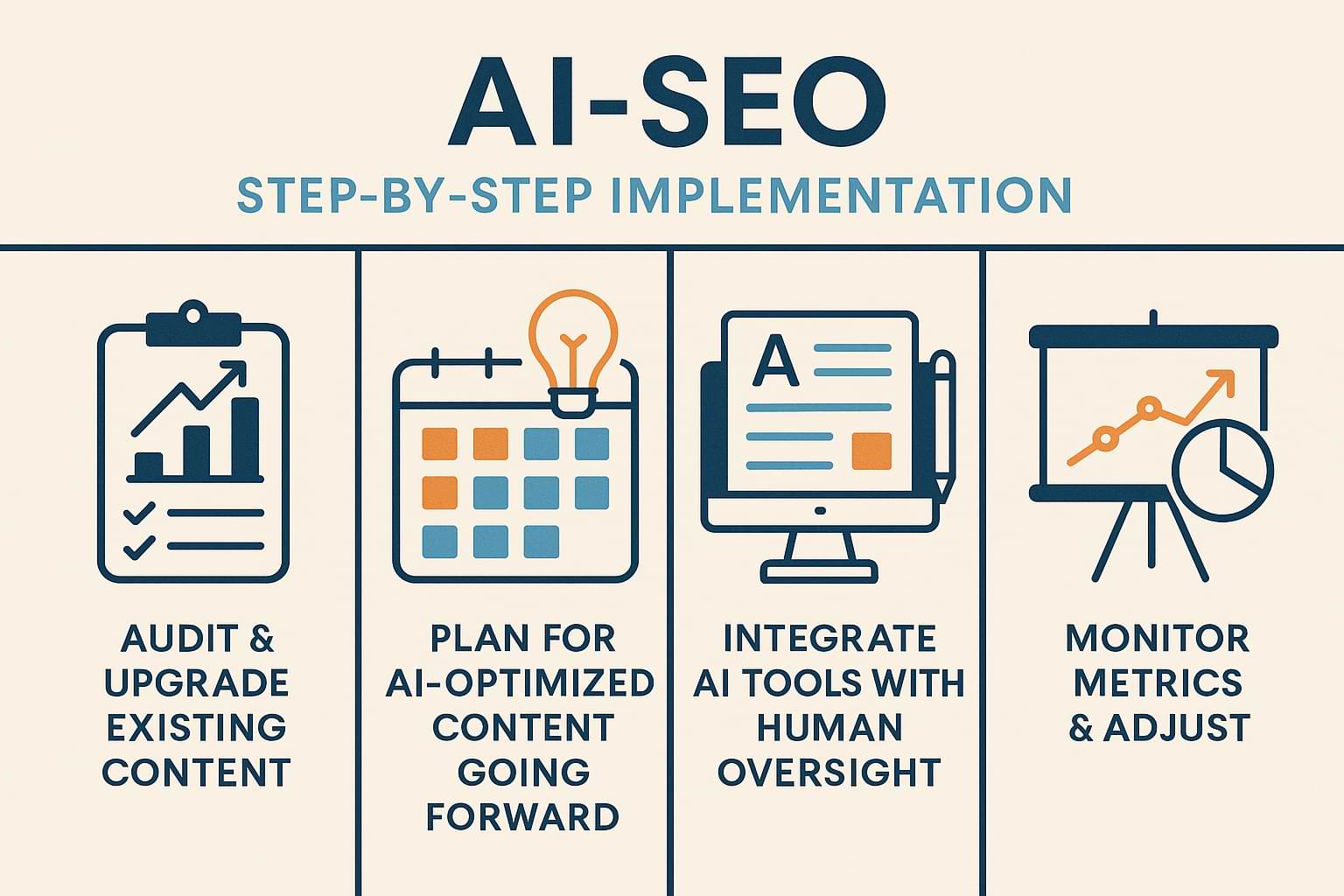
Here are 4 steps you can follow to bring AI-SEO into your content strategy:
1. Audit & Upgrade Existing Content
-
Identify your top pages and posts. Look for ones that are ranking or getting traffic but have short content, shallow detail, or missing structure (no FAQs, summaries, etc.).
-
Update those pages: add depth, more unique insights, stats/data, quotes, fresh examples.
-
Reorganize structure: use clear headings, bullet points, FAQs. Make content “AI-friendly,” meaning easy to parse, clear answer to likely questions.
2. Plan for AI-Optimized Content Going Forward
-
When planning new content, start with keyword-intent mapping: what are users asking vs what AI systems summarizing?
-
Include features that AI systems tend to use: “answer boxes,” definitions, comparisons, tips, FAQs.
-
Think of evergreen content that continues to be useful, because AI-driven search may surface older content in new contexts (if it remains relevant).
3. Integrate AI Tools with Human Oversight
-
Use AI tools for drafting, research, summarization—but always review and enrich with original insight, case studies, examples.
-
Test how different prompts or AI workflows perform (e.g. AI first draft vs human first) and adjust.
-
Ensure you have quality control: fact-checking, voice, relevance.
4. Monitor Metrics & Adjust
-
Track beyond standard SEO metrics (traffic, rankings). Add metrics like “time to answer,” “user journey completion,” and engagement.
-
Watch for when content loses visibility—why? Is it being superseded by content that’s more AI-optimized or more authoritative?
-
Use feedback (comments, internal search, user behavior) to iterate.
Common Mistakes to Avoid
-
Relying fully on AI generation without unique value — content may be grammatically fine, but may lack credibility, originality, or actionable insight.
-
Neglecting structure and readability — dense, unstructured posts are harder for both people and AI systems to parse. Headings, summaries, FAQs matter.
-
Ignoring user intent in favor of keywords — chasing keywords alone won’t work if the content doesn’t satisfy what people are really asking or what AI systems judge as helpful.
Action Step
Today, pick one existing high-performing but thin content page on your site. Spend 30–60 minutes adding:
- One new section (FAQ or summary) that addresses a question related to that topic
- One example, stat, or unique insight that only you can bring
- improve the headings and add bullet lists to improve scan-ability
You’ll likely see improved performance over time, both in search visibility and how users stay engaged.
Final Thoughts
AI-SEO isn’t a magic bullet, but it is fast becoming a requirement. As Google’s updates make quality, depth, and insight central to ranking, and as AI-driven answers and discovery reshape how people find information, aligning your content strategy with this reality will keep you visible, trusted, and growing. If you approach AI-SEO thoughtfully—blending the strength of AI tools with your own expertise—you can turn uncertainty into opportunity.
Thanks for reading. If you try today’s action step, or have your own wins or questions with AI-SEO, I’d love to hear from you in the comments.
Remember: “Content sees what content does.” (Adapted from a saying by Seth Godin.)
AI-SEO is no longer optional. If your content isn’t deep, structured, and genuinely helpful, you’ll get left behind. Dive into how to optimize for AI-led search this fall. #SEO #AI #MarketingMonday Share on X“Marketing Monday” articles archive.

Note: Some links on this page are affiliate links meaning that if you click on my link and make a purchase, I will receive a small commission. It does not however affect the price you pay. Plus, it’s a great way to support me and the content I’m providing.