Why $29–$99 Micro-Products Are the Smartest Way to Monetize Your Existing Skills
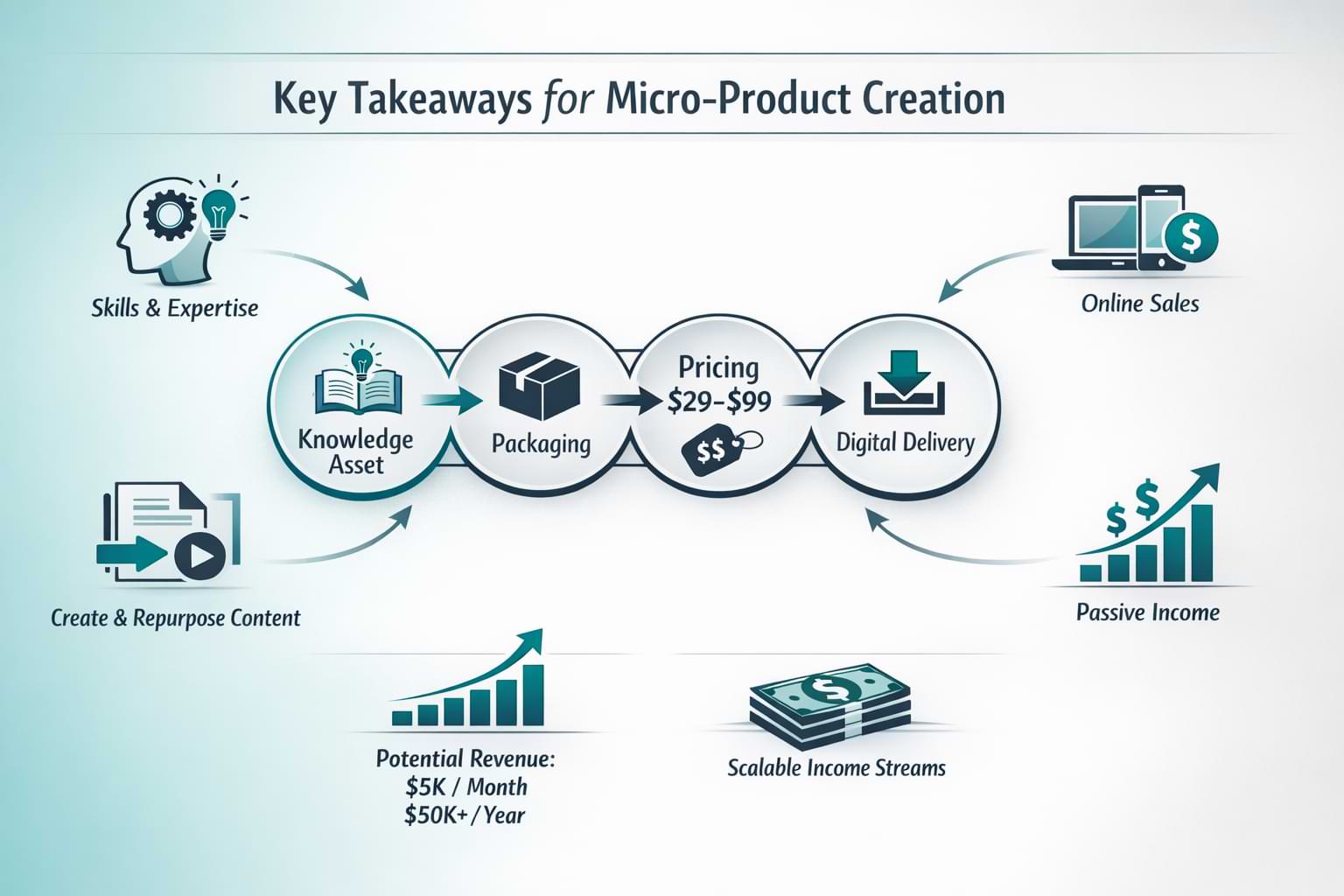
Creating a micro-product priced between $29 and $99 means packaging your existing skills, processes, or knowledge into a focused digital offering that solves one specific problem for a defined audience.
This price range hits the impulse-buy threshold while remaining accessible, and products can include templates, mini-courses, software tools, or frameworks. The key is to identify what you already know that others struggle with, then package that knowledge into a repeatable format that delivers quick wins.
Key Takeaways
- Micro-products priced between $29 and $99 represent the sweet spot for converting existing knowledge into revenue without requiring massive audiences or complex infrastructure
- The skills and expertise already in your toolkit can become profitable digital products, templates, or tools within 2-4 weeks of focused development
- Platform-specific tools (TikTok Shop analytics, Threads automation) and AI-powered micro-SaaS products are achieving $5,000–$30,000 monthly recurring revenue for solo creators in 2026
- Industry-specific knowledge commands premium pricing, with niche tools charging $99–299/month compared to $25–99/month for generic alternatives
- Validation comes before creation: test your idea with pre-sales, surveys, or beta waitlists to confirm demand before building the full product
- Templates, worksheets, mini-courses, and software plugins require minimal overhead while solving specific, painful problems for defined audiences
- Distribution matters more than perfection: a good product with strong marketing beats a perfect product with no audience
What Exactly Is a Micro-Product and Why This Price Range Works
A micro-product is a focused digital offering that solves one specific problem rather than attempting to be comprehensive. Unlike full courses or extensive software platforms, micro-products deliver targeted solutions that customers can implement quickly.
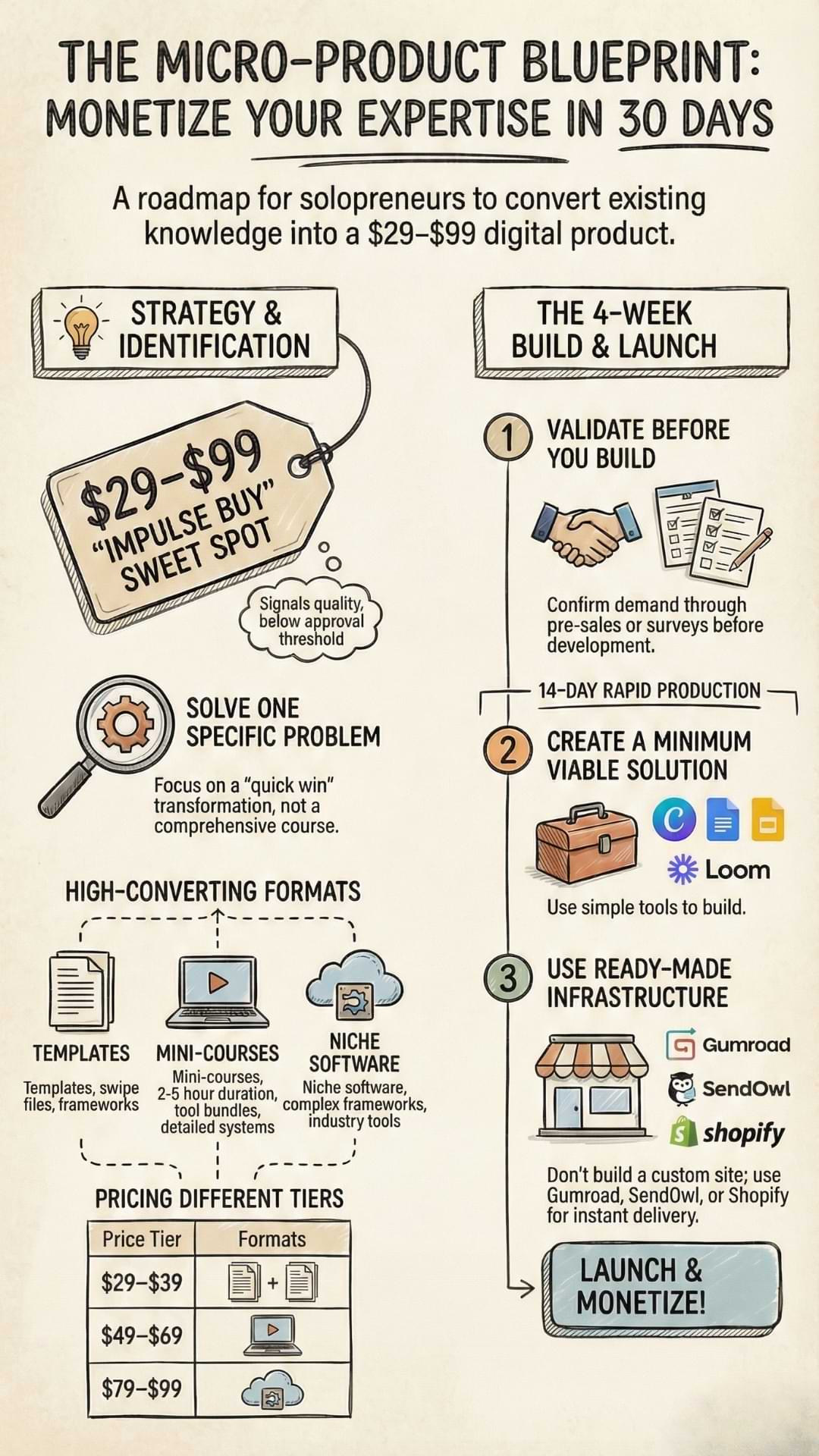
The $29–$99 price range works because it sits in the “impulse purchase” zone for most buyers. People don’t need approval from a boss or spouse to spend $49 on a tool that solves an immediate problem. At the same time, the price point signals quality and value—it’s not so cheap that buyers question whether it actually works.
Common micro-product formats include:
- Templates and swipe files (email sequences, social media calendars, design templates)
- Mini-courses teaching one specific skill (2-5 hours of content)
- Software plugins or tools solving niche problems
- Frameworks and worksheets guiding specific processes
- Curated resource libraries with implementation guides
- AI-powered automation tools for specific platforms
Consider someone who spent years perfecting their client onboarding process. That documented system, turned into editable templates with video walkthroughs, becomes a $79 product for other service providers. The knowledge was already there—it just needed packaging.
How to Identify Knowledge Worth Packaging
Start by auditing what you already know how to do that others find difficult. The best micro-products emerge from skills you’ve developed through repetition, not necessarily formal credentials.
Ask yourself these questions:
- What do colleagues or friends regularly ask for help with?
- Which processes have you documented or systematized in your work?
- What shortcuts or frameworks have you developed that save significant time?
- Which problems did you struggle with initially but have now mastered?
- What tools or methods do you use that others in your field don’t know about?
The answers reveal knowledge gaps in your market. If five people have asked you the same question in the past month, hundreds more have the same problem but haven’t asked yet.
Choose knowledge that meets these criteria:
- Specific outcome: “Write better cold emails” beats “improve communication”
- Quick win: Buyers should see results within days, not months
- Repeatable process: Your method works consistently, not just once by luck
- Clear before/after: The transformation should be measurable and obvious
A freelance designer who created a color palette selection system for brand projects has packageable knowledge. The system works repeatedly, produces clear results, and solves a specific problem other designers face. That’s a $49 template pack with tutorial videos.

Steps to Create a $29–$99 Micro-Product Using What You Already Know
The creation process follows a validation-first approach that prevents wasting time building products nobody wants.
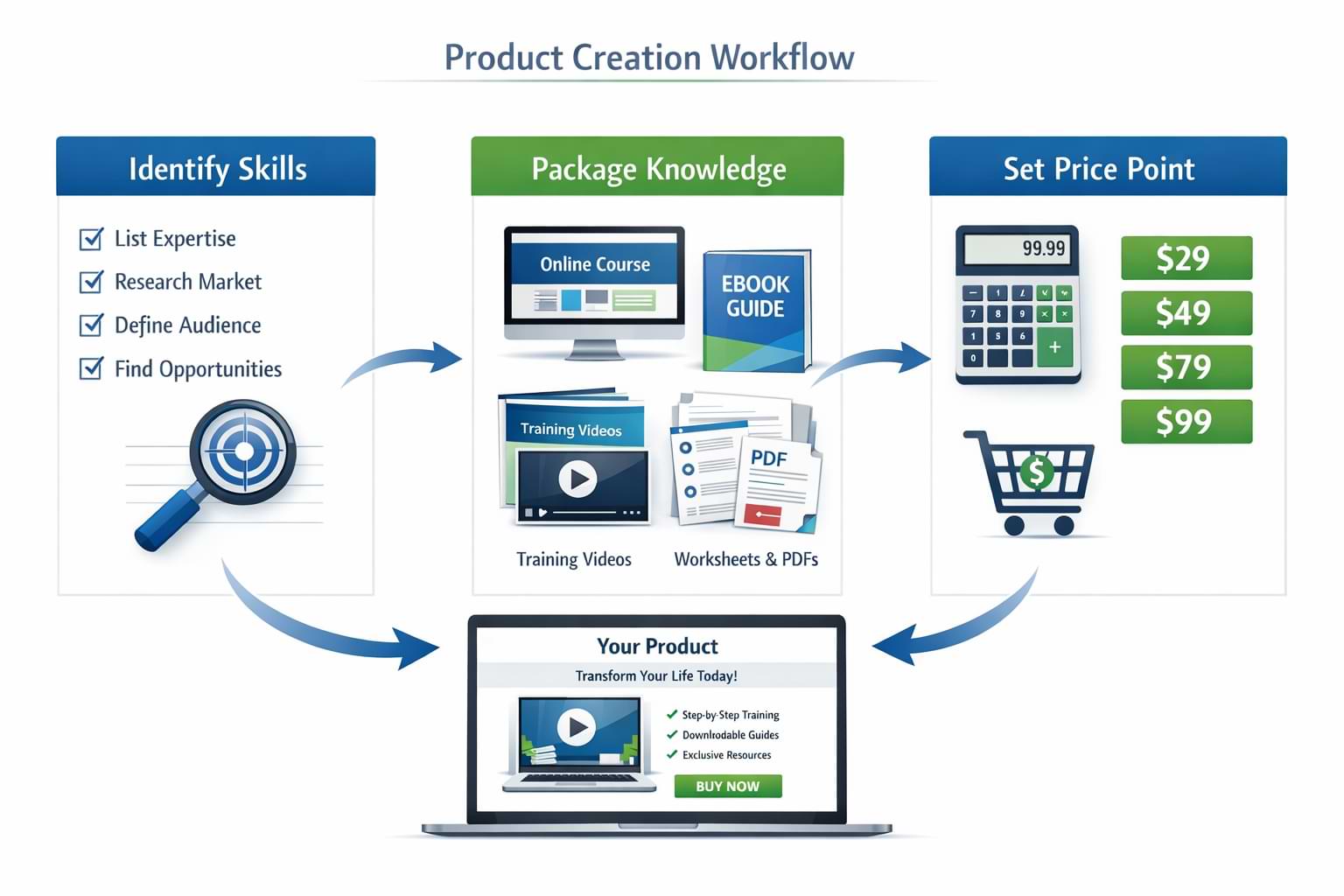
Step 1: Validate demand before building
Survey your audience, run a pre-sale, or create a waitlist landing page. If you can’t get 10-20 people interested before the product exists, demand might be weaker than expected. Test your idea with real potential buyers, not just friends who’ll be polite.
Step 2: Define the transformation
Write one sentence: “This product helps [specific person] go from [painful situation] to [desired outcome] in [timeframe].” Example: “This template pack helps Shopify store owners go from generic product descriptions to SEO-optimized, conversion-focused copy in under 2 hours.”
Step 3: Map the minimum viable solution
List only what’s essential to deliver the transformation. Resist adding “nice to have” elements. A worksheet-based framework might need 5 core templates, not 47. More isn’t better if it delays launch or overwhelms buyers.
Step 4: Package your knowledge in the simplest format
Choose the format requiring the least production time while still delivering value:
- PDF workbooks: 1-2 weeks to create with tools like Canva
- Video tutorials: 3-5 days for 2-3 hours of recorded content
- Templates: 1 week to create and document 5-10 templates
- Software tools: 2-4 weeks for simple automation or data tools
Step 5: Create supporting materials
Include quick-start guides, implementation checklists, and example files. These reduce support questions and increase completion rates. Buyers who get results become testimonials and repeat customers.
Step 6: Set up simple delivery
Platforms like Gumroad, SendOwl, or Shopify handle payment processing and digital delivery. Setup takes 2-3 hours. Don’t build custom infrastructure for your first product—use existing platforms and migrate later if needed.
Pricing Strategy for Maximum Conversions
Price based on the value delivered and the speed of transformation, not the hours spent creating the product.
Pricing tiers that work:
- $29-39: Templates, swipe files, simple frameworks
- 49-69: Mini-courses, tool bundles, detailed systems
- $79-99: Software tools, comprehensive frameworks, industry-specific solutions
Industry-specific products command higher prices. A social media calendar template might sell for $29, but a “TikTok Shop Product Research Dashboard” targeting e-commerce sellers can charge $79-99 because it solves a revenue-generating problem for a specific audience with money to spend[1].
Test pricing by launching at your target price point and monitoring conversion rates. If 100 people visit your sales page and 8-12 buy, pricing is appropriate. A conversion rate below 5% suggests the price is too high relative to perceived value, or the offer isn’t compelling enough.
Common pricing mistake: Underpricing because “it only took me a few hours to create.” The buyer doesn’t care about creation time—they care about the hours or money your product saves them.
Platform-Specific Micro-Products Performing Well in 2026
Certain niches are experiencing explosive growth and demonstrate what’s working right now.
TikTok Shop analytics tools charge $29- $199/month for seller analytics and product research dashboards. TikTok Shop sales grew 600% year-over-year in Q1 2024, driving demand for tools that help sellers identify trending products and optimize listings.
Threads’ automation tools for scheduling and analytics cost $29-99/month. As Meta’s Twitter alternative gained traction, creators needed tools that didn’t exist yet, creating opportunities for solo developers to build focused solutions.
AI video clip generators that identify viral moments in long-form content are priced at $29-79/month, with clip limits. Content creators producing hours of video need tools that automatically find and export the most engaging 30-60-second segments for social media.
Shopify micro-SaaS tools include AI product description generators at $14.99-29.99/month and inventory forecasting at $19.99-49.99/month. Solo developers in this niche achieved $5,000- $30,000 in monthly recurring revenue in 2024 by solving specific merchant problems.
These examples share common traits: they solve immediate problems for audiences with money to spend, they’re platform-specific (reducing competition), and they deliver measurable results quickly.
How to Market Your Micro-Product Without a Huge Audience
You don’t need 10,000 followers to generate sales. Focused distribution to the right 100 people outperforms broad distribution to 10,000 wrong people.
Start with warm audiences:
- Email your existing list (even if it’s just 50 people)
- Post in communities where your target buyers already gather
- Reach out directly to 20-30 people who’ve asked questions your product answers
- Partner with others serving the same audience for affiliate promotions
Create content that demonstrates expertise:
Share the thinking behind your product through blog posts, videos, or social media content. Someone who teaches their framework publicly builds trust and attracts buyers. Creating killer content fast helps maintain consistent visibility without overwhelming your schedule.
Leverage existing platforms:
Product Hunt, Gumroad Discover, and niche directories provide built-in audiences searching for solutions. A well-crafted listing with clear benefits and social proof can generate initial sales without paid advertising.
Use the “helpful human” approach:
Answer questions in forums, Facebook groups, and Reddit communities where your target buyers hang out. Provide genuinely useful answers, then mention your product as an optional resource for those who want the complete system. This builds authority and drives qualified traffic.
One creator selling Notion templates generated $3,000 in the first month by answering Notion-related questions on Reddit and Twitter, linking to free sample templates that included a “Get the Full System” call-to-action. No ads, no huge following—just consistent helpfulness.
Common Mistakes That Kill Micro-Product Sales
Trying to serve everyone: “This works for anyone wanting to improve productivity” is too broad. “This works for freelance writers managing 5+ client projects simultaneously” is specific enough to convert.
Overbuilding before validation: Spending three months perfecting a product before getting any buyer feedback often results in features nobody wanted. Launch a minimum viable version, get feedback, then improve based on actual usage.
Ignoring the sales page: A brilliant product with a confusing sales page generates zero revenue. The sales page needs clear headlines, specific benefits, social proof, and obvious next steps. Creating high-converting pages doesn’t require expensive tools—just clarity about the transformation you’re selling.
Pricing too low out of fear: Charging $19 instead of $49 doesn’t triple your sales—it just cuts your revenue by 60%. Buyers judge value by price. Too-low pricing signals low quality.
No email follow-up: 70-80% of buyers need multiple touchpoints before purchasing. If someone visits your sales page but doesn’t buy, and you have no way to follow up, that potential sale is gone forever. Build an email list from day one.
Forgetting about existing customers: Selling a second product to an existing customer is 5-7 times easier than finding a new customer. Create logical next-step products or complementary offerings for people who already bought from you.
Turning One Micro-Product Into Multiple Revenue Streams
Your first micro-product becomes the foundation for expanded offerings that serve the same audience.
Create a product ladder:
- Entry product ($29-39): Templates or quick-start guides
- Core product ($49-79): Complete system or mini-course
- Premium product ($99-199): Advanced tools or implementation support
- Service tier ($500+): Done-for-you or consulting based on the framework
Someone buying your $39 email template pack might later purchase your $79 complete email marketing system, then hire you for $1,500 to implement it in their business. Same knowledge, different packaging and price points.
Bundle and package variations:
Combine related products into bundles at slight discounts. Three individual $49 products become a $129 bundle, increasing average order value while providing more value to customers.
Add recurring revenue:
Convert one-time products into subscription offerings by adding monthly updates, new templates, or ongoing access to resources. A $79 one-time purchase becomes a $29/month subscription with monthly template additions and quarterly training updates. Creating new revenue streams from knowledge you already have multiplies the value of your initial product development work.
License or white-label:
Allow others to rebrand and sell your product to their audiences. A $79 product licensed to 10 partners at $200 each generates $2,000 in passive income while expanding distribution.
Real Examples of Knowledge Turned Into Micro-Products
A virtual assistant who developed a client onboarding system over three years packaged it into a $67 product called “The 5-Day Onboarding System.” It included email templates, welcome packet templates, contract templates, and video walkthroughs. First-month sales: $2,100. The knowledge existed in her Google Drive—she just organized and packaged it.
A former teacher created a $49 “Classroom Management Toolkit” that includes behavior-tracking sheets, parent-communication templates, and intervention frameworks. She sold it through Teachers Pay Teachers and Facebook groups, generating $4,500 in the first quarter. The systems were ones she’d used for five years—she just made them editable and added instructions.
A freelance developer built a $79 Shopify app that automatically generates alt text for product images using AI. Development took three weeks. Monthly recurring revenue hit $8,000 within six months by solving one specific, annoying problem for store owners who understood that alt text impacts SEO but didn’t want to write it manually.
These creators didn’t have unique knowledge—they had organized, packaged knowledge that solved specific problems for defined audiences.
FAQ
How long does it take to create a micro-product?
Most micro-products can be created in 1-4 weeks, working part-time (5-10 hours per week). Templates and frameworks take 1-2 weeks, mini-courses take 2-3 weeks, and simple software tools take 3-4 weeks. The key is starting with a minimum viable version rather than trying to perfect everything before launch.
Do I need technical skills to create a micro-product?
Not necessarily. Templates, worksheets, frameworks, and mini-courses require no coding. Tools like Canva, Google Docs, and video recording software handle most creation needs. Software-based products do require development skills, but no-code platforms like Bubble or Webflow enable non-technical creators to build functional tools.
What if someone copies my product?
They will, eventually. But execution, marketing, and relationship-building matter more than the product itself. Your audience buys from you because they trust you, not just because of the specific templates or frameworks. Focus on serving your customers well and building authority in your niche.
How do I know if my knowledge is valuable enough to sell?
If people are currently asking you questions about it, searching for it online, or struggling with it publicly, it’s valuable enough. The test is whether someone would pay to solve the problem faster or more effectively than figuring it out themselves. Run a pre-sale or survey to validate specific demand.
Should I create a course or a different type of product?
Choose the format that delivers the transformation most efficiently. If the knowledge requires step-by-step instruction, a mini-course works. If it’s about having the right templates, skip the videos and sell the templates. Match format to outcome, not to what you think you “should” create.
How many sales should I expect in the first month?
Without an existing audience, expect 5-20 sales in month one if you’re actively marketing. With an email list of 500-1,000 engaged subscribers, expect 20-50 sales. With a larger audience or strong launch partnerships, 50-100+ sales are achievable. Focus on getting your first 10 customers and learning from their feedback.
Can I sell micro-products on multiple platforms?
Yes, and you should. List on your own website, Gumroad, Etsy (for templates), Teachers Pay Teachers (for educational products), or relevant marketplaces. Each platform provides different audiences and discovery opportunities. Just ensure pricing is consistent across platforms.
What’s the best way to price my first product?
Start at the higher end of your comfort zone. It’s easier to lower prices than raise them. For a first product, $49-79 is a safe middle ground that signals quality while remaining accessible. Test for 30 days, then adjust based on conversion rates and customer feedback.
How do I handle customer support?
Create comprehensive documentation, FAQs, and video tutorials that answer 80% of questions before they’re asked. Use email for support initially—don’t overcomplicate with ticketing systems until you’re handling 20+ support requests weekly. Most micro-products generate 2-5 support emails per 100 sales.
Should I offer refunds?
Yes, offer a 30-day money-back guarantee. It reduces purchase friction and builds trust. Refund rates for digital products typically run 2-5%. The increased conversions from offering a guarantee far outweigh the cost of occasional refunds.
How often should I update my product?
Update when you receive consistent feedback about missing elements or when the underlying platform/process changes. Don’t update just to update. Announce improvements to existing customers—it reinforces their purchase decision and can generate referrals.
Can I create micro-products while working full-time?
Absolutely. Most successful micro-product creators started while employed elsewhere. Allocate 5-10 hours weekly for 3-4 weeks to create your first product. Evenings and weekends provide enough time to build, launch, and market without quitting your day job.
Final Thought
Creating a micro-product priced between $29 and $99 using knowledge you already possess is one of the most accessible paths to generating additional revenue in 2026. The skills, systems, and expertise sitting in your head, notebooks, or Google Drive right now can become packaged solutions that others will pay for—if you identify the specific problems they solve and present them clearly.
The process starts with honest inventory: what do you know that others struggle with? What have you systematized that could be templated? Which problems have you solved repeatedly that others are still figuring out? Those answers point to your first product.
Validation comes before creation. Test demand through pre-sales, surveys, or direct conversations with potential buyers. Build the minimum viable version that delivers the core transformation, launch it, and improve based on real customer feedback. Perfection delays revenue—good enough ships and generates sales.
Marketing doesn’t require a massive audience. The right 100 people in focused communities, combined with helpful content that demonstrates expertise, generate initial sales. Those first customers provide testimonials, feedback, and word-of-mouth that fuel growth.
Your next steps:
- Complete a knowledge inventory this week: list 10 things you know how to do that others find difficult
- Choose one item and write the transformation sentence: “This helps [who] go from [pain] to [result] in [time]”
- Validate demand by asking 10 potential buyers if they’d purchase the solution at your target price
- Create the minimum viable version in 2-3 weeks
- Launch to your warm audience and one relevant community
- Collect feedback, testimonials, and iterate based on actual usage
The knowledge is already there. The market exists. The tools are accessible. What’s missing is the decision to package what you know and present it to people who need it. Start this week—your first micro-product is closer than you think.
References
[1] List Profitable Micro Niches – https://mktclarity.com/blogs/news/list-profitable-micro-niches
[3] Startup Ideas – https://wellows.com/blog/startup-ideas/
Weekend Workshop: Learn how to create and sell micro-products priced $29–$99 using skills you already have. Step-by-step guide to packaging knowledge into profitable digital products. Share on X>>> Read more Weekend Workshop lessons here

Note: Some links on this page are affiliate links meaning that if you click on my link and make a purchase, I will receive a small commission. It does not however affect the price you pay. Plus, it’s a great way to support me and the content I’m providing.