Welcome back to Marketing Monday. Last week we talked about focusing on just one channel. This week, we need to talk about how people find that channel. Hint: AI chatbots are involved!
For the last twenty years, “search” meant one thing. It meant typing a few awkward keywords into Google’s white bar and hoping for the best.
You had to engage in the Google game if you wanted to be found. You needed to incorporate keywords into your headlines. You had to chase backlinks. You had to write 2,000-word articles that robots loved, but humans merely tolerated.
In 2026, that game has entirely changed.
Your prospective clients aren’t just Googling anymore. They are having conversations with AI. They are asking ChatGPT, Perplexity, or Gemini questions like:
“Who is the best local accountant for a freelance graphic designer?” “Find me a business coach who specializes in female solopreneurs and doesn’t use high-pressure sales tactics.” “Planning a small wedding in Austin. Suggest three photographers with a candid, documentary style.”
If your online presence fails to address these specific, conversational questions, it renders you invisible to the fastest-growing search segment.
The New SEO: Generative Engine Optimization (GEO)
The industry term for this is Generative Engine Optimization, or GEO. But don’t let the acronym scare you. It is actually much simpler than traditional SEO.
Traditional Google SEO was about matching keywords. Modern AI search is about matching intent.
The AI models want to provide the best possible answer to their users. They are looking for trustworthy, clear sources they can summarize and cite. They don’t care about your keyword density. They care about whether you clearly solve the user’s problem.
If your website says something vague like “Helping businesses reach their potential,” the AI has no idea what to do with that information. It won’t recommend your website because it doesn’t understand who your target audience is.
To win in 2026, you have to stop writing for robots and start writing incredibly clearly for humans.
The “Clear Cut” Strategy
The biggest mistake solopreneurs make with their copy is trying to sound clever or professional instead of clear. They use jargon to sound impressive.
When you use jargon, you confuse the AI. When you confuse the AI, it ignores you.
Your goal this week is to make sure your primary online presence passes the “Clear Cut” test. If an AI reads your bio, does it immediately know exactly who you help and what you do?
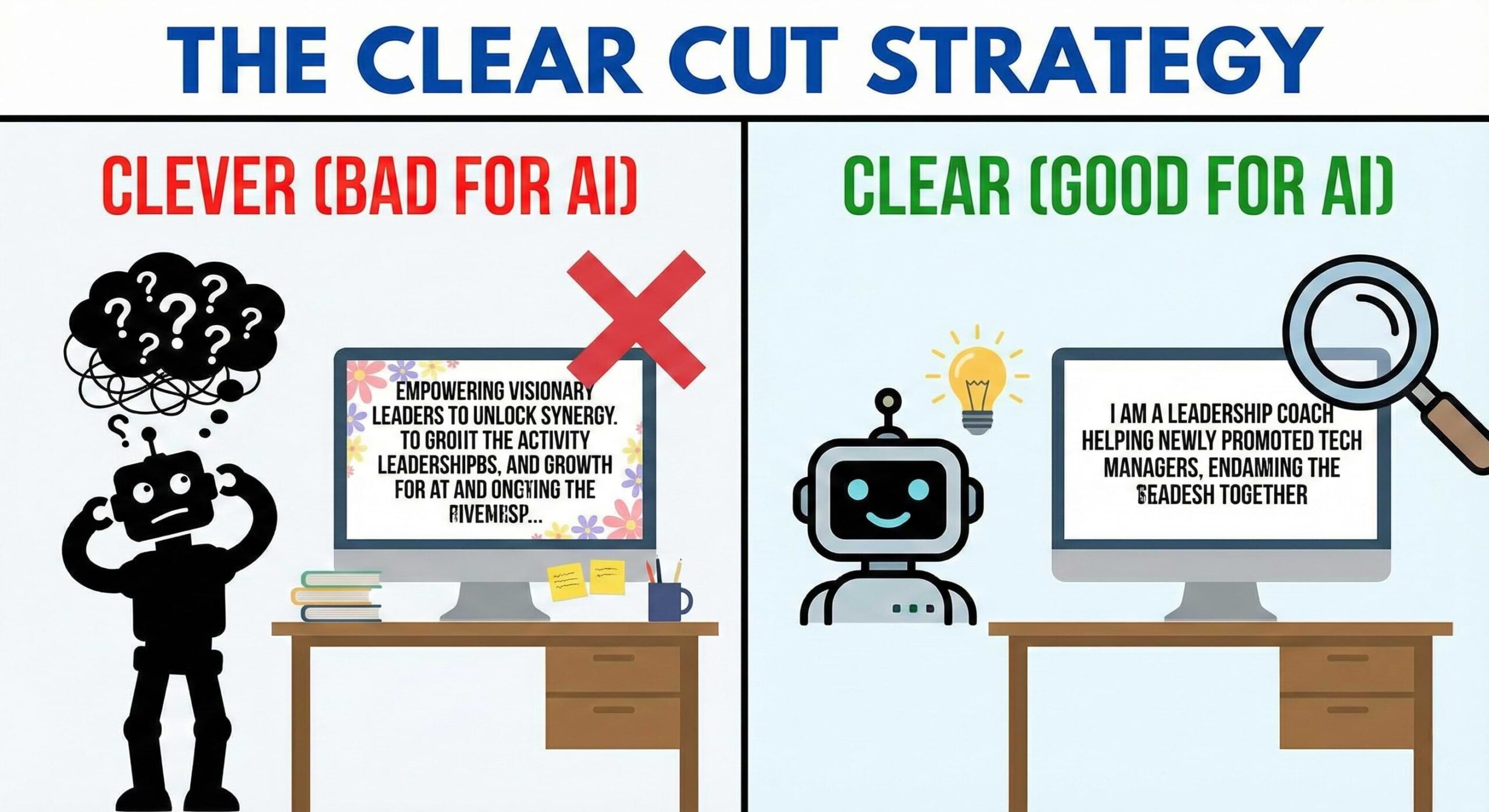
We need to move from clever to clear.
Clever (Bad for AI): “Empowering visionary leaders to unlock synergy and actualize paradigm shifts.” (The AI has absolutely no idea what this person does for a living.)
Clear (Good for AI): “I am a leadership coach helping newly promoted tech managers navigate their first year of managing a team.” (The AI knows exactly when to recommend this person.)
Your Assignment for the Week: The Bio Audit
This week, your task is to audit your digital “front door.” This is the primary place people find you based on last week’s audit. It might be your website’s “About” page, your LinkedIn summary, or your Instagram bio.
You need to rewrite it so that a fifth-grader (or a very literal computer program) understands it.
Ensure your bio answers these three questions in plain, natural language:
-
Who specifically do I help? (Be niche. “Small businesses” is too broad. “Independent coffee shops” is better.)
-
What specific problem do I solve for them? (Not the process, the outcome. “I help them organize their books” is okay. “I help them save 10 hours a month on payroll” is better.)
-
Where am I located? (Crucial if you are a local service business. AI needs to know your geography.)
Don’t overthink it. Don’t try to be poetic. Just state the facts of your business clearly. In 2026, clarity is the ultimate competitive advantage.
Your customers stopped Googling and started asking AI for recommendations instead, which means your old SEO strategy is obsolete but the fix is surprisingly simple and involves writing like a human rather than a robot. Share on X“Marketing Monday” articles archive.

Note: Some links on this page are affiliate links meaning that if you click on my link and make a purchase, I will receive a small commission. It does not however affect the price you pay. Plus, it’s a great way to support me and the content I’m providing.