Report Date: 2026-03-21
AI Adoption in Small Business Operations: A Comprehensive Report for Strategic Growth
Executive Summary
This report provides a comprehensive analysis of Artificial Intelligence (AI) adoption within small and medium-sized businesses (SMBs), focusing on how these organizations are leveraging AI to enhance operational efficiency, drive growth, and compete in an increasingly digital landscape. As of 2026, AI is no longer a futuristic concept for large enterprises but a practical, accessible tool that is fundamentally reshaping how small businesses operate. The core theme emerging from the research is the empowerment of SMBs to “do more with less,” using AI to automate tasks, generate insights, and scale operations in ways previously unimaginable.
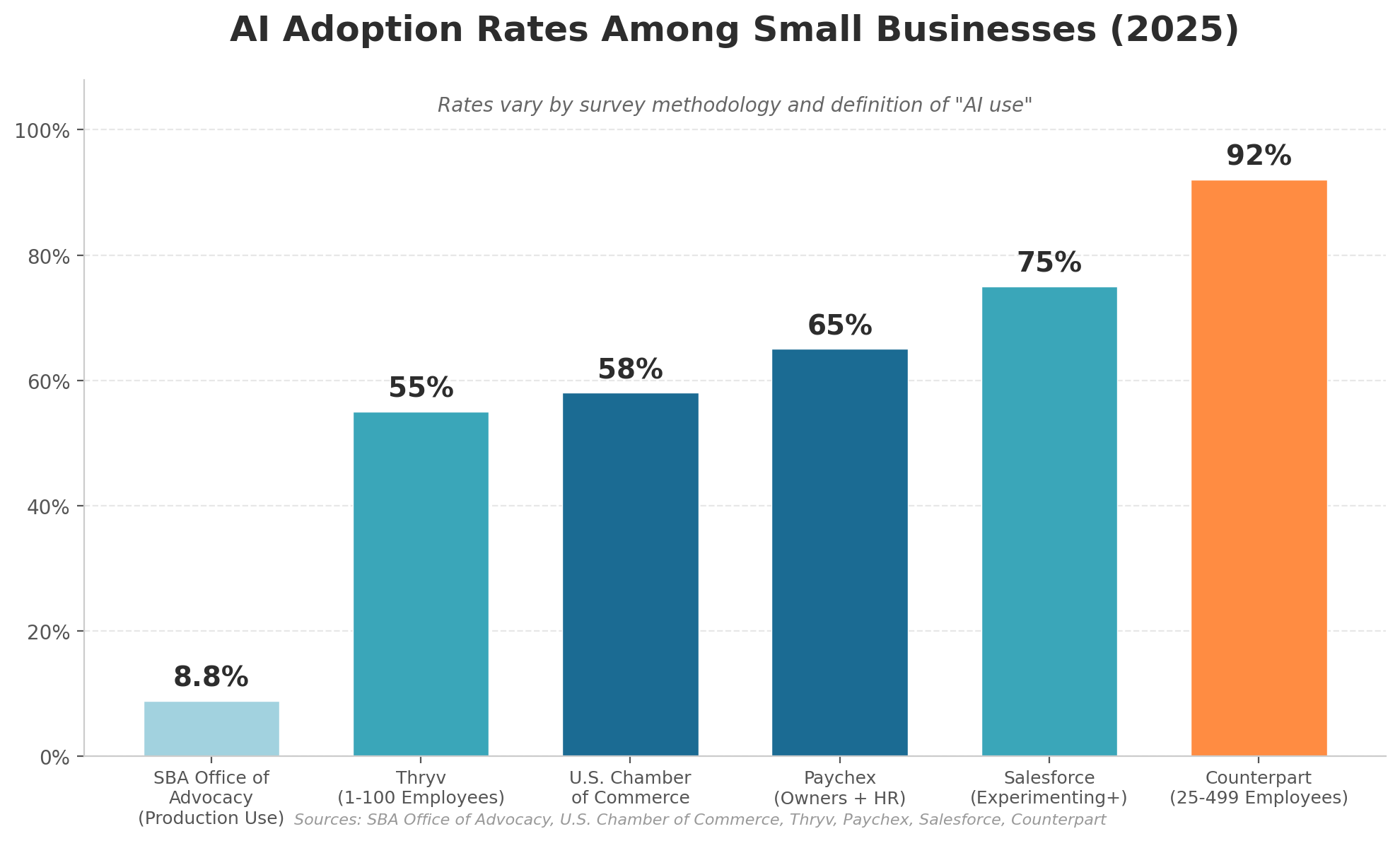
Current AI adoption rates among SMBs show a dramatic and accelerating upward trend. While figures vary by survey methodology—from a conservative 8.8% in production use to as high as 92% including experimentation—all data point to rapid growth [18, 20]. This surge is closing the historical technology adoption gap between small and large businesses, with some analyses suggesting SMBs are now only about a year behind their enterprise counterparts [18]. This momentum is fueled by significant planned investments, with the majority of SMBs intending to spend over $1,000 annually on AI, primarily in Human Resources (HR), customer support, and marketing [1, 2, 5].
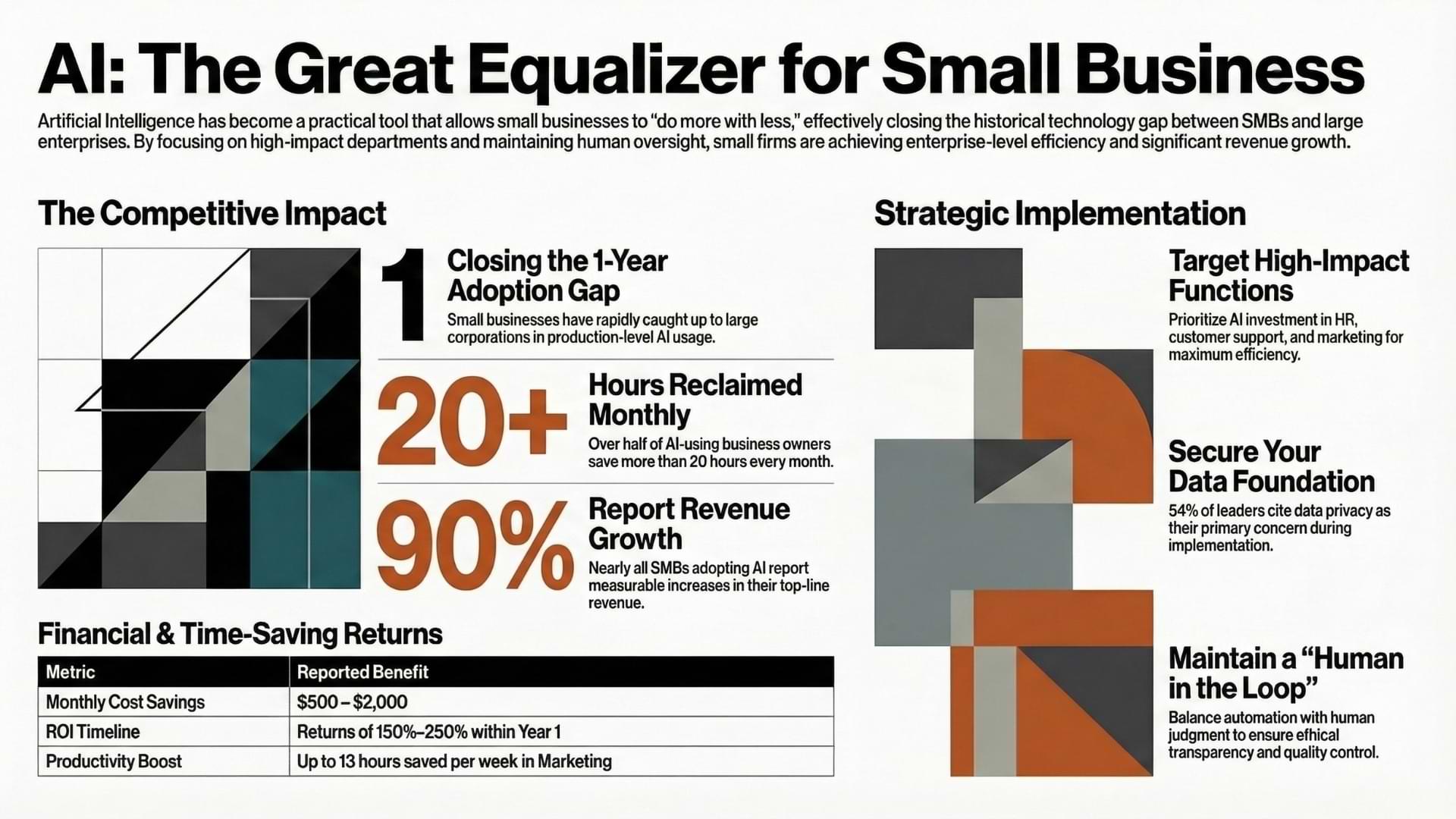
The measurable benefits of AI are substantial and well-documented. Businesses report significant time savings, with many saving over 20 hours per month, and considerable cost reductions, often between $500 and $2,000 monthly [16, 19]. These efficiencies translate directly into improved profitability and revenue growth, with over 90% of SMBs adopting AI reporting increased revenue [24]. The Return on Investment (ROI) is often realized quickly, with many projects achieving returns of 150% to 250% within the first year by improving key metrics like Customer Acquisition Cost (CAC) and Customer Lifetime Value (LTV) [21, 23].
AI is being deployed across all major business functions. In customer service, AI-powered chatbots and virtual agents are handling routine inquiries, boosting satisfaction, and freeing up human agents. In marketing, AI is used to personalize campaigns, optimize social media, generate content, and score leads, saving significant time and increasing conversion rates. Administrative, HR, and finance departments are using AI to automate payroll, streamline recruiting, process invoices, and generate financial reports more quickly and accurately. Workflow automation and content creation are being revolutionized by tools that can summarize meetings, draft documents, and manage projects, enhancing overall productivity.
Despite the clear advantages, SMBs face several challenges. The most significant barriers include data privacy and security concerns, a persistent skills gap, and budget constraints [1, 16]. Many business owners also struggle with data readiness and perceive AI as irrelevant to their specific operations, particularly in micro-businesses [18]. Furthermore, ethical considerations such as algorithmic bias and the need for transparency, especially in HR, require careful management [3, 4]. Employee sentiment is mixed, with a notable portion expressing concern about AI’s role in decision-making and job security, underscoring the critical need for thoughtful change management and human oversight.
The future of AI for SMBs points toward even greater autonomy and integration. The rise of “agentic AI”—autonomous systems that can reason, plan, and execute complex tasks—promises to further revolutionize workflows [11, 25]. This trend, combined with hyper-personalization at scale, is expected to fuel a new boom in small business creation and empower solopreneurs to operate with the capacity of much larger teams [30].
For small business owners, the message is clear: strategic AI adoption is becoming a prerequisite for competitive survival and growth. This report offers actionable insights and a strategic framework for navigating this transformation, recommending that businesses start with specific pain points, select integrated, scalable tools, invest in employee training, prioritize data governance, and maintain a human-centered approach to implementation.
Introduction: The New Competitive Frontier for Small Business
The global business landscape is undergoing a seismic shift, driven by the rapid democratization of Artificial Intelligence. For decades, advanced technology was the exclusive domain of large corporations with deep pockets and extensive IT departments. Small and medium-sized businesses (SMBs) often lag in adopting new technologies, years or even decades behind their enterprise counterparts. Today, that paradigm has been shattered. AI has emerged as the “great equalizer,” providing solos and SMBs with powerful tools to enhance productivity, innovate, and compete on a more level playing field [2, 5]. This report explores the current state and future trajectory of AI adoption within the small business sector, focusing on the central imperative of using this technology to “do more with less.”
The pressure on small businesses has never been greater. They face rising operational costs, intense competition, persistent talent shortages, and ever-increasing customer expectations for speed and personalization. In this environment, the ability to maximize efficiency and output from a limited resource base is not just an advantage; it is a core survival strategy. AI offers a direct answer to this challenge. By automating routine tasks, analyzing complex datasets in seconds, and augmenting human capabilities, AI enables small teams to achieve output that once required a significantly larger workforce and budget. From a solo entrepreneur managing their entire operation from a laptop to a 50-person manufacturing firm optimizing its supply chain, AI is unlocking unprecedented levels of efficiency.
This transformation is evident across every facet of business operations. In customer service, AI chatbots provide 24/7 support, resolving common issues instantly [23, 26]. In marketing, AI algorithms personalize customer journeys and optimize advertising spend with a precision previously unattainable for SMBs. Administrative burdens are being lifted through automated invoice processing, scheduling, and financial reporting. Content creation, once a time-consuming bottleneck, is now accelerated with AI-powered tools that can draft blog posts, social media updates, and email campaigns in minutes. These applications are not isolated novelties; they represent a fundamental rewiring of business workflows, enabling a single person to perform the work of a small team and a small team to compete with a mid-sized company.
The accessibility of these tools is a key driver of this revolution. The emergence of user-friendly, cloud-based AI platforms, many of which are integrated into existing business software such as Zoom and QuickBooks, has dramatically lowered the barrier to entry [7, 26]. Furthermore, many powerful AI capabilities are now offered at low or no additional cost within existing subscription plans, making them financially viable for even the smallest of businesses. This report will delve into the specifics of this new reality, providing small business owners with the actionable insights needed to navigate this new competitive frontier. We will examine current adoption rates, identify the most impactful applications, quantify measurable benefits, address critical challenges, and look ahead to future trends that will continue to shape the role of AI in small business success.
The State of AI Adoption: A Landscape in Rapid Transformation
The adoption of Artificial Intelligence by small and medium-sized businesses is no longer a question of ‘if’ but ‘how fast’ and ‘in what capacity’. The data from 2025 and early 2026 paints a picture of an ecosystem in the midst of an accelerated and profound transformation. SMBs are not only embracing AI but are doing so at a pace that is rapidly closing the long-standing technological divide with larger enterprises. This section analyzes current adoption rates, the narrowing gap between business sizes, and investment trends that signal a deep and lasting commitment to integrating AI into the core of small-business operations.
Current Adoption Rates: Analyzing the Data
Quantifying the precise rate of AI adoption among SMBs presents a complex challenge, as figures vary significantly depending on the source, survey methodology, sample size, and the definition of “AI use.” This variance, however, is itself revealing, highlighting the multifaceted nature of AI integration, which ranges from casual experimentation to deep, production-level implementation.
Several key studies from 2025 provide a spectrum of insights. A survey by the U.S. Chamber of Commerce found that 58% of SMB leaders were currently using generative AI, a dramatic increase from 40% in 2024 and more than double the rate from 2023 [16]. Similarly, a Thryv survey of businesses with 1 to 100 employees reported that AI usage jumped from 39% in 2024 to 55% in 2025, a 41% year-over-year increase [19]. Paychex reports an even higher figure, with 65% of surveyed businesses stating they currently use AI and a remarkable 61% using it daily [1, 2, 5].
At the higher end of the spectrum, research from Salesforce indicated that 75% of SMBs were at least experimenting with AI, with 36% having already fully implemented it into their workflows [16, 24]. An even more striking figure comes from Counterpart’s “Small Business Insights Report,” which surveyed businesses with 25 to 499 employees and found that 92% of respondents had integrated AI into their operations in some form [20].
In contrast, data from government bodies, which often employ stricter definitions, presents a more conservative picture. The SBA Office of Advocacy, using a definition focused on “production AI use,” reported an adoption rate of 8.8% as of August 2025 [18]. While this number is substantially lower than those from vendor and industry surveys, its trajectory is critically important: it represents a significant increase from 6.3% just six months prior, in February 2024 [18].
The discrepancy between these figures is best understood by recognizing that they measure different things. Vendor surveys often capture a broad range of interactions with AI, including pilot programs, experimentation with free tools, and departmental-level use. Government data, conversely, tends to focus on AI that is formally integrated into a company’s core production of goods or services. Taken together, these data points illustrate a clear and powerful narrative: a massive wave of experimentation and initial adoption (as shown by the 55-92% figures) is steadily converting into formal, production-level integration (as shown by the rising 8.8% figure). The overwhelming sentiment is positive, with 72% of small business owners expressing a positive attitude toward AI and 82% viewing it as helpful to their business [1, 2, 5].
The Closing Gap: SMBs Catch Up to Enterprises
One of the most significant trends to emerge from the 2025 data is the rapid narrowing of the AI adoption gap between small and large businesses. Historically, SMBs have lagged enterprises by years, if not decades, in adopting transformative technologies such as the internet and cloud computing. The current AI wave is proving to be different.
Analysis from the SBA Office of Advocacy provides the clearest evidence of this trend. In February 2024, large businesses used AI at a rate 1.8 times that of small businesses (11.1% vs. 6.3%) [18]. However, by August 2025, the landscape had shifted dramatically. Small-business adoption had climbed to 8.8%, while large-business adoption had declined slightly to 10.5% [18]. This indicates that small businesses may now be only about a year behind their larger counterparts in production-level AI adoption. This rapid catch-up is unprecedented and underscores the accessibility and immediate utility of modern AI tools for smaller organizations.
This convergence is driven by several factors. First, the proliferation of affordable, user-friendly AI tools embedded in existing software platforms removes the need for massive upfront capital investment or specialized in-house expertise. Second, the tangible and immediate ROI in terms of time savings and efficiency gains makes a compelling business case that resonates strongly with resource-constrained SMBs. Finally, the competitive pressure is immense; as more peers adopt AI, the cost of inaction rises. Indeed, among the 18% of business owners who view AI as a threat, the primary fear (cited by 26% of that group) is being outpaced by competitors leveraging AI more effectively [1].
Investment Trends: Where SMBs Are Spending on AI
The growing adoption rates are mirrored by robust investment plans. Small businesses are not just experimenting with free tools; they are allocating significant budget to acquire and implement AI solutions. According to a Paychex report, 90% of SMBs plan to invest in AI in the coming year [1]. A significant majority, 72%, plan to invest at least $1,000, and 51% of small businesses are already spending between $1,000 and $9,999 annually on AI [1, 2, 5].
The allocation of these investments reveals the strategic priorities of small business owners. Human Resources emerges as the top investment area, with 53% of businesses planning to direct AI funds toward this function [1, 2, 5]. Within HR, the focus is on solving critical operational pain points: recruiting (44%), payroll (44%), and onboarding new employees (41%) are the leading sub-categories for investment [1, 2, 5]. This reflects a strong desire to automate time-consuming administrative tasks and improve the ability to attract and retain talent in a competitive labor market.
Following HR, other key areas for investment include customer support, finance and accounting, and marketing [1]. This spending pattern aligns perfectly with the primary benefits SMBs seek: increased productivity, cost savings, and revenue growth. Interestingly, while businesses are investing in AI, they are lagging in parallel investments in training and process change. Data from the SBA show that about 50% of small firms using AI reported no associated investments in areas such as employee training or changes to data management practices, compared with 40% of large businesses [18]. This suggests a potential future challenge where the technology is acquired but not fully leveraged due to a lack of human and process readiness.
The ROI of AI: Measuring Tangible Benefits for Small Businesses
For any small business owner, the decision to invest time, money, and resources into a new technology hinges on one critical question: What is the return on investment (ROI)? With Artificial Intelligence, the answer is becoming increasingly clear and compelling. Across industries and use cases, SMBs are realizing substantial, measurable benefits that directly impact both their top and bottom lines. The ROI of AI is not an abstract, long-term promise; it is a tangible reality being achieved through enhanced productivity, direct cost savings, and accelerated revenue growth.
Productivity, Efficiency, and Cost Savings
The most immediate and widely reported benefit of AI adoption is a dramatic increase in operational efficiency. AI excels at automating repetitive, time-consuming tasks, thereby freeing up valuable human hours for more strategic, creative, and customer-facing work. This productivity boost is a cornerstone of the “do more with less” value proposition.
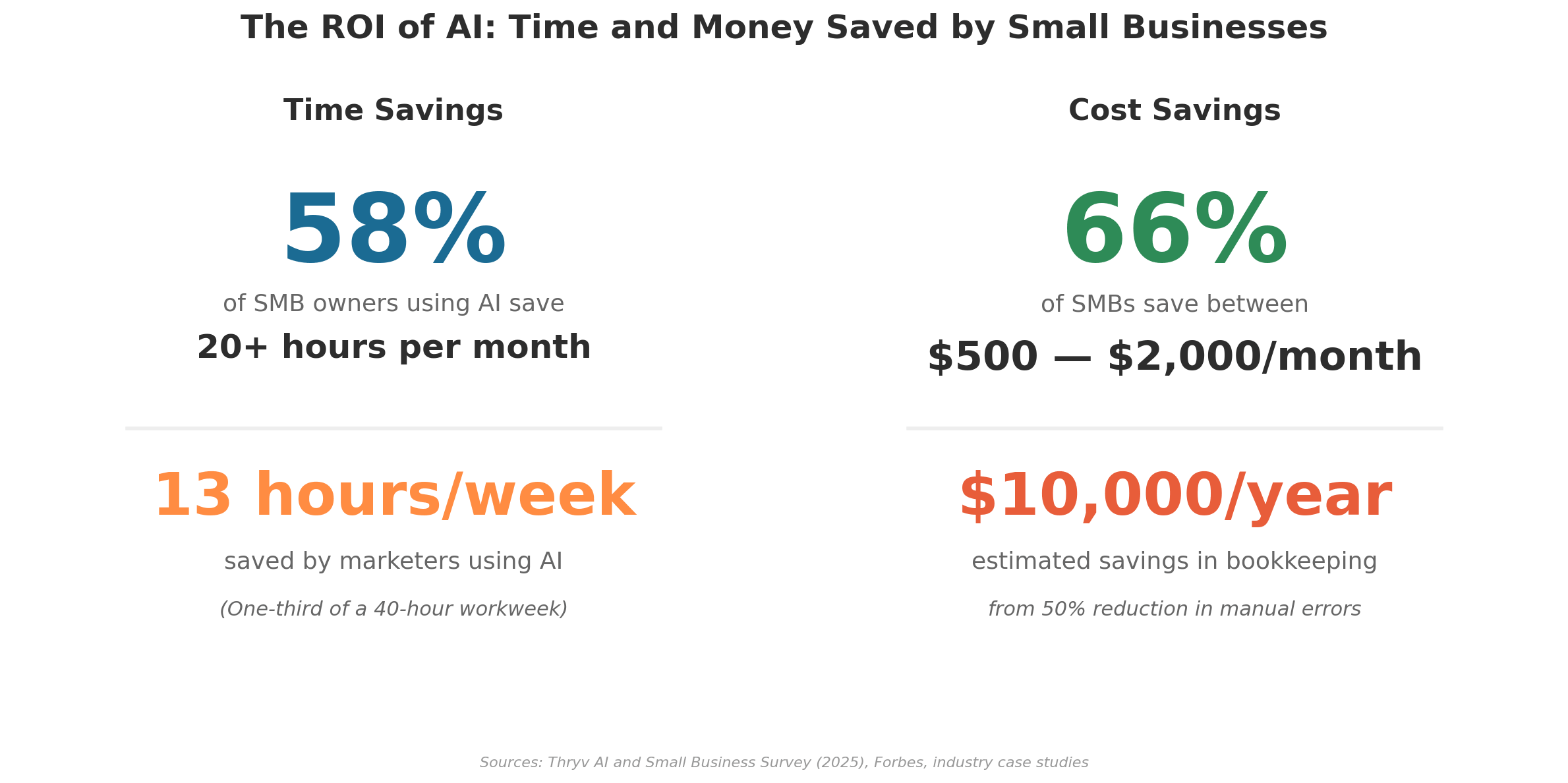
Data from multiple surveys quantifies this impact. A 2025 survey by Thryv found that 58% of small business owners who use AI save over 20 hours per month, equivalent to more than half of a standard workweek [16, 19]. For marketers, the savings are particularly pronounced: one Forbes-hailed study found that AI helps them save an average of 13 hours per week, roughly one-third of a 40-hour workweek [12]. This reclaimed time is a direct productivity gain, allowing small teams to increase their output without increasing their headcount. For example, a marketing agency case study demonstrated that using AI for content creation enabled it to double its monthly article output from 80 to 160 pieces, saving over 85 hours of labor each month [22].
These time savings translate directly into significant cost reductions. The same Thryv survey revealed that 66% of SMBs save between $500 and $2,000 per month by using AI [16, 19]. These savings come from various sources: reduced labor costs for administrative tasks, lower operational expenses through process optimization, and fewer errors. For instance, AI tools in accounting can reduce manual errors by up to 50%, preventing costly mistakes and saving a small business an estimated $10,000 annually in bookkeeping [21]. In a manufacturing context, AI-driven predictive maintenance can reduce maintenance costs by 25% and prevent thousands of dollars in unscheduled downtime [21, 22]. A local service business that automated its payroll and accounting with AI saved 15 hours of work per week and achieved a 150% ROI annually [21].
Driving Revenue and Improving Profitability
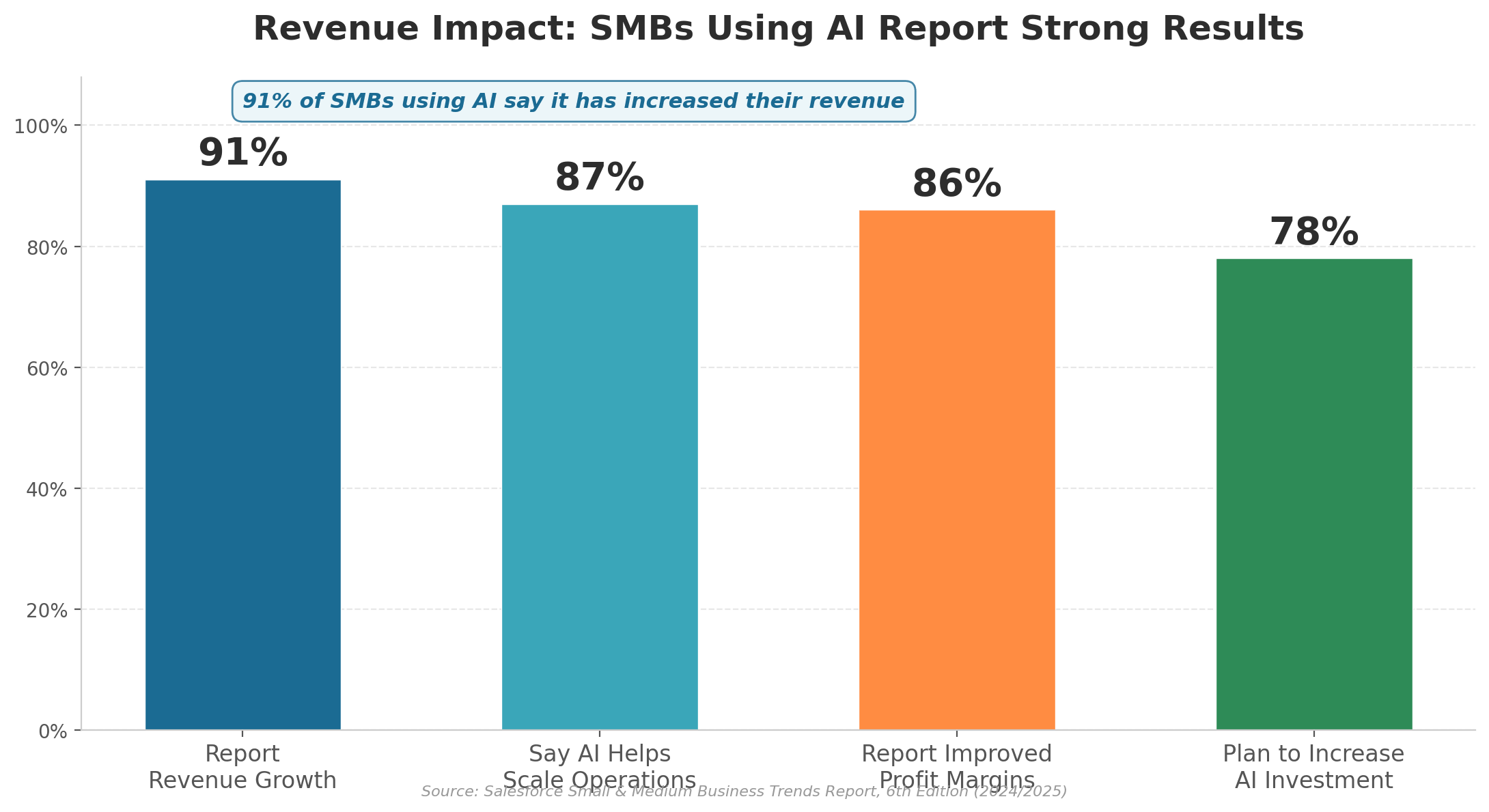
Beyond cost-cutting, AI is a powerful engine for revenue generation and margin improvement. By enhancing marketing effectiveness, accelerating sales cycles, and improving customer retention, AI directly contributes to a healthier top line. Research from Salesforce is particularly telling: a staggering 91% of SMBs using AI report that it has boosted their revenue [21, 24]. The same study found that 87% of respondents reported that AI helps them scale their operations, and 86% reported improved profit margins as a result [21, 24].
AI drives revenue through several key mechanisms. In marketing and sales, AI-powered lead scoring can prioritize high-potential prospects, boosting conversion rates by as much as 25% [21]. This not only increases sales but also makes marketing spend more efficient. U.S. Bank, in a case study applicable to SMBs, implemented AI-enhanced lead scoring and saw a 260% improvement in conversion rates and a 25% shorter sales cycle [22]. AI-driven personalization is another major revenue driver. An e-commerce retailer that implemented an AI product recommendation engine increased its average cart size by 15% and improved customer retention by 12% within just six weeks [22].
These improvements in customer acquisition and retention have a profound effect on core business metrics. AI helps to slash the Customer Acquisition Cost (CAC) by automating lead generation and enabling highly targeted advertising. Simultaneously, it increases Customer Lifetime Value (LTV) by powering better retention strategies and identifying upselling opportunities, with potential LTV increases of 20-30% [21]. The improvement in the CAC-to-LTV ratio is a clear indicator of more sustainable, profitable growth.
Quantifying Success: Key Metrics for AI Initiatives
To truly understand and maximize the value of AI, businesses must move beyond anecdotal evidence and track specific, quantifiable metrics. A successful AI strategy involves establishing a clear framework for measuring ROI from the outset.
One powerful metric is Productivity ROI, which calculates the value of hours saved. For example, if an AI tool saves an employee 20 hours per week and that employee’s time is valued at $50 per hour, the annual productivity gain is $52,000—a figure that can be directly compared to the AI tool’s cost [21].
Another key area is Error Reduction Rate. Tracking the decrease in errors across processes such as accounting, data entry, or manufacturing quality control provides a direct measure of cost avoidance. A 40% reduction in accounting mistakes, for example, has a clear and calculable financial benefit [21].
For revenue-focused initiatives, Revenue Attribution is crucial. By using analytics to track sales and conversions directly influenced by an AI-powered campaign or recommendation engine, businesses can measure the top-line impact of their investment. This allows for the calculation of metrics like a 10-25% improvement in conversion rates or average transaction value, which are commonly reported by businesses within 90 days of implementing AI [22].
Ultimately, the most successful AI projects are those that can demonstrate a high ROI within a reasonable timeframe. Studies suggest that many businesses realize a return on their AI initiatives within 14 months, and high-ROI projects can generate returns of 150% to 250% in the first year alone [21, 23]. For example, an investment of $200,000 in an AI project that saves the company $500,000 in operational costs represents a 150% first-year return [21]. By focusing on these hard numbers, small business owners can make informed decisions, justify their investments, and strategically scale their use of AI to drive sustainable growth.
AI Across the Enterprise: Transforming Key Business Functions
Artificial Intelligence is not a monolithic technology applied in a single way; it is a versatile set of tools being integrated into nearly every department and workflow within a small business. From the front lines of customer interaction to the back office of administrative management, AI is augmenting human capabilities and automating processes to drive efficiency and effectiveness. This section explores the specific applications of AI across five key business functions: customer service, marketing and sales, administration and HR, content creation, and workflow automation.
Revolutionizing Customer Service and Engagement
Customer service is one of the areas where AI is having the most profound and immediate impact for SMBs. A Paychex survey found that a remarkable 64% of small businesses using AI apply it to customer support, making it the single most popular application [1, 2, 5]. The primary goal is to provide faster, more consistent service while freeing up human staff to handle more complex and high-value interactions.
The most common tool in this domain is the AI-powered chatbot or virtual agent. These tools can be deployed on a company’s website or messaging platforms to provide 24/7 support, answering frequently asked questions, scheduling appointments, processing payments, and guiding users to relevant information [23, 26]. This instant, automated support significantly reduces customer wait times and ensures that simple queries are resolved without human intervention. For an SMB, this means being able to offer enterprise-level responsiveness without needing a large, round-the-clock support team.
Beyond basic FAQs, modern AI can draft responses for human agents within platforms like Zoom, Mail, or Team Chat, drawing context from the ongoing conversation [7]. This allows agents to respond more quickly and with greater consistency in tone and information. The impact on customer satisfaction and operational efficiency is significant. A case study from the banking sector showed that implementing a generative AI chatbot for customer service led to an 18% increase in customer satisfaction and a 250% ROI, driven by reduced support ticket volume and higher customer retention [21]. By handling the high volume of repetitive inquiries, AI allows the human team to focus on resolving complex problems, building customer relationships, and turning service interactions into opportunities for loyalty and growth.
Supercharging Marketing and Sales Efforts
Marketing and sales are fertile ground for AI, with 34% to 42% of SMBs applying the technology in these areas [1]. AI tools are helping small marketing teams to punch far above their weight, achieving a level of personalization, optimization, and speed that was once the exclusive purview of large corporations.
Personalization at scale is a key benefit. AI algorithms can analyze customer data to segment audiences with incredible granularity. This allows for the creation of highly tailored email marketing campaigns. Tools like Mailchimp now incorporate AI to generate templates that adapt to recipients’ behavior, resulting in significantly higher engagement [26]. One case study showed a retail business boosting its email open rates by 35% simply by using AI to improve customer segmentation [21]. Similarly, AI-powered product recommendation engines on e-commerce sites can analyze a user’s browsing history and past purchases to suggest relevant products, increasing average cart size and conversion rates.
AI is also a powerful tool for content and campaign optimization. It can analyze engagement patterns on social media to determine the optimal times to post, a feature integrated into platforms like Buffer and Hootsuite [26]. For search engine optimization (SEO), tools like Surfer SEO use AI to analyze top-ranking content and provide concrete suggestions for improving a website’s articles, helping SMBs rank higher for their target keywords [26]. Furthermore, AI is instrumental in lead scoring, analyzing prospect data to identify those most likely to convert [21]. This allows a small sales team to focus its efforts where it will have the most impact, leading to shorter sales cycles and higher conversion rates.
Streamlining Administrative and HR Processes
Administrative and Human Resources tasks, often seen as time-consuming but necessary overhead, are being fundamentally streamlined by AI. Paychex data reveals that HR is a leading area for AI adoption and investment, with 50% of businesses using AI in this function [1, 2, 5].
In finance and accounting, AI is automating laborious processes and reducing errors. AI-powered accounting platforms like QuickBooks and Xero can automatically categorize expenses, detect anomalies that may indicate fraud, and generate custom financial reports in minutes rather than hours [26]. AI can process invoices up to 10 times faster than manual methods, extracting key information from documents and accelerating approval workflows [21]. This not only saves countless hours of bookkeeping but also provides business owners with a clearer, more real-time view of their financial health. A case study of a local service business that automated its accounting and payroll with AI reported saving 15 hours per week and preventing costly errors, yielding a 150% annual ROI [21].
In Human Resources, AI is transforming the entire employee lifecycle. For recruiting, AI-assisted tools like the Paychex Recruiting Copilot can help generate lists of top talent by sourcing and screening candidates more efficiently [1]. AI can screen resumes, assess skills, and even assist with the initial stages of candidate engagement [3]. This helps SMBs find qualified candidates faster in a tight labor market. Beyond recruiting, AI is used to automate payroll, manage employee onboarding, and analyze data to predict and reduce employee attrition. While the use of AI in HR requires careful attention to ethics and bias, its potential to automate administrative burdens and provide data-driven insights is immense.
Automating Content Creation and Ideation
For many small businesses, particularly solopreneurs and small marketing teams, content creation is a critical but often overwhelming task. AI has emerged as a revolutionary assistant in this domain, capable of jumpstarting the creative process, generating drafts, and repurposing existing information into new formats.
Generative AI tools can produce first drafts of a wide variety of content, including blog posts, social media updates, marketing copy, email newsletters, and even business plans [7]. This dramatically reduces the “blank page” problem and allows creators to move directly to refining and editing, rather than starting from scratch. A marketing agency case study demonstrated that by using AI, the agency doubled its monthly article output, effectively doubling its content marketing capacity without hiring new staff [22].
AI also excels at summarizing and repurposing information. An AI assistant like Zoom’s AI Companion can take a meeting transcript and automatically generate a polished project brief or summary document [7, 8]. It can synthesize long email threads or complex reports into succinct, easy-to-digest summaries. This capability is invaluable for busy entrepreneurs who need to stay informed but lack the time to read every word of every document. By automating the initial drafting and summarization process, AI acts as a powerful force multiplier for content and communication efforts.
Optimizing Workflows and Operations
Beyond specific departmental functions, AI is being used to optimize and automate cross-functional workflows, enhancing overall business productivity. This involves connecting different tasks and systems to create seamless, intelligent processes.
Meeting and project management are prime examples. AI tools can automatically record, transcribe, and summarize meetings, extracting key decisions and action items. These action items can then be automatically populated into project management tools like Asana or ClickUp, which themselves use AI to help prioritize tasks and track deadlines [26]. This creates an end-to-end workflow from discussion to execution, reducing the chance of tasks falling through the cracks and eliminating hours of manual note-taking and data entry.
In more physical operations, such as manufacturing or retail, AI is used for process and inventory optimization. AI-powered systems can analyze sales data and market trends to predict future demand with high accuracy, allowing for automated reordering of supplies. This reduces the costs associated with overstocking while preventing lost sales from stockouts. An e-commerce retailer that used AI for inventory forecasting reduced its overstock costs by 30% and achieved a 200% ROI in just six months [21]. In manufacturing, AI can monitor machinery to predict maintenance needs, preventing costly breakdowns and optimizing production schedules, resulting in an 80-90% improvement in efficiency [16]. These applications demonstrate how AI can bring a new level of intelligence and automation to the core operational heartbeat of a small business.
The SMB AI Toolkit: Popular Platforms and Solutions
The explosion in AI adoption among small businesses has been fueled by the availability of a diverse and increasingly accessible ecosystem of tools and platforms. These solutions range from comprehensive, integrated suites that embed AI across multiple functions to specialized, best-of-breed applications designed to solve a specific problem. For the SMB owner, navigating this landscape means choosing tools that are not only powerful but also affordable, easy to implement, and scalable. This section highlights some of the popular platforms and categories of tools that are empowering small businesses today.
Integrated Platforms: The Power of Ecosystems like Zoom
A significant trend in the SMB tech space is the integration of AI capabilities directly into the business software that companies already use every day. This approach dramatically lowers the barrier to adoption by avoiding the “app overload” that many small businesses struggle with and eliminating the need for complex, custom integrations. These platforms are evolving from single-purpose tools into AI-first work hubs.
Zoom is a prime example of this evolution. Moving beyond its origins as a video conferencing tool, Zoom has positioned itself as an “AI-first work platform” with its AI Companion [8, 10]. This AI assistant is a powerful asset for SMBs because it is included at no additional cost with eligible paid plans and works across the entire Zoom ecosystem, including Meetings, Team Chat, Phone, and Docs [7]. For a small business, this means having a single, cohesive tool that can automatically summarize meetings and extract action items, draft emails and chat messages, help write project briefs, and synthesize long message threads [7, 8]. By leveraging contextual data from these different products, the AI Companion provides more relevant and helpful assistance, streamlining workflows and enhancing collaboration without adding another subscription to the monthly budget.
Other major business software providers are following a similar playbook. Accounting platforms like QuickBooks and Xero are embedding AI to automate expense categorization, detect financial anomalies, and provide predictive cash flow forecasts [26]. Customer Relationship Management (CRM) systems like Salesforce are integrating AI to power lead scoring, automate sales workflows, and personalize customer communications [24]. The key advantage of these integrated platforms is that they enable AI to work with the business’s existing data in a secure, unified environment, yielding more powerful insights and a smoother user experience.
Specialized Tools for Core Functions
Alongside integrated platforms, a vibrant market of specialized AI tools offers powerful solutions for specific business functions. These tools often provide deep functionality in one particular area, allowing SMBs to assemble a “best-of-breed” tech stack tailored to their unique needs.
In Marketing, a host of AI-powered tools are available. Mailchimp uses AI to help users design more effective email campaigns and predict customer behavior [26]. Social media management platforms like Buffer and Hootsuite leverage AI to analyze engagement data and recommend optimal posting schedules [26]. For content optimization, Surfer SEO and Ahrefs use AI to provide data-driven recommendations to improve website content and help it rank higher in search engine results, a critical task for discoverability [26].
For Administrative and Operational tasks, project management tools like Asana and ClickUp use AI to automate task prioritization, track progress, and help teams manage their workloads more effectively [26]. These tools can automatically assign tasks based on meeting summaries or identify potential bottlenecks in a project timeline.
In Human Resources, specialized AI tools are emerging to tackle the challenges of recruitment and retention. Paychex, for example, offers its Recruiting Copilot, developed in partnership with Findem, which uses AI to help businesses generate lists of top talent and streamline the sourcing process [1]. These specialized tools allow SMBs to bring a high level of sophistication to individual departments without needing to invest in a massive, all-encompassing enterprise system.
The Rise of Accessible AI Models
Underpinning many of these applications is the growing accessibility of powerful, foundational large language models (LLMs). Platforms like OpenAI’s ChatGPT and Anthropic’s Claude have put state-of-the-art generative AI into the hands of the general public, including small business owners. Many entrepreneurs are now using these models directly for a wide range of tasks, from brainstorming marketing slogans and drafting business correspondence to writing code snippets and analyzing customer feedback.
The significance of these models cannot be overstated. They provide a flexible, powerful, and often low-cost way for non-technical users to leverage advanced AI. The concept of “vibe coding,” highlighted by Forbes, enables founders to develop minimum viable products (MVPs) using natural-language prompts, turning ideas into functional applications in hours rather than months [13]. Social media commentary reflects this grassroots adoption, with business experts advising entrepreneurs to learn how to use models like Claude to build custom “AI agents” for their businesses [27]. One user described building a system in which the AI model has full context of their entire company, including multiple operating companies and over 50 properties, enabling highly informed and efficient interactions [28]. This direct engagement with foundational models represents a new frontier of DIY innovation for SMBs, enabling them to create bespoke AI solutions tailored precisely to their operational needs.
Navigating the Hurdles: Challenges and Concerns in AI Implementation
While the benefits of AI for small businesses are compelling, the path to successful adoption is not without its obstacles. SMB owners must navigate a complex landscape of technical, financial, and ethical challenges. Acknowledging and proactively addressing these concerns is crucial to mitigating risks and ensuring AI is implemented responsibly and effectively. The primary hurdles fall into four main categories: data security, the human element, resource constraints, and ethical considerations.
Data Privacy, Security, and Trust
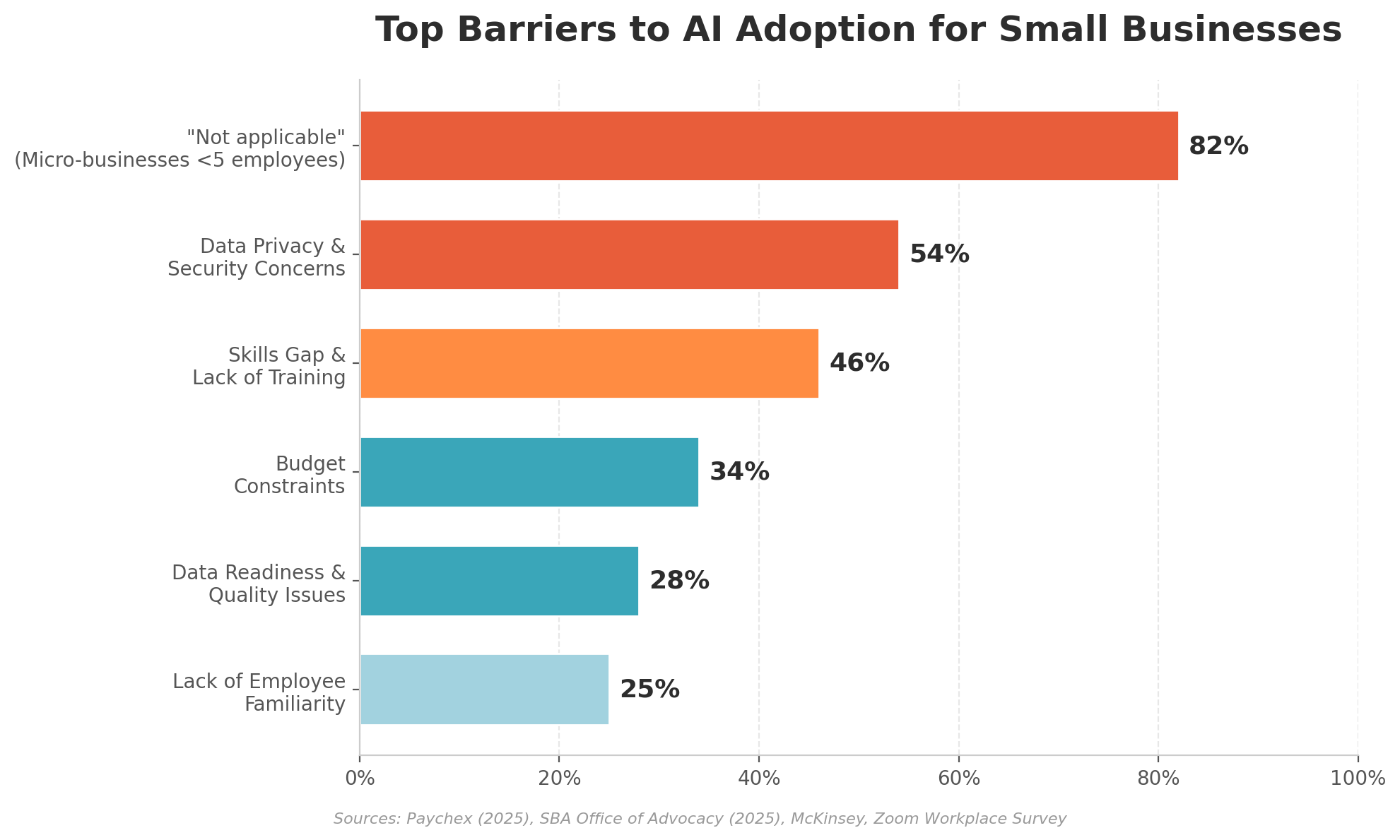
By a significant margin, the most pressing concern for business owners regarding AI is data privacy and security. A Paychex survey found that this was the top concern for 54% of business owners and HR leaders [1, 2, 5]. This anxiety is multifaceted. There is a fundamental concern about the security of feeding sensitive company and customer data into third-party AI systems. Furthermore, 45% of business leaders are worried about how technology companies themselves might use their data, and 17% explicitly distrust tech companies with their proprietary information [1, 2, 5]. For the 31% of businesses that have not adopted AI, data and privacy issues are the number one reason for their hesitation [1].
These concerns are not unfounded. The very nature of AI, which relies on vast amounts of data for training and operation, creates new potential vulnerabilities. SMBs must perform rigorous due to diligence when selecting AI vendors, prioritizing those with strong security credentials, clear data governance policies, and a commitment to privacy. The issue of trust is paramount; Salesforce research indicates that SMB leaders are willing to spend more on technology from trusted vendors [24]. As businesses integrate AI more deeply into their operations, establishing a secure data foundation and partnering with reputable providers will be a critical prerequisite for success. While concerns about data security have reportedly decreased year-over-year, they remain a significant barrier that demands careful consideration [19].
The Human Element: Skills Gaps, Training, and Employee Perceptions
The second major challenge revolves around the human side of the AI equation. The most frequently cited barrier to adoption is a lack of skills and training. McKinsey research found that this affects 46% of business leaders [16]. Many SMB owners and their employees simply do not know how to effectively use AI tools or where to even begin. This skills gap is particularly acute in certain sectors, like manufacturing, where 68% of firms report difficulty finding qualified employees to manage new technologies [16].
This lack of familiarity breeds resistance and underutilization. A Zoom survey noted that 25% of employees do not use available AI tools simply because they are unfamiliar with them [7]. This highlights a critical gap in implementation strategy: the technology may be present, but without proper training and change management, its potential will not be realized. The SBA has found that small businesses lag significantly behind large enterprises in investing in staff training for AI, creating a “no ROI” trap in which software investments are wasted due to insufficient investment in people [18].
Furthermore, employee perceptions and anxieties about AI must be managed. A Paychex study on AI in HR revealed mixed feelings among employees. While 20% desired more AI involvement, a substantial 41% preferred less [4]. A striking 78% of employees believe that sensitive, human-centric functions like conflict resolution and disciplinary actions should remain exclusively human-led [4]. Job security is also a major concern, with 46% of employees stating they would consider leaving their company if AI were to completely replace human-led HR teams [4]. This underscores the importance of framing AI as a tool for augmentation, not replacement, and maintaining transparency about how and why it is being used.
Financial and Technical Barriers
Despite the increasing affordability of AI, cost and technical readiness remain significant hurdles for many SMBs. Budget constraints were cited as a barrier by 34% of SMBs [16]. While many tools offer low-cost entry points, the cumulative cost of multiple subscriptions, along with potential implementation and consulting fees, can be prohibitive for businesses operating on thin margins.
Beyond the direct cost of software, data readiness is a major technical challenge, affecting 28% of SMBs [16]. AI systems are only as good as the data they are fed. Many small businesses have siloed, inconsistent, or poor-quality data, which can lead to inaccurate or unreliable AI outputs. A Paychex report noted that 18% of businesses using AI have experienced difficulties due to poor data quality [1]. Successful AI implementation often requires an upfront investment in data management and cleanup, a step that many SMBs overlook.
Finally, there is a perception issue, especially among the smallest businesses. Data from the SBA reveals that a staggering 82% of micro-businesses (under 5 employees) believe AI is “not applicable to their business” [16, 18]. This percentage drops dramatically as business size increases, suggesting that the barrier is not a true lack of applicability but rather a lack of awareness and education about how AI can be practically applied to smaller-scale operations.
Ethical Considerations: Bias and Transparency
As AI becomes more involved in critical business decisions, particularly in hiring and employee management, ethical considerations come to the forefront. A primary concern is the potential for AI systems to perpetuate or even amplify existing human biases. An AI model trained on historical hiring data that reflects past discriminatory practices may learn to unfairly favor certain demographic groups [3]. This not only has serious ethical implications but also exposes businesses to legal risk. Jurisdictions like New York City now mandate annual bias audits for certain automated hiring tools, and the U.S. Equal Employment Opportunity Commission (EEOC) has emphasized that using AI does not absolve a company of its responsibility to prevent discrimination [3].
Transparency is another critical ethical issue. The Paychex study on AI in HR found that only 11% of employees believe their company’s AI processes are transparent [4]. While legal requirements in some areas mandate disclosure when AI is used in hiring, this disclosure can sometimes undermine candidate confidence if not handled properly [3]. To build trust with both employees and customers, businesses must be transparent about where they use AI, what data the AI considers, and the extent of human oversight in the final decision-making process. Maintaining a “human in the loop” to review AI outputs and make final judgments, especially in sensitive areas, is a widely recommended best practice to ensure ethical and effective implementation.
Real-World Impact: Case Studies in AI-Driven Success
The theoretical benefits of AI become concrete when examined through the lens of real-world applications. Across various sectors, small and medium-sized businesses are implementing AI to solve specific problems, resulting in measurable improvements in efficiency, profitability, and competitive positioning. These case studies illustrate the practical power of AI and provide tangible examples of how the technology is being used to achieve significant returns on investment.
E-commerce and Retail: Personalization and Efficiency
The e-commerce and retail sectors are prime candidates for AI-driven transformation, as they are data-rich environments where customer experience and operational efficiency are paramount. SMBs in this space are using AI to compete with larger players by delivering highly personalized shopping experiences and optimizing their back-end operations.
One compelling case study involves an e-commerce retailer that implemented an AI-powered product recommendation engine. By analyzing customer browsing behavior, purchase history, and real-time interactions, the AI system presented each visitor with a unique, personalized selection of products they were most likely to be interested in. The results were swift and substantial: within six weeks, the retailer saw a 15% increase in its average cart size and a 12% improvement in customer retention [22]. The return on investment for this initiative was achieved in just 45 days, demonstrating the rapid impact of effective personalization.
Another retail SMB focused on operational efficiency by using AI to forecast inventory. Manually managing stock levels is a classic challenge, often leading to costly overstocking or lost sales due to stockouts. This business implemented an AI system that analyzed historical sales data, seasonality, and market trends to predict future demand with far greater accuracy. This allowed for the automation of the reordering process, ensuring optimal stock levels at all times. The implementation cut overstock costs by an impressive 30% and delivered a 200% ROI within the first six months, turning a major operational headache into a source of significant cost savings [21].
Professional Services: Automating Expertise
Professional service firms, such as marketing agencies and accounting practices, are leveraging AI to automate routine tasks, scale their service delivery, and provide more value to their clients. These businesses are effectively using AI to augment the expertise of their human professionals.
A marketing agency provides a powerful example of how to use AI for lead scoring and content creation. The agency used an AI tool to analyze incoming leads, scoring them based on their likelihood to convert. This allowed the sales team to focus their efforts on the most promising prospects, resulting in a 25% uplift in conversions and a drop in the average Customer Acquisition Cost (CAC) from $150 to $100 [21]. This efficiency gain directly contributed to a 15% scaling of revenue. On the content side, the same agency used generative AI tools to assist in drafting articles and marketing materials. This enabled them to double their monthly article output from 80 to 160 pieces, saving over 85 hours of valuable staff time each month that could be redirected to client strategy and creative work [22].
In the financial services space, a local service business implemented AI in its accounting workflow. By automating tasks like payroll processing and expense categorization, the firm saved 15 hours of administrative work per week [21]. More importantly, the AI system helped prevent common human errors in bookkeeping, which saved the company from potential financial penalties and miscalculations. The firm calculated an annual ROI of 150% on this initiative, driven purely by time savings and error reduction [21]. This demonstrates how AI can fortify the core administrative functions of a service-based business, freeing up professionals to focus on client-facing activities.
Manufacturing and Trades: Optimizing the Physical World
AI is also making significant inroads into more traditional, physically oriented sectors like manufacturing and the skilled trades. Here, AI is used to optimize complex processes, predict equipment failures, and improve quality control, leading to substantial gains in efficiency and cost reduction.
A small to medium-sized manufacturing enterprise (SME) used AI for process optimization and predictive maintenance. The company installed sensors on its production machinery and fed the data into an AI platform. The AI analyzed the operational data in real-time to identify inefficiencies in the production flow and suggest adjustments. This resulted in a 40% overall efficiency gain [21]. The same system was used for predictive maintenance; by detecting subtle anomalies in machine performance, the AI could predict potential equipment failures before they occurred. This allowed the company to schedule maintenance proactively, preventing over $5,000 in unscheduled downtime and reducing overall maintenance costs by 25% [21, 22].
Even local trade businesses, such as plumbers and HVAC contractors, are beginning to feel the impact of AI. While direct case study data is emerging, the integration of AI into platforms like Google Maps with its “Ask Maps” feature is changing how customers find and select local services [35]. The AI chatbot within Maps can recommend specific businesses based on user queries. This creates a new imperative for these SMBs to optimize their online presence and review profiles to be favorably recommended by the AI, effectively turning AI into a new and powerful channel for customer acquisition. The opportunity for these businesses lies in using AI-powered scheduling and customer service automation to manage the increased lead flow, creating a virtuous cycle of AI-driven growth.
Cost Considerations: A Practical Guide to AI Investment
For a small business owner, the decision to adopt AI is intrinsically linked to its financial feasibility. The perception of AI as an expensive, enterprise-level technology is rapidly becoming outdated. The modern AI landscape offers a wide spectrum of solutions with varying cost structures, enabling businesses of all sizes to find an entry point. A strategic approach to AI investment involves understanding potential costs, building a solid business case based on expected returns, and implementing the technology to maximize its value.
Understanding the Spectrum of AI Costs
The cost of implementing AI is not a single figure but a range that depends on the complexity and scale of the solution. At the most accessible end of the spectrum are AI features embedded in existing software. Many SMBs are getting their first taste of AI through tools like Zoom’s AI Companion, which is included at no additional cost for users with eligible paid plans [7]. Similarly, AI-powered features are increasingly being bundled into subscriptions for accounting software, CRMs, and marketing platforms. This model provides immense value by allowing businesses to leverage powerful AI capabilities without any incremental software spend.
The next tier involves subscribing to specialized, stand-alone AI applications. These are typically cloud-based, Software-as-a-Service (SaaS) products with monthly or annual subscription fees. Costs can range from as little as $20-$50 per month for a simple generative AI content tool to several hundred or even thousands of dollars per month for a sophisticated AI-powered marketing automation or customer service platform. A Paychex report indicates that this is the most common spending bracket for SMBs, with 51% spending between $1,000 and $9,999 annually on AI [1].
At the higher end are custom AI solutions. This could involve hiring developers or consultants to build a bespoke AI model or to deeply integrate AI into a company’s unique, proprietary systems. This approach offers the most tailored solution but also comes with the highest upfront costs for development, implementation, and ongoing maintenance. While this is typically the domain of larger businesses, the rise of more accessible AI development platforms is slowly making custom solutions more attainable for some SMBs with specific, high-value use cases.
Beyond software licenses, business owners must also account for associated costs, including employee training, potential implementation consulting fees, and the time required to adapt business processes to incorporate the new technology.
Building a Business Case for AI
A successful AI investment begins with a clear and compelling business case. This involves moving beyond the hype and identifying a specific, measurable problem that AI can solve. Instead of asking, “How can we use AI?”, the more effective question is, “What is our biggest operational bottleneck, and is there an AI tool that can address it?”
The business case should be built on a conservative estimate of the potential return on investment. This requires quantifying the expected benefits. For example, if the goal is to automate customer service queries, the business should estimate the number of staff hours saved per month. This figure can be converted to a dollar amount by multiplying the hours by the staff member’s hourly wage. This projected cost saving can then be directly compared to the monthly subscription cost of the AI chatbot software.
Similarly, for a revenue-generating initiative, such as an AI-powered lead-scoring tool, the business case could be based on a projected increase in conversion rate. If the tool costs $500 per month and is expected to increase conversions by 10%, leading to an additional $2,000 in monthly profit, the ROI is clear and easily justifiable. Data suggests that these returns are realistic; many businesses report 20-40% efficiency improvements and 10-25% improvements in key revenue metrics within the first 90 days of an AI pilot project [22]. A 2025 study found that high-ROI AI projects can generate returns of 150% in the first year, such as saving $500,000 on a $200,000 investment [21].
Maximizing ROI Through Strategic Implementation
The cost of AI is not just the price tag; it is the total investment relative to the value received. To maximize ROI, SMBs should adopt a strategic, phased approach to implementation.
The recommended strategy is to start small with a constrained pilot project. Rather than attempting a company-wide AI overhaul, it is far more effective to identify one high-pain, high-impact area and implement an AI solution there [13, 22]. This minimizes risk, keeps initial costs low, and provides a clear, contained environment to measure success. For example, a business could run a 90-day pilot of an AI tool for social media scheduling to see if it measurably increases engagement and saves time.
Investing in team training and change management is non-negotiable for maximizing ROI. The most expensive tool is one that nobody uses. Businesses must enable and educate their teams, demonstrating how AI features support their roles and make their jobs easier, rather than how they threaten them [22, 25]. This fosters buy-in and ensures the technology is used to its full potential.
Finally, choosing scalable and integrated tools is key to long-term value. Opting for platforms that can grow with the business and integrate smoothly with existing systems prevents data silos and avoids the future costs and headaches of migrating to a new system. By focusing on clear use cases, measuring results iteratively, and investing in both technology and people, small businesses can ensure that their AI expenditures are not just costs, but strategic investments that pay significant dividends.
The Future is Now: Emerging Trends in AI for SMBs
The field of Artificial Intelligence is evolving at a breathtaking pace, and the trends that are emerging today will define the competitive landscape for small businesses tomorrow. The current wave of adoption, focused primarily on task automation and data analysis, is merely the prelude to a more profound transformation. The future of AI for SMBs points toward greater autonomy, deeper integration into creative and strategic processes, and a fundamental reshaping of the nature of work itself. Three key trends stand out: the dawn of agentic AI, the pursuit of hyper-personalization at scale, and the resulting intensification of work and the rise of the empowered solopreneur.
The Dawn of Agentic AI
Perhaps the most significant development on the horizon is the rise of agentic AI. Unlike current AI assistants that primarily respond to direct commands, agentic AI refers to autonomous or semi-autonomous systems that can reason, make decisions, take multi-step actions, and adapt their workflows to achieve a given goal with minimal human supervision [25]. These “AI agents” are designed to tackle unstructured problems and orchestrate complex processes from start to finish.
For an SMB, the implications are revolutionary. Imagine an AI agent tasked with the goal of “increasing online sales by 15% this quarter.” The agent could autonomously analyze sales data, identify underperforming products, devise a marketing campaign, generate ad copy and visuals, deploy the campaign across multiple channels, monitor its performance in real time, and reallocate the budget based on which ads are performing best. This moves beyond simple automation of a single task (like scheduling a social media post) to the orchestration of an entire strategic initiative.
PwC’s 2026 AI Predictions suggest that while the technology itself delivers about 20% of an initiative’s value, the other 80% comes from redesigning work so that AI agents can handle routine and complex workflows, allowing human employees to focus on high-level strategy, creativity, and relationship-building [25]. Prominent entrepreneurs like Mark Cuban have predicted that AI agents will run through every small and mid-size business in the country, and that learning how to build and manage them will become a critical business skill [27]. This trend promises to give small teams the operational capacity of much larger organizations, further leveling the competitive playing field.
Hyper-Personalization at Scale
While AI is already enabling a significant degree of personalization in marketing and customer service, future developments will push this to an entirely new level. Hyper-personalization involves creating unique, one-to-one experiences for every single customer at every touchpoint. This goes beyond recommending products based on past purchases; it involves dynamically tailoring website content, marketing messages, pricing, and support interactions based on a deep, real-time understanding of the individual customer’s context, intent, and emotional state.
For an SMB, this means being able to offer the kind of bespoke, concierge-level service that was once only possible for a local artisan with a handful of clients, but now delivered at the scale of a national e-commerce brand. An AI system could, for example, adjust the language and imagery on a website in real-time to match the visitor’s perceived technical expertise or buying motivation. In customer service, an AI could access the full history of a customer’s interactions and anticipate their needs before they even articulate them. This level of personalization fosters deep customer loyalty and creates a powerful competitive moat that is difficult for competitors to replicate.
The Intensification of Work and the Solopreneur Boom
Contrary to early fears of mass job displacement, the immediate impact of AI on the SMB workforce appears to be an intensification of work, rather than its elimination. Research from Forbes indicates that AI adoption is associated with more intense workdays, with increases in collaboration, messaging, and even weekend work [13]. This suggests that AI is not replacing human workers but augmenting them, allowing them to produce more and operate at a higher tempo. Data support this, with 98% of small businesses using Generative AI reporting no job losses and 82% of AI-adopting SMBs reporting workforce growth [13, 16].
This augmentation effect is predicted to fuel the biggest small business and solopreneur boom in history [30]. With a laptop, a niche audience, and a suite of powerful AI tools, a single individual can now perform the work that once required a 15-person team and a $200,000 budget [30]. AI agents can handle marketing, sales, customer support, and administrative tasks, allowing the solopreneur to focus on their core expertise, product development, or creative vision. This trend is democratizing entrepreneurship, enabling more people to launch and scale viable businesses with minimal capital and overhead. The future will likely see a proliferation of highly specialized micro-niche businesses run by one or two people who leverage AI to operate with the efficiency and reach of a much larger company.
Conclusion: Strategic Recommendations for AI Adoption
The evidence is unequivocal: Artificial Intelligence is a transformative force that is reshaping the landscape for small and medium-sized businesses. It is no longer a luxury for the few but a strategic necessity for the many. For the small business owner, AI offers a powerful toolkit to amplify productivity, enhance customer relationships, and drive profitable growth, embodying the principle of “doing more with less.” However, realizing these benefits requires a thoughtful, strategic, and human-centered approach to adoption. The journey into AI is not a single leap but a series of deliberate steps. Based on the extensive research analyzed in this report, the following recommendations provide a strategic framework for SMBs looking to successfully navigate the AI revolution.
First, start with a specific problem, not a generic technology. The most successful AI implementations begin by identifying a clear and pressing business pain point [1, 22]. Whether it is excessive time spent on administrative tasks, a high volume of repetitive customer inquiries, or an inefficient marketing process, focusing on a tangible problem ensures that the AI solution has a clear purpose and a measurable impact. A constrained pilot project in a high-pain area is the most effective way to demonstrate value, build momentum, and minimize initial risk.
Second, choose integrated, scalable, and trustworthy tools. The modern AI ecosystem is vast, but SMBs should prioritize solutions that integrate smoothly with their existing workflows. Platforms that embed AI into the software you already use, like Zoom or QuickBooks, offer the lowest barrier to entry and avoid the complexity of managing multiple, disconnected applications [7]. When selecting any AI vendor, prioritize security and data privacy. Be willing to invest in technology from trusted vendors with transparent data policies to protect your most valuable assets: your company and customer information [24].
Third, invest in your people as much as you invest in your technology. The most common failure point in AI adoption is not the technology itself, but the lack of human readiness. A powerful tool is useless if the team does not know how or why to use it. Allocate budget and time for employee training and education. Frame AI as an augmentative tool that supports their roles and frees them from tedious work, not as a replacement [22]. Fostering a culture of learning and experimentation is crucial for ensuring that the full potential of your AI investment is realized.
Fourth, establish a solid data foundation and maintain human oversight. AI systems are powered by data; their output is only as good as their input. Before embarking on ambitious AI projects, assess the quality and accessibility of your business data. Invest in data management practices to ensure accuracy and consistency [24]. Crucially, never abdicate final responsibility to an algorithm. Maintain a “human in the loop,” especially for sensitive decisions in areas like hiring, finance, and customer relations [3]. Human judgment, empathy, and ethical oversight are irreplaceable and are the key to using AI responsibly and effectively.
Finally, embrace an iterative approach and define success. The world of AI is dynamic, and your strategy should be as well. Set clear, measurable objectives for each AI initiative. Track key metrics related to time saved, costs reduced, or revenue generated. Use this data to analyze what is working, optimize your approach, and make informed decisions about where to scale your AI efforts next [25].
The age of AI is here, and it presents an unprecedented opportunity for small businesses to innovate, grow, and thrive. By approaching adoption with a clear strategy, a focus on people, and a commitment to responsible implementation, SMB owners can harness the power of this technology to not only compete but to redefine the standards of success in their industries.
References
- Small Business AI Impact – Paychex
- Survey Finds AI is Empowering Small Businesses – Paychex
- Understanding AI in Recruiting – Paychex
- Paychex Study on AI Involvement in HR Processes – Paychex
- Paychex Survey: AI Adoption Small Business – Small Business Trends
- The Impact of AI on SMBs: 2025 Trends, Challenges, and What’s Next – Zoom
- Must-know strategies and real-world examples for small businesses using AI – Zoom
- Zoom Perspectives 2025: From Conversations to Completions – Laurie McCabe
- Highlights from Zoomtopia – Zoom
- Zoom Radical Rethink: Is Their AI-First, Partner-Led Strategy a Blueprint for the Future of Work? – Techaisle
- 15 AI Predictions For Small Businesses In 2026 – Forbes
- New Study: AI Cuts Costs, Adds 13 Hours For SMB Marketers – Forbes
- Small Business Tech And Innovation – Forbes
- How SMBs Can Confidentially Adopt AI – Forbes Technology Council
- AI Statistics For Business In 2026 – Forbes Advisor
- Small Business AI Adoption Statistics 2025 – USM Systems
- AI adoption by small and medium‑sized enterprises – OECD
- AI In Business: Small Firms Closing In – SBA Office of Advocacy
- AI Adoption Among Small Businesses Surges 41% in 2025 According to New Survey from Thryv – Thryv, Inc.
- AI for Small Business: 92% Adoption Rate Drives Growth – Los Angeles Times
- AI Measuring ROI: The Definitive Guide for SMBs (2026) – Rapid Architect
- Case Study: How Small Businesses Are Winning with AI Tools in 2025 – Done For You
- AI in SMB: 10 Practical Use Cases You Can Start with Today – Cigen
- SMBs AI Trends 2025 – Salesforce
- AI in Small Business: A Practical Guide for SMBs – AlphaBOLD
- 7 Quick Wins To Put AI To Work In Your Small Business – Forbes
- Mark Cuban on AI agents running through every small and mid-size business – X
- Building a system where Claude knows our entire company – X
- The price to develop a basic website for a small business is now 250 INR in India – X
- We’re going to witness the biggest small business boom in history – X
- Local business idea: AI agency for small businesses – X
- Companies that had 10 people running fulfillment are now doing it with 3 and a few AI tools – X
- Most small businesses don’t need a ‘brand experience.’ They need reviews, trust signals, and consistency – X
- My friend runs a small business and has been asking me how to best use AI – X
- Google just launched a new AI feature that could BURY small plumbers, HVAC contractors, remodelers, etc. – X
- If you work at a financial services firm and are still not onboarded with AI, you are falling behind – X